Join 650k+ students breezing through the IBReady to breeze through the IB?
A growth mindset in MYP Individuals and Societies means treating your ability to investigate, analyse evidence, communicate ideas, and think critically as something you can develop. It does not mean pretending every task is easy or believing effort automatically produces a high grade. It means responding to difficulty with a better strategy, useful feedback, and another attempt.
That approach suits a subject built around complicated systems, competing perspectives, and qualified conclusions. Your first interpretation will not always be your strongest. That is not proof that you are bad at the subject. It is often the beginning of serious inquiry.
A quick growth mindset checklist
Before your next task, ask:
What specific skill am I developing?
Which MYP criterion is being assessed?
What does the command term require?
What did my first attempt reveal?
Which strategy should I change?
When will I practise the skill again?
Replace the vague goal of “getting better at I&S” with a visible action, such as evaluating one source more precisely or rewriting one paragraph with stronger reasoning.
What a growth mindset looks like in this subject
MYP Individuals and Societies develops knowledge and understanding, investigation, communication, and critical thinking. A growth-oriented student therefore does more than memorize additional information. They identify which part of their performance can change.
Fixed response
Growth-oriented response
“I am bad at source analysis.”
“I described the source, but I need to connect its purpose to its value.”
“My argument makes no sense.”
“My evidence is relevant, but the explanation does not prove the claim yet.”
“I cannot remember case studies.”
“I need retrieval practice rather than another rereading session.”
“I studied for hours.”
“Which activity improved my performance?”
A label closes the problem. A diagnosis gives you somewhere to begin. The guide to explains the abilities you can deliberately develop.
A disappointing result can feel like a judgement on your ability. In a criteria-based subject, it is more useful to treat it as a map.
Knowing and understanding
If Criterion A is weak, determine whether the problem is inaccurate terminology, missing factual knowledge, or an explanation that remains too general. Review one concept through the MYP Individuals and Societies resource hub, close the Study Notes, and explain it from memory using an original example.
Investigating
If Criterion B is difficult, break investigation into decisions: formulate a focused question, plan the process, select appropriate methods, record evidence, and evaluate what worked. Improve one decision at a time rather than deciding you are “not a research person.”
Criterion D involves actions you can practise: comparing perspectives, identifying relationships, evaluating evidence, synthesizing ideas, and reaching supported conclusions. The MYP I&S criteria guide translates these expectations into visible features of successful work.
Turn mistakes into information
Suppose you evaluate a historical speech and receive feedback saying your response is descriptive. A fixed response hears, “I cannot analyse sources.” A productive response asks, “What relationship did I fail to explain?”
Perhaps you identified the speaker and audience but never explained how the intended audience shaped the message. Your next step is concrete: connect purpose to content, then explain how that relationship affects the source's value or limitations for the inquiry.
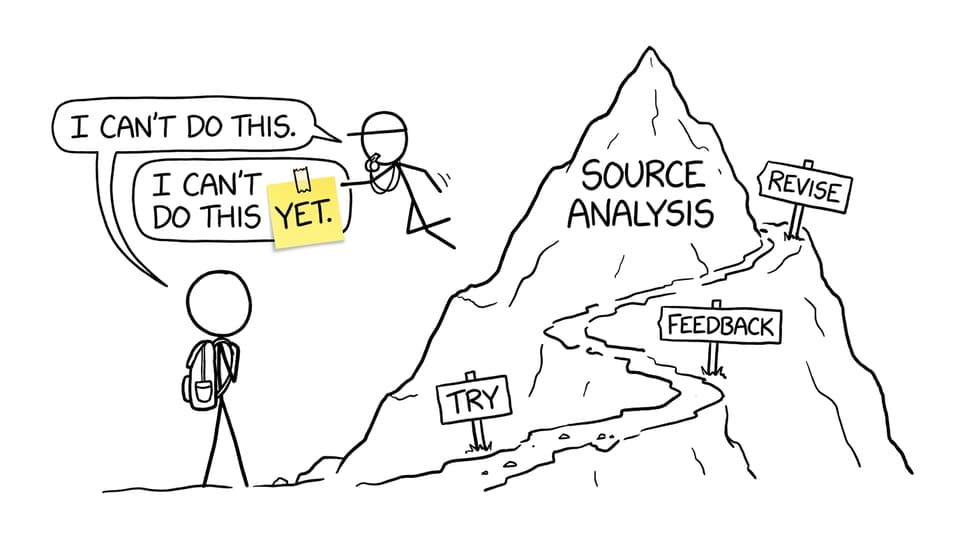
A student discovers that adding yet turns source analysis into a climbable process
The guide to analysing historical sources develops this process through origin, purpose, audience, context, value, and limitations. Each point should connect to the specific investigation rather than simply declaring a source reliable or unreliable.
Build motivation through visible progress
MYP Individuals and Societies motivation is often treated as something you must find before beginning. More often, it appears after progress becomes visible.
Instead of “revise urbanisation,” try this sequence:
Retrieve three important terms without notes.
Answer one focused question.
Compare the response with the criterion expectations.
Identify one weakness.
Rewrite the weakest section.
This improvement loop shows whether you can use your knowledge. RevisionDojo supports each stage: Study Notes clarify concepts, Flashcards strengthen retrieval, and the MYP Individuals and Societies Questionbank tests application. AI Chat can challenge an unsupported claim, while Grading tools help connect feedback to criterion language. For wider habit-building, read How to Stay Motivated Studying for MYP.
Replace more effort with a better strategy
Growth mindset is sometimes reduced to “work harder.” Repeating an ineffective method with greater intensity can simply make you tired. Use this cycle instead:
Use Flashcards if terminology disappears under pressure. Practise one point-evidence-explanation-link paragraph if your writing contains facts without reasoning. Move gradually from untimed responses to Mock Exams or Predicted Papers when timing is the problem.
The RevisionDojo review for MYP Individuals and Societies shows how notes, questions, and feedback can form one revision loop. The Coursework Library can reveal how strong work is organized, while Tutors can help when repeated attempts expose a problem you cannot diagnose alone.
Make reflection your next step
A useful MYP Individuals and Societies mindset includes intellectual flexibility. After each task, record three statements: what improved, what weakness you noticed, and what you will change next time. This prevents feedback from disappearing into a folder.
Choose one Questionbank problem from your current unit and attempt it before opening your notes. Identify the relevant criterion, find one improvable feature, and rewrite only that section. Keep both versions. The distance between them is evidence of growth.
RevisionDojo becomes the ultimate IB resource when every tool serves this cycle: Questionbank for attempts, Study Notes and Flashcards for repair, AI Chat and Grading tools for feedback, Mock Exams and Predicted Papers for rehearsal, the Coursework Library for informed modelling, and Tutors for human guidance. Progress begins with one honest attempt and one precise correction.