
Choosing between ESS and Biology can feel strangely permanent when you have barely begun DP1. One timetable decision seems to carry questions about university, workload, grades, and a future you may not have planned yet.
The short answer is this: choose Biology if you enjoy explaining living systems at molecular, cellular, and organismal levels, particularly if a life science or health-related degree is possible. Choose Environmental Systems and Societies (ESS) if you prefer connecting scientific evidence with sustainability, policy, economics, ethics, and human behaviour.
Neither subject is automatically easier. The better choice is the one whose thinking style, assessment demands, and university value match your goals. The comparison below will help you make that decision without relying on reputation or guesswork.
ESS vs Biology at a glance
| Decision factor | ESS | Biology |
|---|---|---|
| Central focus | Environmental systems and their relationship with societies | Living organisms from molecules to ecosystems |
| Typical thinking | Systems analysis, data interpretation, evaluation, and case-study reasoning | Scientific explanation, data analysis, application, and experimental reasoning |
| Content style | Broad and interdisciplinary | Detailed and biologically focused |
| Best fit | Sustainability, environmental policy, conservation, geography, or interdisciplinary interests | Medicine, biological sciences, healthcare, biotechnology, or life science interests |
| Practical work | Environmental investigations, fieldwork, surveys, and secondary data may be suitable | Laboratory or database investigations are common |
| HL distinction | Additional depth plus environmental law, ecological economics, and environmental ethics | Greater biological depth, breadth, and analytical demand |
| Main risk | Underestimating the precision and evidence required in evaluative answers | Falling behind as detailed concepts and terminology accumulate |
Before deciding, ask yourself four questions:
- Which class would I still find interesting during a demanding week?
- Do any likely university courses require Biology, especially at HL?
- Am I better at detailed scientific explanation or interdisciplinary evaluation?
- Does this choice create a balanced overall HL and SL workload?
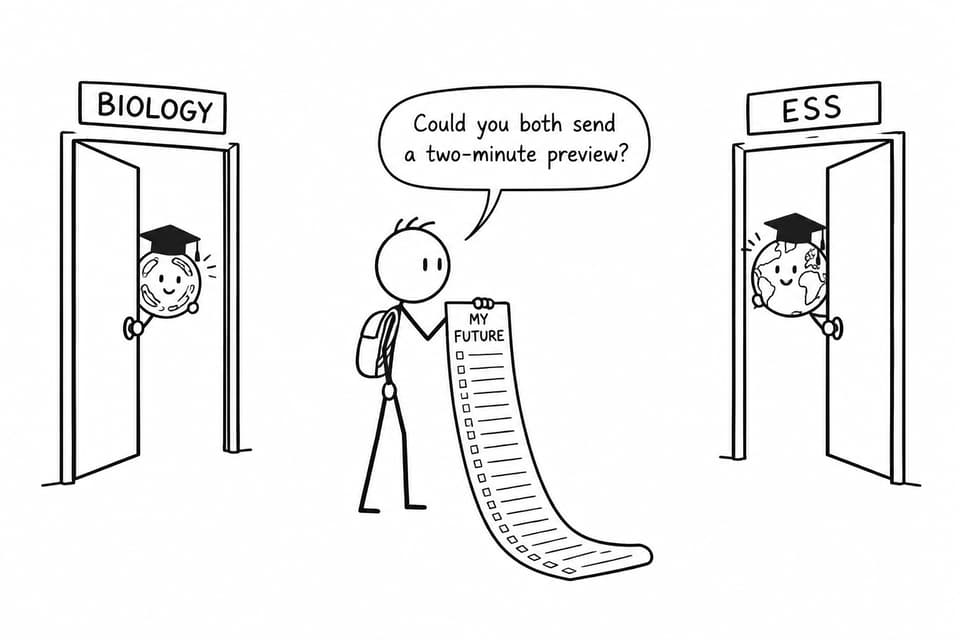
Sometimes the sensible response to a large decision is to request a small preview.
What studying IB Biology actually feels like
IB Biology examines life across several levels of organization. You move between molecules, cells, organisms, and ecosystems while studying ideas involving form and function, interaction, interdependence, continuity, and change.
That movement between scales matters. A question about health might require you to connect molecular structure to cell activity and then explain consequences for an organism. Knowing a definition is rarely enough. You must use biological knowledge accurately in unfamiliar contexts.
Biology therefore suits students who enjoy understanding mechanisms. If you naturally ask how a membrane controls movement, why a mutation changes a protein, or how organisms maintain internal stability, the subject may fit your curiosity.
It also rewards steady revision. Biological vocabulary, processes, diagrams, and experimental skills accumulate quickly. Short, frequent sessions using IB Biology notes, questions, and flashcards are usually more effective than trying to reconstruct an entire topic shortly before an assessment.
Biology should receive especially serious consideration if you may pursue medicine, biomedical science, biological science, neuroscience, veterinary science, or another life science. Requirements vary significantly among universities. For example, some medical courses require Chemistry HL alongside Biology, Physics, or Mathematics HL, while other institutions specifically expect Biology. Check several realistic course pages before finalizing your IB subject choices.
What studying ESS actually feels like
ESS is not simply Biology with more climate change. It is an interdisciplinary subject that examines environmental systems alongside social, political, economic, cultural, and ethical perspectives.
You might study ecosystems and biodiversity, but you also consider how environmental decisions are made. Why do communities respond differently to the same environmental risk? Who bears the cost of resource use? How should evidence, economics, and values shape policy?
This makes ESS attractive to students who enjoy connections. Scientific data matters, but so does your ability to interpret competing perspectives and reach a justified conclusion. A strong response recognizes complexity without becoming vague.
The current ESS course is available at SL and HL. HL extends the course through additional depth and lenses involving environmental law, environmental and ecological economics, and environmental ethics. If you are interested in sustainability, conservation, environmental management, policy, development, or geography, read what IB ESS is actually like before assuming it is a lighter science.
ESS can also have implications for how your Diploma subject groups are arranged because it is interdisciplinary across sciences and individuals and societies. Your coordinator should confirm how it fits your combination, what your school offers, and whether timetable restrictions apply.
The real difference is the kind of difficulty
Students often ask which science is easier. A more useful question is: which difficulty can you handle consistently?
Biology often feels difficult because of its volume, precision, and interconnected detail. You need accurate terminology, but memorization alone will not carry an answer. You must apply concepts and interpret unfamiliar experimental information.
ESS can feel difficult because strong answers must combine evidence, systems thinking, and evaluation. Students who expect common sense to be sufficient may lose marks when their claims lack specific knowledge, examples, or balanced reasoning. The subject is broader than it first appears.
A student who loves molecular explanations may find Biology demanding but satisfying. The same student might dislike weighing environmental viewpoints. Another student may thrive when connecting ecological evidence to policy but find detailed cell biology draining.
That is why rankings of the easiest IB science subjects should be treated carefully. Ease is partly a relationship between the course and the learner.
Assessment and investigation trade-offs
Both subjects combine external examinations with an internally assessed scientific investigation. Under the current courses, the investigation contributes 20% of the final subject grade at both SL and HL.
In Biology, a suitable investigation may involve laboratory work, simulations, or database data. The challenge is designing a focused research question, controlling or accounting for variables, analysing evidence, and evaluating limitations scientifically.
ESS investigations can use environmental fieldwork, experiments, surveys, or secondary data where appropriate. A strong project must still be methodologically sound. Broad concern about pollution or biodiversity is not yet a research question.
Your preference should influence the decision. If carefully controlled biological experimentation appeals to you, Biology may feel natural. If you would rather investigate an environmental system and connect findings to a wider issue, ESS may provide a better fit. RevisionDojo's Coursework Library and Grading tools can help you understand structure and evaluate drafts, while a tutor can provide individualized guidance without taking ownership of your work.
HL vs SL may matter more than the subject name
The IB recommends 150 teaching hours for an SL course and 240 for an HL course. Those additional hours are not merely more homework. HL involves greater breadth, depth, and assessment demand.
Biology HL is often the safer choice when a target degree explicitly requires advanced Biology. If it does not, Biology SL may preserve the scientific foundation you want while leaving HL capacity for subjects more central to your plans. The differences between Biology HL and SL deserve separate consideration.
ESS HL may suit a student who wants environmental study to become a defining part of the Diploma. Its law, economics, and ethics lenses make it meaningfully broader than ESS SL. However, choosing ESS HL because you expect an effortless grade would be a poor strategy.
Look at your entire combination. Three individually sensible HL subjects can become an unreasonable package when combined. RevisionDojo's guide to mixing SL and HL sciences can help you test the balance.
A simple decision checklist
Choose Biology if most of these statements sound like you:
- I enjoy learning how living systems work in precise scientific detail.
- I am comfortable revisiting content regularly rather than relying on last-minute study.
- Medicine, healthcare, biotechnology, or biological science remains a possibility.
- I prefer explaining mechanisms to evaluating policy choices.
- I am willing to check whether Biology HL is required for my likely degrees.
Choose ESS if most of these statements sound like you:
- I am interested in sustainability and relationships between people and the environment.
- I enjoy interpreting data alongside social, economic, political, and ethical factors.
- I prefer systems and case studies to detailed molecular biology.
- I can construct balanced arguments supported by specific evidence.
- My likely university options do not depend on Biology HL.
If the result is close, run a small experiment. Review one introductory topic from each subject, attempt several exam-style questions, and notice which mistakes you are more motivated to correct. You can also compare ESS and Biology by content and assessment and consider the career implications of ESS and Biology.
Make the decision with evidence, not reputation
A good IB choice does not guarantee an easy two years. It gives your effort somewhere productive to go.
Once you choose, RevisionDojo can support the full journey through its Questionbank, Study Notes, Flashcards, AI Chat, Grading tools, Predicted Papers, Mock Exams, Coursework Library, and Tutors. A DP1 student might begin with notes and flashcards, use the Questionbank to expose misunderstandings, then bring difficult explanations to AI Chat or a tutor.
Before confirming your combination, take the RevisionDojo HL/SL decision quiz and save the result. Treat it as a structured record of your priorities, not a command. Discuss the result with your coordinator, compare it with current university requirements, and revisit it after experiencing both subjects at school. The best decision is not the one that sounds most impressive. It is the one you can explain clearly and still believe when the work begins.