
Some IB choices feel like they’re really about a timetable. This one doesn’t.
Choosing between IB ESS and IB Biology is a Group 4 decision that quietly shapes what you’ll enjoy studying, how you’ll spend your revision hours, and which university doors stay wide open. It’s also the kind of choice that can feel emotional: you’re not just picking a subject, you’re picking a story about who you might become.
The good news is that both courses can lead to strong outcomes. The better news is that the “right” answer usually shows up once you match the Group 4 subject to the skills your future needs, not the rumors in the hallway.
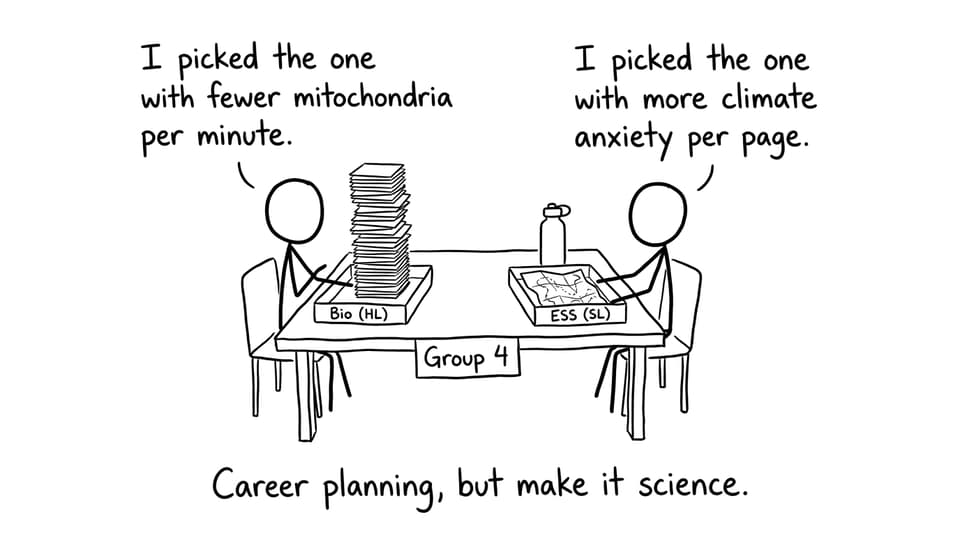
IB ESS vs IB Biology: a quick Group 4 checklist
If you’re revising for exams while also trying to make a smart decision, use this fast filter first:
-
Do you need Biology for university prerequisites? If yes, Biology is often non-negotiable.
-
Do you prefer mechanisms or systems? Biology rewards “how it works” thinking; ESS rewards “how it connects” thinking.
-
Do you like labs or real-world case studies? Biology is more lab-centered; ESS leans into fieldwork, data interpretation, and sustainability dilemmas.
-
Are you aiming for medicine/biomed? Biology (often HL) is commonly expected.
-
Are you aiming for policy/sustainability/NGO work? ESS aligns naturally.
For a wider lens on science selection, keep RevisionDojo’s guide to How to Choose the Right Group 4 Subject for You open as you decide.
What IB Biology is really like (and why Group 4 students respect it)
IB Biology is the classic life-science route inside Group 4. You spend a lot of time learning precise processes: cell biology, genetics, evolution, physiology, and ecology. The challenge isn’t only the content volume; it’s the expectation that you can explain mechanisms clearly under timed conditions.
Biology tends to fit students who enjoy:
-
learning detailed scientific language (and using it accurately)
-
spotting cause-and-effect chains (stimulus to response, mutation to phenotype, etc.)
-
interpreting data and experimental design
-
practising structured exam writing
Career alignment is strongest when your next step requires biological foundations: medicine, dentistry, vet science, nursing, biomedical science, biochemistry, biotechnology, and often psychology or sports-related health degrees.
If you want a full overview of how the course works and what to prioritise for exams, use IB Biology: Complete Guide for IB Exam Prep. And if you’re already in the course and want a clean plan, How to Pass IB Biology SL Exams: Proven Study Strategy is a strong starting point.
What IB ESS is really like (and why it’s a unique Group 4 option)
IB Environmental Systems and Societies (ESS) is Group 4 with a twist: it refuses to separate science from human decision-making. You still do science, studying ecosystems, energy flows, pollution, and resource management, but you also deal with economics, ethics, policy, and competing stakeholder perspectives.
ESS tends to fit students who enjoy:
-
learning concepts that connect across topics
-
debating trade-offs (environment vs economy, development vs conservation)
-
writing evaluations, not just explanations
-
using real examples and case studies to support answers
Career alignment is strongest when you’re interested in sustainability, environmental management, conservation, geography, urban planning, environmental law/policy, and work with NGOs or government.
To understand the course structure (especially with the newer syllabus direction), read IB ESS: What It Is (and How the 2026 Syllabus Works). If you’re worried about difficulty, How Difficult Is IB ESS vs Other IB Sciences? frames it honestly.
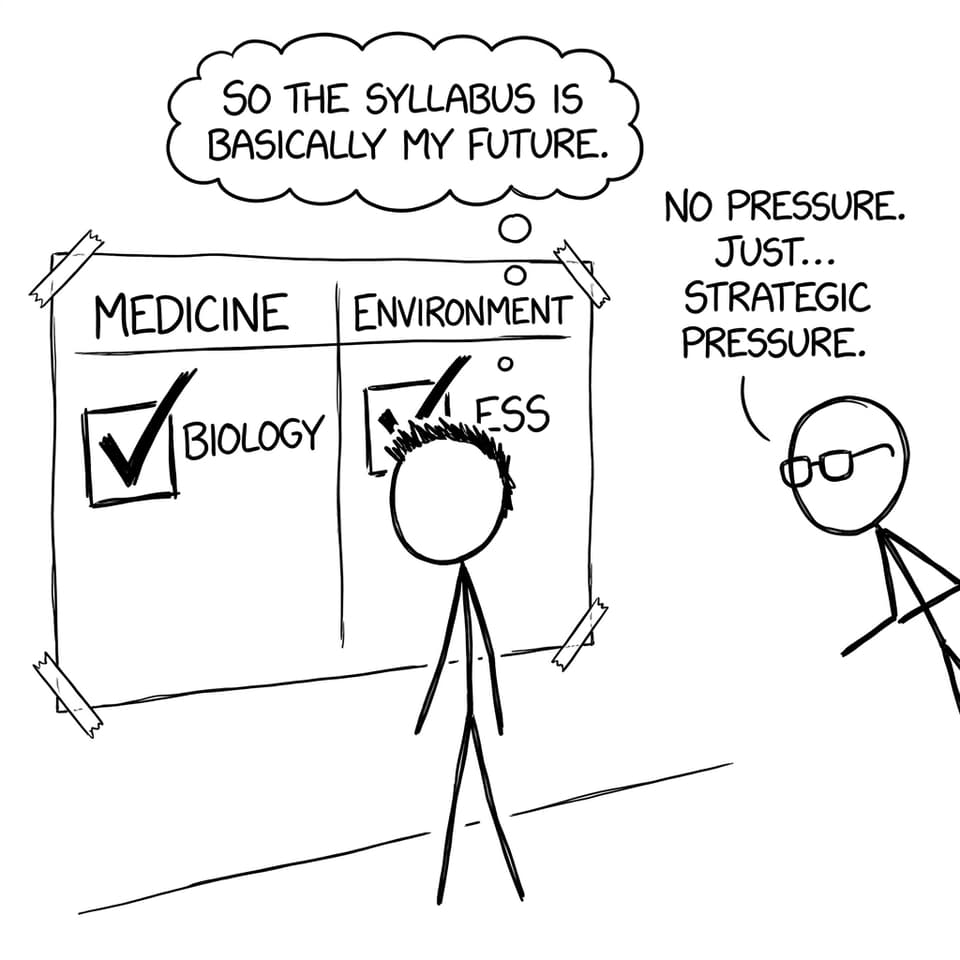
Group 4 career fit: choose based on the work you want to do
A practical way to decide is to picture the kind of problems you want to solve at 25.
Choose IB Biology if your career path needs biological proof
Pick Biology when your future requires you to speak the language of the body, cells, and experiments.
Biology is usually the more strategic Group 4 choice if you’re aiming for:
-
medicine, dentistry, veterinary science
-
biomed, pharmacology, neuroscience
-
lab research and life-science degrees
It’s also a good fit if you like revision that’s built from active recall: key terms, diagrams, processes, and short structured explanations.
RevisionDojo helps here because Biology success is often about repetition with feedback: using the Questionbank to expose weak topics, Study Notes to clarify them, and Flashcards to lock them in. When you want quick correction on exam phrasing, AI Chat and Grading tools help you tighten responses to what markschemes reward.
Start from the official hub: IB Biology Resources.
Choose IB ESS if your career path needs systems thinking and evaluation
Pick ESS when you care about how science collides with society, and you’re willing to write clearly about that collision.
ESS is often the more strategic Group 4 choice if you’re aiming for:
-
sustainability roles in business or government
-
environmental policy, planning, or regulation
-
conservation, environmental management
-
environmental studies and human geography pathways
RevisionDojo supports ESS especially well because ESS marks live in application: practising exam-style responses in the Questionbank, building sharp case-study recall with Flashcards, and improving IA structure with the ESS-focused IA Grader.
Useful starting points:
Workload and assessment: the part of Group 4 no one brags about
It’s tempting to ask, “Which one is easier?” The more useful question is: “Which one is my kind of hard?”
-
Biology can feel heavy because there’s a lot to remember and a lot to apply quickly. The IA often leans toward controlled investigations and careful evaluation of method and data.
-
ESS can feel lighter in pure memorisation, but it punishes vague writing. You need crisp definitions, clear chains of reasoning, and confident evaluation using real examples.
If you want a direct comparison built for decision-making, RevisionDojo’s How to Choose Between IB Biology and IB Environmental Systems and Societies (ESS) is worth reading alongside this post.

FAQ: IB ESS vs IB Biology for Group 4 students
Can IB ESS count as a Group 4 subject?
Yes, ESS counts as a Group 4 science and satisfies the IB science requirement for the Diploma Programme. It’s treated as a science subject in terms of assessment expectations: you’ll still analyse data, use scientific terminology, and build evidence-based arguments. The key difference is that ESS explicitly integrates social science lenses like policy, ethics, and economics. That means your answers often need evaluation and stakeholder perspectives, not just scientific mechanisms. If you want to confirm how science subjects fit the diploma scoring picture, The Role of Group 4 Sciences in IB Diploma Scoring gives helpful context. ESS is still science, just science that admits humans are part of the system.
Is IB Biology required for medical careers?
Often, yes, Biology (frequently at HL) is expected or strongly preferred for medicine-related university pathways, depending on the country and specific programme. Medical and biomedical degrees tend to assume you can handle core biological concepts like physiology, genetics, and cell processes from day one. That’s why Biology remains a “door-opener” inside Group 4. But you should always check specific university prerequisites rather than relying on general advice from older students. If you’re taking Biology, your best advantage is to prepare like the exam is a skill: use the Questionbank, then refine explanations with AI Chat and Grading tools until your wording becomes mark-efficient. In other words, don’t just learn Biology, learn how Biology is examined.
Which is more suitable for sustainability careers: IB ESS or IB Biology?
For sustainability careers, ESS is usually the more direct Group 4 match because it trains you to connect environmental science to human systems. Sustainability work often involves trade-offs: budgets, politics, public behaviour, and imperfect data. ESS helps you practise that style of thinking and writing, especially through case study application and evaluation. Biology can still support sustainability paths if you lean toward ecology, conservation science, or research, but it’s less explicitly policy-facing. A smart approach is to look at the kind of writing you enjoy: ESS rewards structured evaluation; Biology rewards mechanistic explanation and experimental reasoning. If sustainability is your direction, build your exam confidence with RevisionDojo ESS resources and practise writing tight evaluations using real examples.
A final way to decide your Group 4 path
Imagine it’s April before exams. You’re tired, but you sit down anyway. Which revision session sounds more like you?
-
“Let me master this mechanism and explain it precisely” (Biology).
-
“Let me compare perspectives and defend a justified conclusion” (ESS).
That’s your signal.
Whichever Group 4 route you choose, RevisionDojo is built to turn effort into marks: Study Notes when content feels foggy, Flashcards for daily recall, a targeted Questionbank to practise exam-style prompts, AI Chat for instant clarification, Grading tools for feedback, and Predicted Papers plus Mock Exams when you need timed pressure in a safe place. If your IA is stressing you out, the Coursework Library and Tutors add structure when you need it most.
Start with the hubs and build your plan from there:
Your Group 4 choice isn’t about choosing the “easy” science. It’s about choosing the science that matches the work you want to do, and then revising like it matters.