
If you have ever reread a chapter three times and still felt like it vanished the moment you closed the book, you already know the quiet truth of IB English: effort is not the same thing as progress. The course rewards a particular kind of work. Not more highlighting. Not longer notes. But the ability to notice authorial choices, connect them to meaning, and explain that connection under time pressure.
This is a guide to study techniques that match how IB English is actually assessed. Think of it as building three muscles: close reading, clear argument, and controlled timing. When those are strong, confidence stops being a mood and becomes a routine.
The IB English checklist (use this before every session)
Before you start, run this 90-second checklist. It keeps IB English revision practical, not decorative.
-
Outcome: What will exist after 45 minutes? (An outline, a thesis bank, a timed paragraph, an IO plan.)
-
Text focus: Which extract or chapter section are you using?
-
Technique focus: Choose 1-2 features only (tone shift, structure, imagery, modality, juxtaposition).
-
Assessment link: Are you training Paper 1, Paper 2, or the Individual Oral?
-
Feedback loop: How will you check quality? (Rubric, teacher, or a grader.)
If you want a single home base for the course structure and practice workflow, start with IB English A Lang & Lit Resources.
Understand what IB English is testing (so you study the right thing)
Most students think IB English is about having “good ideas.” High scores are usually simpler: the examiner wants to see how consistently you turn observations into interpretations, and interpretations into a line of argument.
That is why the best revision habits look repetitive:
-
observe a choice
-
name the technique
-
explain the effect
-
link to purpose, audience, context, or global issue
-
repeat with sharper wording
For Paper 1 specifically, a strong starting point is Mastering IB English Paper 1: A Complete Guide, and for a focused revision workflow see Step-by-Step Guide to Revising IB English Paper 1.
IB English active reading that is not just highlighting
Active reading in IB English means you annotate with a job in mind: produce claims you can later defend.
How to annotate like an examiner is watching
-
Circle patterns, not pretty lines. Repetition, contrasts, pronouns, tense changes, visual layout.
-
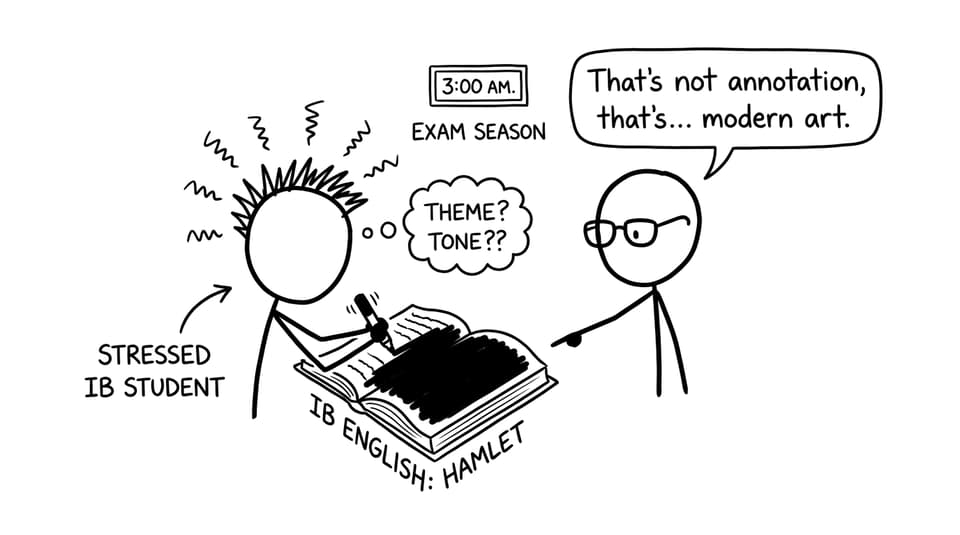
Write micro-claims in the margin. “Tone turns from ironic to urgent,” “authority is borrowed via statistics,” “narrator withholds names to control sympathy.”
-
Tag the “why.” Each note should point toward purpose and effect: why that choice, why that moment, why that audience.
For deeper close reading practice, keep Close Reading Techniques for Prose and Poetry open while you work. It trains the habit of noticing before interpreting, which is basically the hidden curriculum of IB English.
IB English Paper 1: practice the first 10 minutes, not the whole essay
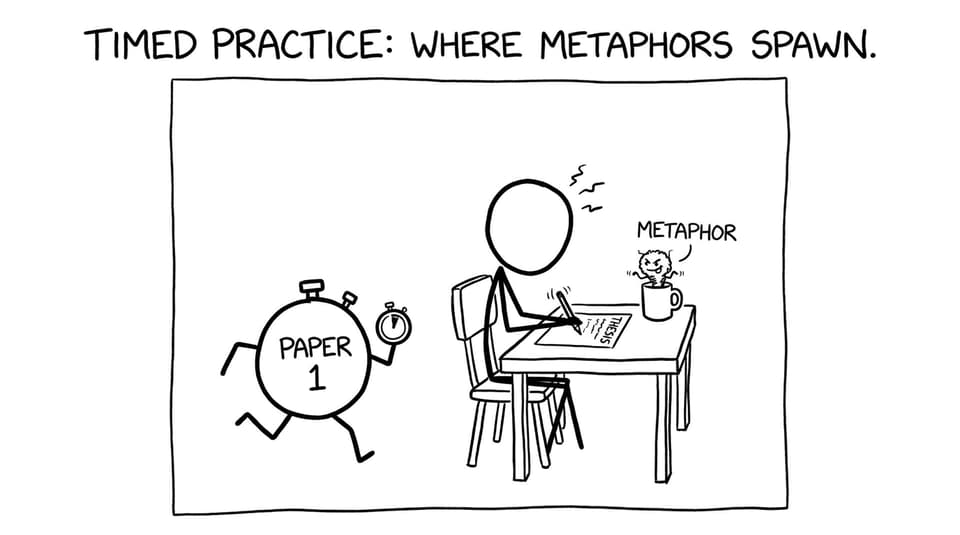
Paper 1 anxiety in IB English often comes from the start. The timer begins and your brain tries to write a perfect introduction while also understanding the text. So train the part that decides your whole response: the first 10 minutes.
A high-yield Paper 1 drill (15 minutes)
-
5 minutes: annotate for purpose, audience, context, and 2-3 dominant choices.
-
5 minutes: write one thesis sentence plus 3 topic sentences.
-
5 minutes: draft one body paragraph only.
Then repeat on another extract tomorrow. This builds speed without exhausting you.
For more structure guidance, read Best Ways to Prepare for IB English Paper 1. If you want criterion-based feedback loops, use the IB English Language and Literature Paper 1 Grader after each timed paragraph to spot what your writing does under pressure.
IB English Paper 2: build comparison frameworks you can reuse
Paper 2 rewards students who walk in with pre-built thinking. You cannot predict the exact question, but you can predict the relationships between your texts.
A simple comparison framework (that examiners like)
Create 3 tables (one per big theme). Each table has:
-
Theme statement: a sentence you could argue either way.
-
Text A methods: 3 authorial choices (form, structure, characterization, narrative perspective).
-
Text B methods: 3 authorial choices.
-
Key quotes: 2 per text, short and flexible.
-
So what: what the comparison reveals about values, power, identity, or society.
If you feel unsure whether your revision is balanced between Paper 1 and Paper 2, use What’s the Best Way to Study for Paper 1 vs Paper 2? to plan your week.
IB English Individual Oral: train clarity, not confidence
The Individual Oral in IB English is rarely lost on ideas. It is lost on organization. Students know their global issue, but their analysis arrives in a fog.
A calm IO routine that scales
-
Define the global issue in one sentence that is specific and debatable.
-
Choose extracts that do different work. One should sharpen the issue, the other should complicate it.
-
Use a 10-point outline where every point begins with a verb: “introduce,” “contrast,” “zoom in,” “evaluate.”
-
Record once per week and refine only one thing each time (signposting, pacing, or technique depth).
Use these RevisionDojo links as your anchors:
-
How to Approach the IB English Individual Oral (Step-by-Step)
-
For rubric-aligned self-checking, use the IB Language A: Individual Oral Grader
Turn RevisionDojo into a complete IB English system
A good IB English plan is a loop, not a pile of resources. RevisionDojo is built around that loop:
-
Study Notes to clarify techniques and text-type conventions
-
Flashcards to lock in literary terms, authorial choices, and quote-banks
-
Questionbank to practice exam-style prompts with immediate direction
-
AI Chat to diagnose confusion quickly (ask it to challenge your thesis, not comfort it)
-
Grading tools for criterion-level feedback on writing and orals
-
Mock Exams to train stamina and timing
-
Predicted Papers to rehearse realistic exam conditions and coverage
-
Coursework Library to see what strong analysis looks like in real student work
-
Tutors when you need a human to push your thinking up a level
If you want a wider set of reading on IB English, browse All IB English posts.
Conclusion: Make IB English feel predictable
The goal of IB English revision is not to become “good at English.” It is to make your performance predictable: you see a text, you notice choices, you shape an argument, you support it with evidence, and you do it on time.
Build your week around small outputs, not big intentions. Then tighten the loop with RevisionDojo: practice in the Questionbank, clarify with Study Notes, lock terms and quotes with Flashcards, stress-test timing with Mock Exams and Predicted Papers, and use AI Chat plus Grading tools to turn feedback into your next attempt.
When you are ready, open IB English A Lang & Lit Resources and set up your first 15-minute drill. That is how IB English starts to move in your direction.