
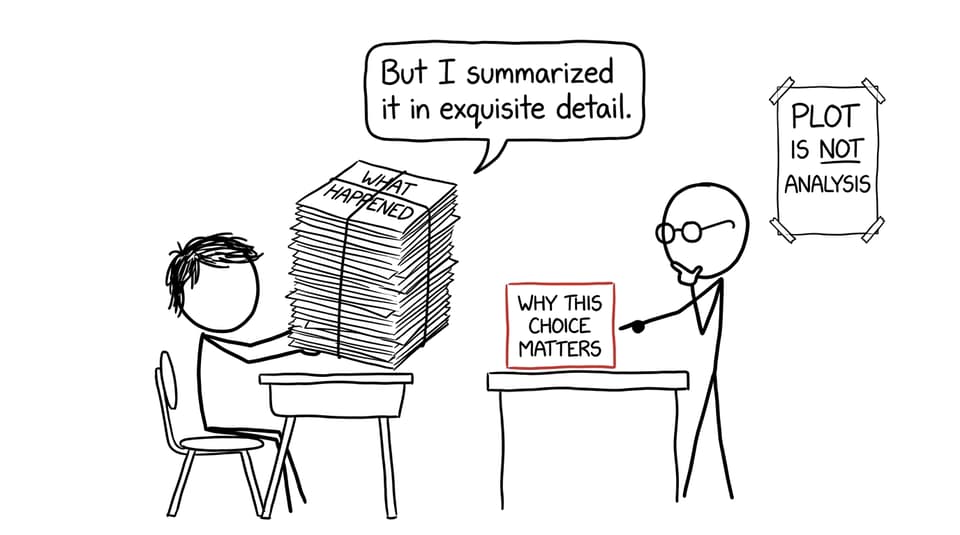
The biggest adjustment shock in IB English is not the reading load or the terminology. It is discovering that understanding a text is only the beginning. Students are expected to explain how specific authorial choices create meaning, then build those observations into a focused argument.
That shift explains many IB English first term struggles. A student may understand the plot, identify a metaphor, and write fluently, yet still receive feedback such as “too descriptive” or “develop the analysis.” The problem is rarely intelligence. The student is reporting what the text contains instead of examining how it works.
Fortunately, analysis is trainable. You need a repeatable method for moving from observation to interpretation.
The first-term adjustment checklist
Focus on five habits:
- Read for patterns and shifts, not isolated devices.
- Turn observations into claims about meaning.
- Use short, precise evidence.
- Explain each choice in its context.
- Rewrite one weak paragraph after receiving feedback.
Terminology helps you name what you see. Analysis begins when you explain why it matters.
Why summary stops being enough
Before IB English, students are often rewarded for accurate comprehension. They explain events, describe characters, identify themes, or recognize persuasive language. Those abilities remain useful, but IB English requires another layer.
A response should follow a chain like this:
Authorial choice → evidence → immediate effect → larger meaning → significance
Suppose a narrator describes a family home through images of locked doors and narrow corridors. Summary says the home feels restrictive. Technique spotting identifies recurring spatial imagery. Analysis argues that the imagery turns the domestic setting into a symbol of controlled identity, encouraging readers to question whether its apparent safety is actually confinement.
The final version connects craft to interpretation. RevisionDojo’s guide to building insightful literary arguments explores this distinction further.
Stop collecting techniques
Once students learn that summary is insufficient, their annotations often become crowded with labels: metaphor, alliteration, repetition, contrast, rhetorical question, short sentence.
This may look analytical, but a list of devices is still a list. Ask instead, “Which choices work together to create the text’s central effect?” A shift from formal language to personal confession, for example, may reduce the distance between speaker and audience. Repeated imperatives may then turn emotional identification into a demand for action.
Look for clusters such as recurring images, tonal changes, structural turns, contrasts, and combinations of visual and verbal choices. The RevisionDojo authorial choices guide can develop this awareness without reducing analysis to feature spotting.
Build an analytical paragraph
A strong paragraph does not need to sound complicated. It needs to make every step in the reasoning visible.
Start with an arguable claim
Avoid opening with “The writer uses imagery.” State what the imagery accomplishes:
The writer’s increasingly mechanical description of the workers presents efficiency as a form of dehumanization rather than progress.
Because a reader could question or refine this statement, it functions as an argument. The IB English thesis statement guide applies the same principle to an entire essay.
Select evidence containing craft
Choose a short phrase, visual detail, or structural moment that rewards close examination. More evidence does not automatically produce better analysis. One carefully chosen word can reveal connotation, tone, perspective, and purpose.
Next, explain the mechanism. Instead of claiming that a phrase “makes the reader interested,” ask what it actually does. Does intimate diction reduce distance? Does an abrupt sentence interrupt a calm rhythm? Does passive construction conceal responsibility?
Connect that local effect to a larger idea. The guide to audience and purpose in IB English is useful when an explanation keeps stopping at a generic reader effect.
Finally, return to your central argument. Think of the thesis as a promise and each paragraph as part of its proof.
Practise in smaller pieces
The natural response to weak feedback is to write more essays. Yet full essays contain many moving parts, making it difficult to isolate the habit holding you back.
Use shorter drills:
- Five-minute annotation: Identify purpose, audience, tension, and two patterns.
- Five-minute thesis: Connect authorial choices to meaning.
- Fifteen-minute paragraph: Complete one analytical chain using precise evidence.
- Five-minute review: Mark summary, technique labels, and genuine analysis differently.
- One-paragraph rewrite: Apply one piece of feedback immediately.
The step-by-step Paper 1 revision guide provides a progression from short exercises to timed responses. These habits also transfer to literary discussion, comparative writing, and oral analysis.
Build notes that become arguments
Notes organized only around plot, characters, and broad themes feel safe, but they often fail during assessment. You may remember what happened without understanding how the writer constructed its significance.
For each important textual moment, record the tension being developed, the authorial choice creating it, a short piece of evidence, and a possible interpretation beginning with “This suggests...”
Do not file a scene only under “power.” Record how interruptions, pronouns, stage positioning, or narrative access distribute power. RevisionDojo’s IB English note-taking strategies can help turn class notes into reusable analytical material.
Treat feedback as a loop
A disappointing first mark can feel like a judgment. It is more useful as a diagnosis of your current method.
Translate broad comments into visible actions. “Needs more analysis” might become “After each quotation, explain how one word shapes interpretation.” “Unclear argument” might become “Write a topic sentence that answers the question before introducing evidence.” Practise one behavior several times before changing targets.
RevisionDojo brings this feedback loop together through its IB English resource hub. Study Notes and Flashcards strengthen knowledge before Questionbank practice. AI Chat can challenge a thesis, while Grading tools can reveal where a paragraph becomes descriptive. Predicted Papers and Mock Exams support timed preparation once your method is stable. The Coursework Library and Tutors add models and personalized direction when written feedback is not enough.
Learn how to notice
The deepest first-term change is a change in attention. A text stops being a container of themes and becomes a sequence of decisions. A word was chosen. A voice was limited. An image returned. A conclusion was delayed. Each decision shapes what readers can feel, know, or question.
If your early essays contain too much summary, do not mistake a developing habit for a permanent limit. Build one analytical chain at a time. With RevisionDojo’s connected notes, practice, grading, exam simulations, coursework support, and tutoring, the adjustment becomes less mysterious. The goal is not to notice everything. It is to explain the few choices that matter most.