


There’s a specific kind of silence right before an IB English Individual Oral. Not quiet like a library. Quiet like your brain is loading a 47-tab browser and one tab starts playing music. The good news is the IO isn’t a mystery test of “natural talent”; it’s a structure problem. When you build a repeatable system, confidence follows.
In this guide, you’ll learn what the IB English Individual Oral really is, how to shape a global issue that actually holds up under pressure, and a practical plan for your 10 minutes (plus the 5-minute teacher discussion). Along the way, you’ll see how RevisionDojo can turn practice into feedback you can use.
What the Individual Oral is (and what it rewards)
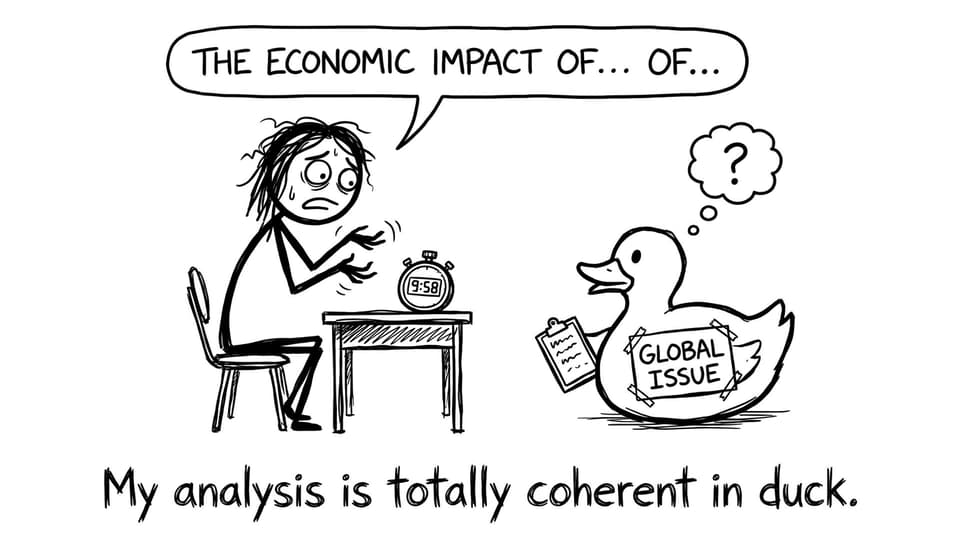
The Individual Oral (IO) is a major internal assessment for IB English Language A courses. You deliver a 10-minute presentation analyzing how a global issue is represented across two texts, followed by a 5-minute discussion with your teacher.
What earns marks is not “knowing quotes.” It’s showing that you understand authorial choices and can explain how those choices build meaning around your global issue.
If you want the official basics in one place, start with What is an IB Individual Oral (IO)?.
A quick IO checklist for IB English students
Before you write a single script, check these boxes:
-
A global issue that is specific enough to argue, broad enough to matter
-
Two texts that clearly connect to that issue (with analyzable techniques)
-
Two extracts you can discuss in close detail
-
A timed plan (intro, Text 1, Text 2, conclusion)
-
At least 2 rounds of practice with feedback
For a step-by-step walk-through, use How to Approach the IB English Individual Oral (IO) Presentation.
Choosing a global issue that doesn’t collapse mid-speech
Most IO panic starts here: students choose something too wide (“gender inequality”) or too plot-based (“this character is sad”). In IB English, a strong global issue feels like a lens, not a topic.
Try framing it as:
-
A system (surveillance, censorship, labor exploitation)
-
A tension (belonging vs. assimilation, security vs. freedom)
-
A pattern (how media normalizes harmful stereotypes)
If you need help narrowing your lens, Understanding the Fields of Inquiry in IB English A makes the “global issue” concept much easier to handle.
The safest structure for a high-scoring IB English IO
Structure is how you protect your thinking when nerves show up.
A clean 10-minute flow
-
Introduction (about 1 minute): Define the global issue, introduce both texts, state your line of argument.
-
Text 1 (about 4 minutes): Close analysis of the extract, then briefly widen to the whole work/body of work.
-
Text 2 (about 4 minutes): Repeat close then wide, staying anchored to the global issue.
-
Conclusion (about 1 minute): What did both texts reveal about the issue, and why does it matter?
If you want a deeper strategy guide, pair this with Master the IB Individual Oral: Expert Strategies, Practice Tools.

What to say in your intro (without wasting time)
In IB English, your intro is not a warm-up. It’s a contract with the listener.
Include:
-
Your global issue in one sharp sentence
-
The two texts (and what kind they are)
-
Your thesis: how each text represents the issue differently
Then move. Your best insights belong in the analysis.
Practice that actually improves your IB English score
Rehearsing isn’t repeating the same speech until it “sounds nice.” It’s testing whether your ideas survive a timer.
Here are three high-return practice loops:
-
Record once, revise once: Speak your IO, then rewrite only the parts where you rambled.
-
Technique spotlight: Run a 2-minute drill where you explain just one authorial choice (tone, imagery, structure) and link it to the global issue.
-
Q-and-A pressure test: Have someone interrupt with “Why does that matter?” until your reasoning becomes simple and sharp.
RevisionDojo makes this loop faster. The IB IO Practice Tool and Record and Grade IB Oral Presentations let you practise under real timing, then get criteria-aligned feedback you can act on.
For targeted skill-building, you can also explore the IB English hub at IB English A Lang & Lit Resources and train with the Questionbank, Study Notes, and Flashcards.
Common mistakes that quietly drop marks
These are the traps that feel productive but cost you points:
-
Too many points, not enough proof: Two strong claims with technique-based evidence beat six vague claims.
-
Global issue disappears: If a paragraph can’t clearly connect back, cut it.
-
Plot summary in disguise: “This shows…” must be followed by how language/structure creates the effect.
-
Timing drift: If Text 1 takes 6 minutes, Text 2 becomes rushed and your organization suffers.
Final thought: turn IB English nerves into a plan
The IB English Individual Oral feels intense because it’s live. But it’s also one of the few assessments where you can control almost everything: the global issue, the extracts, the structure, and the practice loop.
If you want to make your prep simpler, build your IO on RevisionDojo: use the Questionbank to train analysis habits, Study Notes and Flashcards to sharpen evidence, and the AI-powered grading tools to iterate quickly until your delivery matches your ideas.