
The first time you time yourself for the IB English Individual Oral (IO), it feels unfair. You have ten minutes to sound calm, intelligent, and in control, while your brain keeps trying to sprint into summary. That tension is exactly why the IO works as an IA: it rewards students who can build a small, precise argument and keep it standing under pressure.
This step-by-step guide shows you how to approach the IO like a manageable IA: choose a global issue you can actually defend, organise your notes so you do not ramble, and practise in a way that improves marks (not just confidence).
What the IB English IO IA is actually testing
The IO is a spoken internal assessment: 10 minutes of analysis on two texts (paired through a global issue), followed by 5 minutes of teacher questions. If you are unsure about how the task works in your course, start with RevisionDojo’s Language A Individual Oral: How to Score Higher with AI and the broader overview in the IB Oral (IO) Guide: Language & Lit and Literature.
At a high level, your IO IA is marked on four repeating ideas:
-
Knowledge and interpretation (you understand both works, not just the extract)
-
Analysis of authorial choices (how techniques create meaning)
-
Focus and organisation (clear line of argument, balanced timing)
-
Language (clear, accurate, appropriately academic)
For a rubric-based breakdown, use RevisionDojo’s IB Language A: Individual Oral Grader and the companion explanation of the Language A IA rubric.
The fast checklist (before you write more notes)
If your IO IA preparation feels messy, run this quick diagnostic:
-
I can define my global issue in one sentence.
-
Each extract contains 2-3 techniques I can analyse closely.
-
I have one clear thesis that links both texts.
-
My outline is 10 bullet points max (not a script).
-
I have practised at least three timed runs with revisions.
If any of those are missing, do not polish language yet. Fix the structure first.
Step 1: Choose a global issue that stays specific
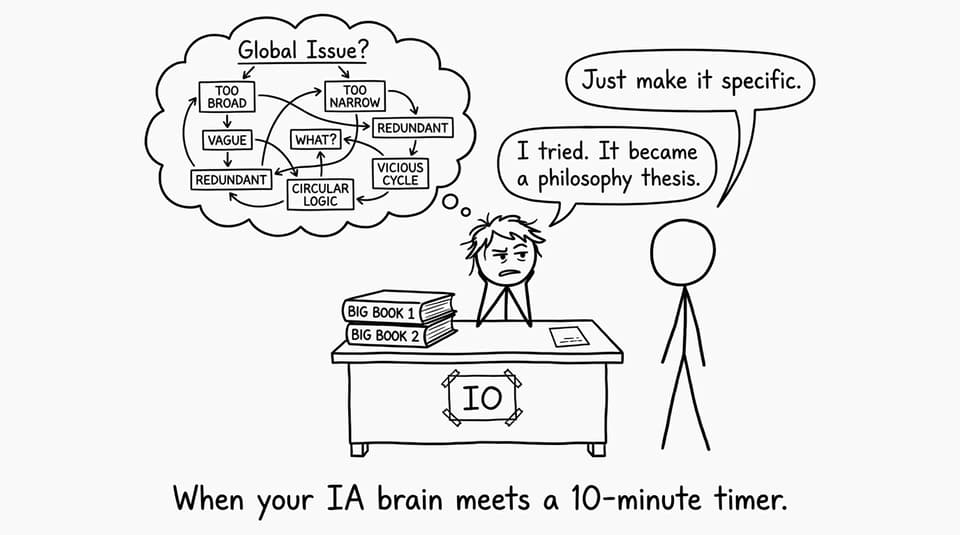
Most IO IA stress comes from choosing a global issue that sounds big but behaves vague. “Power” and “identity” are not global issues; they are categories. Your global issue needs a tension you can trace in both texts.
Try framing it as:
-
A force (policy, media, tradition, technology)
-
A human outcome (silencing, belonging, fear, resistance)
-
A scope (across societies, not only one character’s life)
If you get stuck, RevisionDojo’s How to Choose the Right Field of Inquiry for Your IB IO helps you keep the issue global without drifting into abstraction.
Step 2: Pick extracts that “do work” on the issue
A strong IO IA extract is not just a good scene. It is a scene where authorial choices visibly collide with your global issue.
Choose extracts that:
-
Give you specific language or visual choices to quote and unpack
-
Include a shift: conflict, irony, reversal, revelation
-
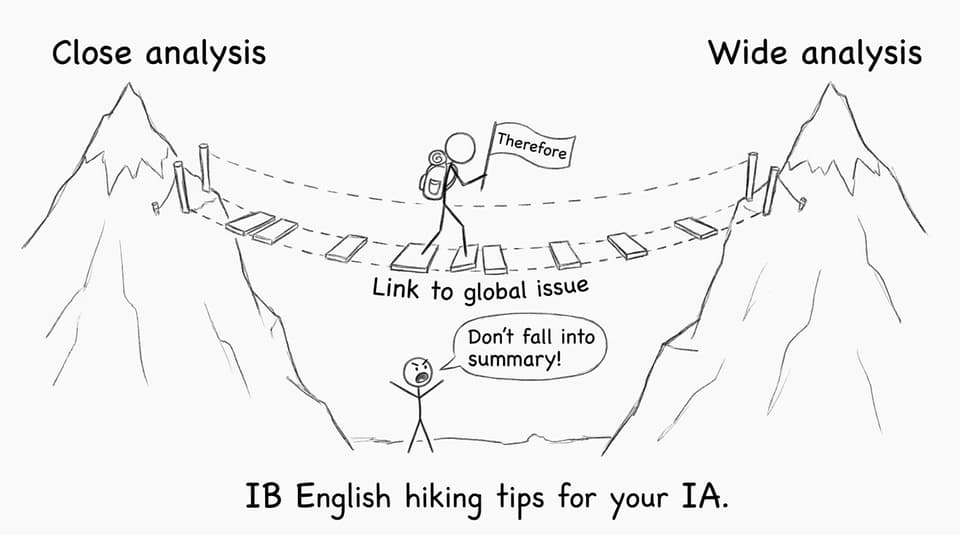
Make it easy to move from close analysis (this moment) to wide analysis (patterns across the whole work/body of work)
If you need a model of what “IO-ready” material looks like, use the Language A: Individual Oral Examples inside the RevisionDojo Coursework Library.
Step 3: Build a 10-minute structure that protects your timing
Think of your IO IA as a train schedule. You can have brilliant ideas, but if you miss the stops, the examiner only sees chaos.
A reliable structure:
Opening (about 1 minute)
-
Define the global issue in one sentence
-
Introduce both texts (author, form, context in a phrase)
-
State your thesis: what each text reveals about the issue
Text 1 (about 4 minutes)
-
Close analysis: 2-3 techniques, precise references
-
Wide analysis: how the issue repeats across the whole work/body of work
Text 2 (about 4 minutes)
- Mirror the same pattern to stay balanced
Closing (about 1 minute)
-
Synthesize: what we learn when the texts sit next to each other
-
End with significance (why this issue matters beyond the texts)
For more structural options and practice advice, RevisionDojo’s notes on Choosing IO structure and Tips for practicing are worth bookmarking.
Step 4: Write the outline the IB expects (and nothing more)
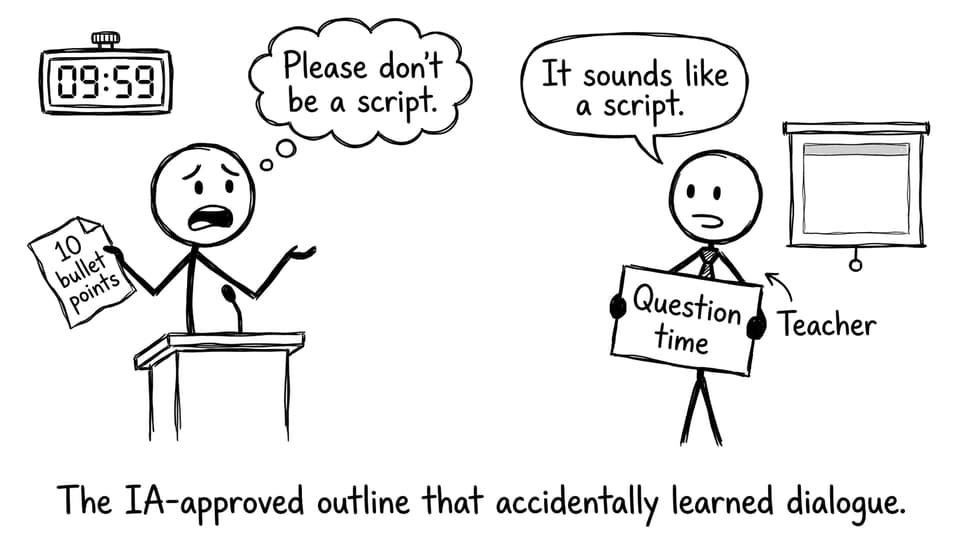
Your IO IA outline should feel slightly underpowered on paper, because it is designed to trigger your spoken thinking, not replace it.
Use bullets like:
- Technique + micro-quote + effect + link to global issue
Avoid:
-
Full sentences
-
Transitions written out word-for-word
-
Long embedded quotes
A good test: if someone else could read your outline and deliver the IO, it is too detailed.
Step 5: Practise like an IA, not like a performance
Students often practise until they can survive a run. High scorers practise until they can improve a criterion each time.
Use this loop:
-
Record one full IO
-
Check one criterion (focus, analysis, language, knowledge)
-
Rewrite only the parts that harm that criterion
-
Re-record
RevisionDojo makes this feedback loop faster. The Record and Grade IB Oral Presentations workflow and the IB Oral Practice Schedule help you practise in short, repeatable sessions. Pair that with RevisionDojo’s AI Chat for quick clarification on techniques, plus Flashcards for terminology you want to use naturally.
Common IA mistakes that quietly drop IO marks
-
Summary disguised as context: if you are describing what happens, stop and ask “So what?”
-
One-text imbalance: the IO IA cannot be saved by one brilliant half
-
Global issue drift: if your point does not link back, it does not score
-
Technique spotting without effect: name it, show it, explain its impact, then connect
A final word: make the IA small enough to win
The best IO IA presentations are not the ones with the most ideas. They are the ones with the cleanest line of argument: two texts, one global issue, and a steady chain of choices and effects.
If you want to make that process faster, RevisionDojo is built for it: a Coursework Library for models, a Questionbank and Study Notes for targeted skills, Flashcards for terminology, Mock Exams and Predicted Papers for broader exam readiness, and grader tools that turn vague practice into clear next steps. Use the structure, practise with feedback, and let your IA become predictable.