
If you have ever sat down for an EE reflection session and felt the quiet pressure to “say something meaningful,” you are not alone.
The odd thing about the EE is that the most important moments are rarely dramatic. They are small decisions: a research question that finally narrows, a method that stops wobbling, a paragraph that turns from summary into argument. The three mandatory reflection sessions exist to capture those decisions, not to manufacture inspiration.
But many supervisors (and students) treat the sessions like admin. A quick chat, a rushed signature, a line on the RPF, done.
That is a missed opportunity. Because when these sessions are run well, they become the simplest way to improve the EE without writing a single extra word. They keep the project honest, focused, and exam-ready. And for IB students juggling coursework and revision, that clarity can feel like oxygen.
Below is a practical supervisor’s guide to running the EE initial, interim, and viva voce reflection sessions. Each is designed to last 20-30 minutes, and each is recorded on the RPF. Informal check-ins between them are encouraged, but do not need to be recorded.
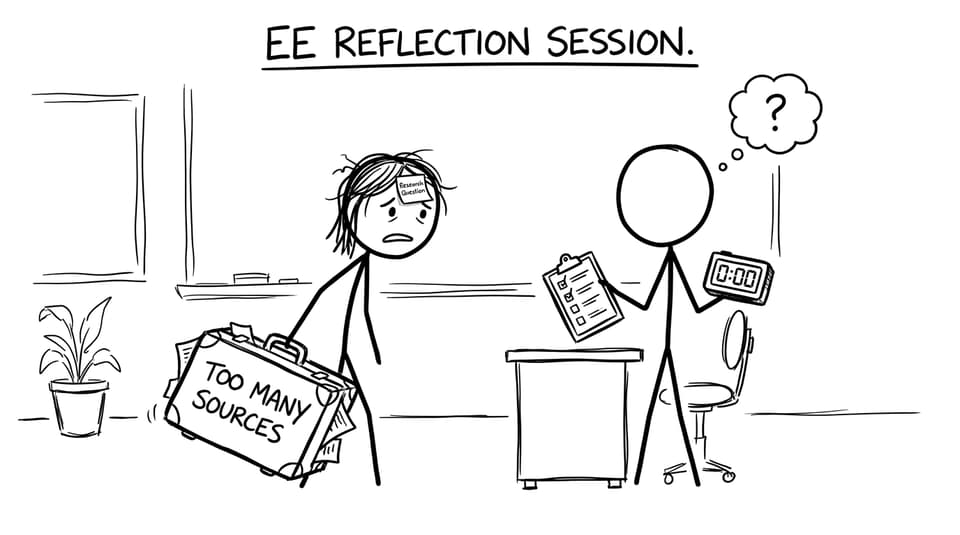
The three EE reflection sessions: quick checklist
Use this as your “open the door, start the timer” plan for every EE reflection.
- Timebox every session to 20-30 minutes
- Start with evidence (notes, outline, draft section, or source map)
- Ask decision questions (what changed, why, what’s next)
- Record the session on the RPF (clear, specific, process-focused)
- End with one next action and one checkpoint date
If your school uses RevisionDojo, students can pair these sessions with the Coursework Grader for criterion-aligned feedback loops and use AI Chat to unblock research-method and argument questions quickly. The goal is not more work. It is fewer wrong turns.
Helpful starting points for students and supervisors:
What the RPF should capture (and what it shouldn’t)
The RPF is not a diary. It is not a set of motivational quotes. And it is not a summary of the whole EE.
A strong RPF entry captures three things:
- The student’s thinking (how their understanding evolved)
- Their decision-making (what they chose, changed, rejected)
- Their evaluation (what worked, what didn’t, what they learned)
In other words: the RPF is evidence of engagement.
If a student needs help understanding what “good reflection” sounds like, point them to:
- How Reflection Strengthens Your IB Extended Essay
- Creating Actionable Reflection Prompts for IB Students
Initial EE reflection session (20-30 minutes)
The first EE reflection session is about topic exploration and early research direction. Think of it as preventing expensive mistakes while they are still cheap.
What students should bring
Ask students to bring:
- 2-3 topic possibilities (even messy)
- A one-paragraph “why I care” explanation
- 3-5 early sources (not necessarily perfect)
- A rough guess at a research question (even if it is bad)
If they are stuck, give them homework before the session: read a guide and produce a first attempt.
Supervisor agenda: the 6 questions that matter
Use these prompts to keep the EE conversation concrete:
- What is the student genuinely curious about (not what sounds impressive)?
- What is the subject-specific method likely to be (text analysis, experiment, economic model, historical evaluation, etc.)?
- What would “analysis” look like here, not description?
- What sources/data are realistically available?
- What is the likely scope boundary (time period, texts, case study, sample size)?
- What is a first research question attempt that is answerable within 4,000 words?
At this stage, the best outcome is not a perfect research question. It is a research question that is finally small enough to be tested.
Support students with:
What to write on the RPF after session 1
The RPF entry should capture:
- The initial direction (topic area)
- Early sources and what they revealed
- The first meaningful narrowing decision
Example phrasing (adapt, don’t copy):
“We explored multiple possible directions for the EE and evaluated feasibility based on source availability and subject-specific method. The student recognized their initial question was too broad and proposed narrowing to a single case study/text set. Next step: collect 6-8 academic sources and draft three revised research question options for review.”
Quiet warning signs to catch early
- The student wants a topic that requires unavailable data
- The student cannot explain the topic without summarizing Wikipedia
- The student’s idea is “interesting,” but not arguable
If you see these, you are not blocking them. You are saving them.
Interim EE reflection session (20-30 minutes)
The interim EE reflection session is the midpoint reality check: progress on the research question, methods, and line of argument.
This is the session where many essays either become a coherent investigation or drift into a scrapbook of quotes.
What students should bring
Ask for evidence that thinking has moved:
- A revised research question (or two options)
- An outline with tentative claims (not just headings)
- A working bibliography
- 1-2 written body sections or a detailed plan
- A short methods note: what they are doing and why
If they have a draft section, this is a great moment to run it through RevisionDojo’s Grading tools to see whether it reads as analysis against the rubric, not “information.”
Supervisor agenda: keep it on argument and method
Your job here is not to edit prose. It is to pressure-test logic.
Ask:
- Is the research question now focused, specific, and researchable?
- What is the current line of argument in one sentence?
- Which section is most at risk of becoming descriptive?
- What is the method, and is it appropriate for the subject?
- What evidence will carry the highest weight?
- What is the biggest uncertainty right now?
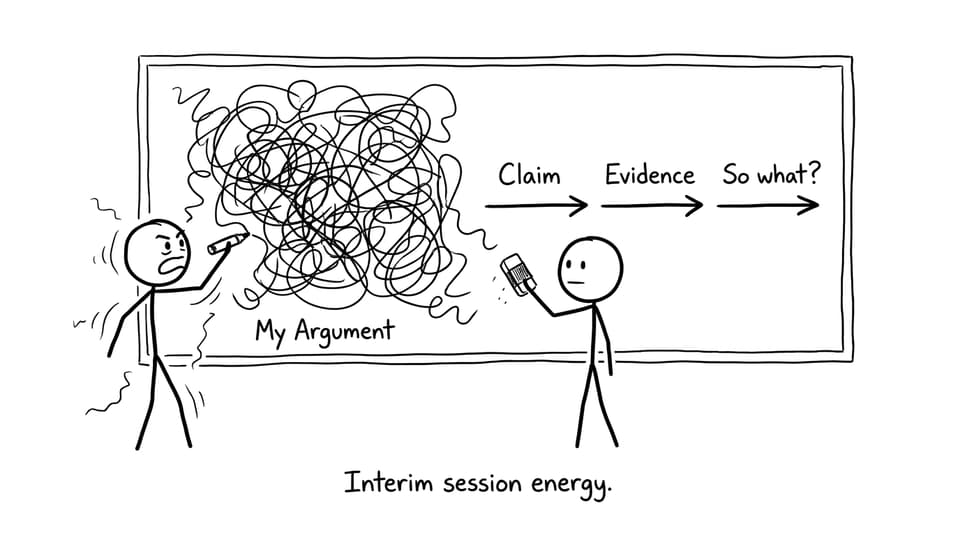
If the student’s argument is tangled, use a simple reset:
- Claim
- Evidence
- So what?
Then repeat.
Useful links for this stage:
- How to Make Your IB Extended Essay Analytical, Not Descriptive
- The Importance of Research Question Revision During the EE Process
- How to Structure an Extended Essay (EE)
What to write on the RPF after session 2
Your RPF notes should highlight change and evaluation:
- What changed in the research question, and why
- What method choices were confirmed or adjusted
- How the student is building an argument (not collecting facts)
Example phrasing:
“In this interim EE reflection, we reviewed progress on the research question and the emerging argument. The student refined the question to improve focus and feasibility, and we discussed how the chosen method supports evaluative analysis. Next step: draft the full argument structure with topic sentences for each section and identify two areas where counterarguments must be addressed.”
Informal check-ins between sessions (use them, don’t record them)
Many EE problems are solved in 6 minutes, not 60.
Encourage informal check-ins when students hit:
- a source problem (not enough academic material)
- a method problem (data not working)
- an argument problem (they’re summarizing)
These do not need to go on the RPF. They are the glue between the formal sessions.
Viva voce EE reflection session (20-30 minutes)
The viva voce is the final EE reflection session. It celebrates completion, confirms authenticity, and prompts evaluative thinking that feeds the final reflective statement.
In a good viva voce, a student does not just say “it was hard.” They explain what they learned about research, evidence, and their own judgment.
What students should bring
- Their final submitted EE
- Their RRS notes (researcher’s reflection space)
- A list of 3 moments they would include in their reflection
If they want targeted preparation prompts, send them to:
Supervisor agenda: five prompts that unlock real evaluation
Ask questions that require reflection, not summary:
- What was your most important research decision, and why?
- Where did your method limit your conclusions?
- Which source changed your thinking the most?
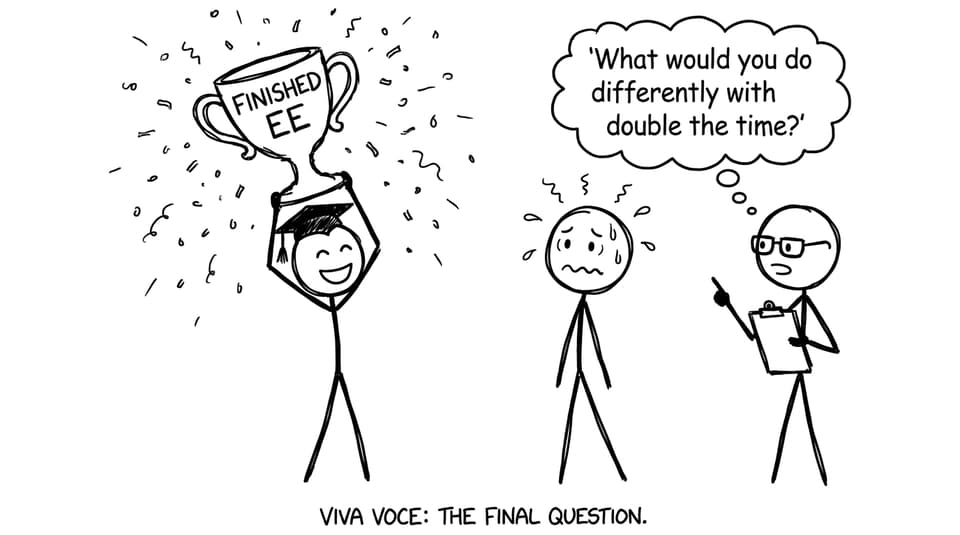
- What would you do differently if you started again with double the time?
- What skill will transfer to exam writing or university work?
This is also a natural moment to connect the EE to exam preparation. Students who can articulate “claim, evidence, evaluation” in their EE tend to write clearer exam responses too. Encourage them to practice that same structure using RevisionDojo’s Questionbank and Study Notes, and to stress-test timing with Mock Exams and Predicted Papers (timed, realistic, and feedback-driven).
What to write on the RPF after the viva voce
The RPF entry should show maturity:
- what they learned
- what they evaluated
- what they would improve
Example phrasing:
“During the viva voce, the student reflected on key turning points in their EE, including refinement of the research question and adaptation of method when initial approaches were limited. They evaluated the strengths and weaknesses of their evidence base and identified how they would improve the investigation if repeating it. The discussion demonstrated thoughtful engagement with the research process and academic skills developed.”
A simple timeline supervisors can reuse
To make the EE feel manageable (especially during exam season), aim for a predictable rhythm:
- Initial reflection session: early in the process, right after topic exploration begins
- Interim reflection session: after meaningful research and planning exist (not just reading)
- Viva voce: after submission
Between these: quick check-ins. No paperwork required.
Closing: run the EE sessions like a compass, not a form
The three reflection sessions are small by design: 20-30 minutes, three times, recorded on the RPF.
But the EE rarely fails because a student didn’t work hard. It fails because their effort pointed in the wrong direction for too long.
Run the initial session to choose a path worth walking. Run the interim session to make sure the argument is real and the method holds. Run the viva voce to turn the whole journey into transferable thinking.
And if you want the student’s workload to feel lighter while their EE quality rises, build a simple system around RevisionDojo: use Study Notes for clarity, Flashcards for daily recall, the Questionbank for marks-driven practice, AI Chat for fast unblocking, Grading tools for rubric alignment, Mock Exams and Predicted Papers for timed realism, plus the Coursework Library and Tutors when students need exemplars or human guidance.
The best EE supervision is not more meetings. It is better moments inside the meetings you already have.