


If you have ever stared at your IB Extended Essay draft and thought, “I worked for weeks… why does it still feel shaky?” you are not alone.
The uncomfortable truth is that most drafts are not ruined by a lack of effort. They are held back by something quieter: unclear priorities. You fix what is easy to fix (wording, formatting, a few citations) and avoid what is hard to fix (argument, method, evaluation). Expert feedback exists to pull your attention back to what actually moves marks.
This guide shows you how to improve an IB Extended Essay draft using supervisor-style, examiner-style, and platform-style feedback without losing your own voice.
The fast checklist for upgrading an IB Extended Essay draft
Use this as your “before I revise anything” filter:
-
Draft is complete enough to judge (intro to conclusion, not fragments).
-
Research question is stable (or you have a clear reason to refine it).
-
Each section earns its place by answering the research question.
-
Evidence is followed by analysis (not just presented).
-
Feedback is sorted by impact: big issues first, polish last.
-
You can explain what changed and why for your reflection.
When you want a criteria map before you start, use RevisionDojo’s IB Extended Essay Guides and the All IB Extended Essay Posts hub to find subject-specific advice.
What “expert feedback” really means for the IB Extended Essay
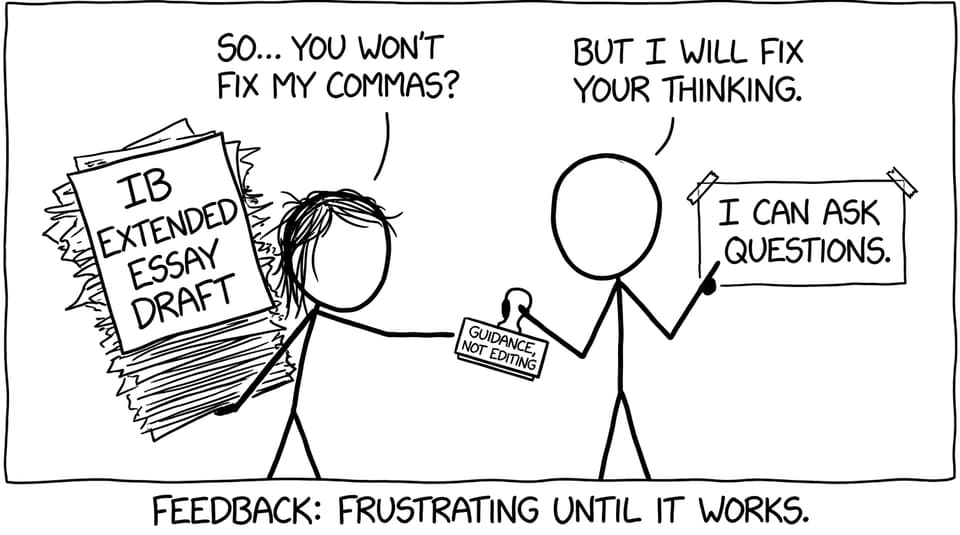
In the IB Extended Essay, supervisor feedback is meant to protect academic honesty and independent thinking. That constraint is annoying when you want someone to “just fix it,” but it is also a gift: it forces you to become the editor-in-chief of your own reasoning.
Expect expert feedback to sound like questions, not rewrites:
-
“Where do you evaluate this evidence rather than describe it?”
-
“How does this paragraph link to your research question?”
-
“What would a counterargument look like here?”
To align your draft with how examiners score, read the IB Extended Essay assessment criteria breakdown and keep the EE Assessment Criteria Explained (2027 Guide) open while you revise.
Submit the kind of draft that earns useful feedback
A supervisor (or any expert reader) can only respond to what exists on the page. If you send a half-built document, you will mostly get feedback about missing pieces. That is not “bad feedback,” it is just the only honest feedback available.
Before you ask for input on your IB Extended Essay draft, make sure it includes:
-
A clearly stated research question (early and unmissable)
-
A method you actually follow (not a paragraph you wrote once)
-
A line of argument that progresses section by section
-
Citations as you go (not a last-minute bibliography scramble)
If you want a full process overview, the guide Mastering IB Extended Essays: How to Research, Write, and Revise pairs well with the feedback steps below.
Turn comments into actions: the 3-pass revision method
Most students revise in one messy pass. Experts revise in layers.
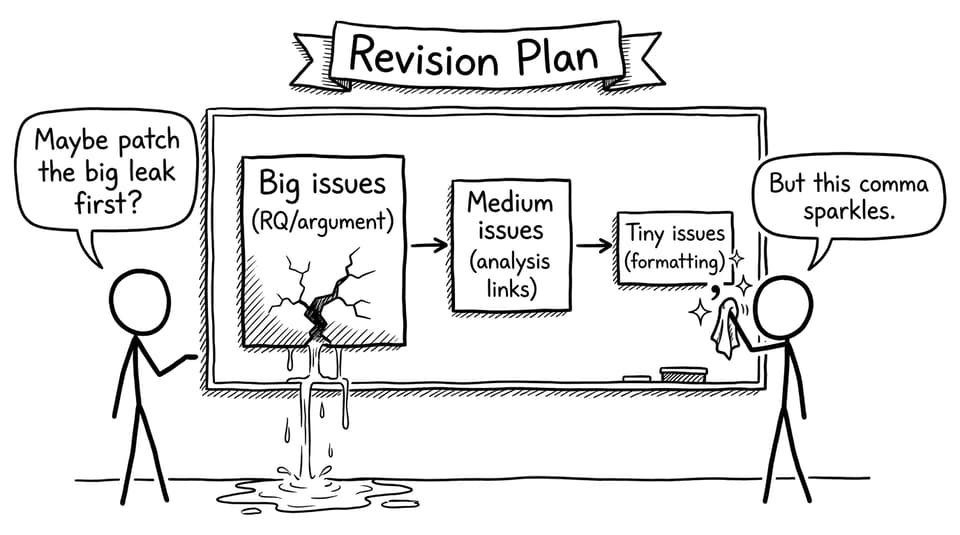
First pass: repair the steering wheel (research question and structure)
Ask:
-
Does every major section directly serve the research question?
-
Does the introduction promise the same essay the conclusion delivers?
-
Are headings logical “argument steps,” not just topics?
If feedback suggests your research question is drifting or too broad, fix it early. A sharper question makes every later paragraph easier to write.
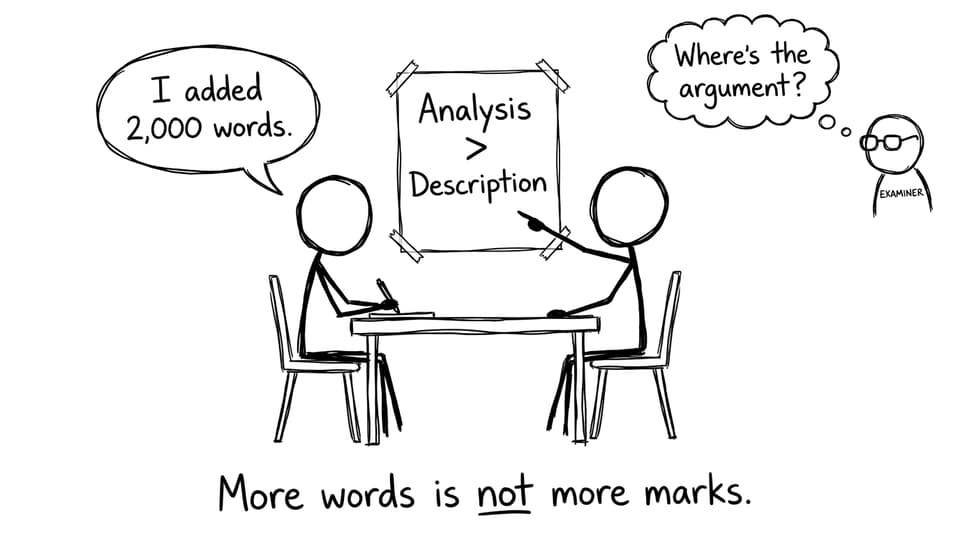
Second pass: upgrade analysis (the “so what?” sentence)
For every key piece of evidence, add one sentence that answers:
-
So what does this show?
-
Why does it matter for my claim?
-
What limitation or alternative explanation exists?
This is where marks are usually won. Especially if you are working under the 2027 emphasis on discussion and evaluation, it helps to understand what is changing. See IB Extended Essay 2027 Changes: What to Know for EE.
Third pass: polish presentation (only after the argument is stable)
Now check:
-
Consistent citation style
-
Clear topic sentences and transitions
-
Formatting, tables, figures, and references
Polish without argument clarity is like repainting a house with a cracked foundation.
How to run a supervisor meeting that actually helps your IB Extended Essay
A short meeting can be more valuable than a page of comments if you walk in with the right prompts.
Bring three things:
-
Your research question in one sentence
-
The single paragraph you feel is your “weakest link”
-
A list of 5 targeted questions (not “Is this good?”)
Good questions sound like:
-
“Which criterion is this section currently weakest in?”
-
“If an examiner misunderstood my argument, where would it happen?”
-
“What is the biggest threat to clarity in my method?”
Then, write down the revision tasks you are committing to. Not every suggestion needs to be followed, but every major concern needs a reasoned decision.
Use RevisionDojo to get examiner-style feedback faster (without losing your voice)
Your IB Extended Essay is still yours. Tools should speed up insight, not replace thinking.
Here is a practical setup:
-
Use the IB Coursework Grader to get criterion-linked feedback on drafts (what is strong, what is missing, what to do next).
-
If you are working toward the new framework, check the IB Extended Essay (First Assessment 2027) Grader for rubric-aligned expectations.
-
For subject technique while you balance exam prep, keep your daily loop alive with RevisionDojo’s Study Notes, Flashcards, and Questionbank practice. Start at the free Questionbank and use IB Question Bank: How to Use It Effectively to build a routine.
RevisionDojo works well here because it does not treat your IB Extended Essay as an isolated task. You can move between Coursework Library exemplars, Grading tools, AI Chat for clarification, and Tutors when you want a human second set of eyes.
Document how you used feedback (your reflection becomes easier)
A strong IB Extended Essay reflection is not poetic. It is specific.
After each feedback round, write 3 bullets:
-
Decision: What did I change?
-
Reason: What feedback or evidence pushed the change?
-
Outcome: What improved in my argument or method?
If you want the vocabulary that examiners use (and the definitions students often miss), read the EE Extended Essay Glossary: Key Terms for the 2027 Guide.
Closing: treat feedback like a spotlight, not a verdict
The best students do not receive “better feedback.” They use feedback better. They let it spotlight the few changes that shift an IB Extended Essay from competent to convincing: a tighter research question, cleaner logic, deeper evaluation, and a reflection that proves real learning.
If you want that process to feel calmer, make RevisionDojo your home base: use the Coursework Grader for rubric clarity, AI Chat to interrogate confusing comments, the Coursework Library for models, and Tutors for deeper guidance. Then keep your exam momentum steady with Study Notes, Flashcards, Questionbank practice, Predicted Papers, and Mock Exams. Your draft does not need more panic. It needs smarter iterations of the same idea, done well.