

The night you finally open your EE draft, it doesn’t feel like writing. It feels like negotiating.
You negotiate with time (which you don’t have), with sources (which disagree), and with your own earlier self (who thought a 4,000-word “mini-thesis” sounded fun). Then you find out the assessment criteria have been updated for 2027.
If you’re an IB student preparing for exams, that news lands in a very specific place in your chest: the place where uncertainty lives.
This guide explains the new EE assessment criteria for 2027 in plain, usable terms, with the exact mark breakdown and what it means for your drafting, editing, and reflection. You’ll also get a practical checklist and a way to convert each criterion into a concrete to-do list using RevisionDojo’s tools.
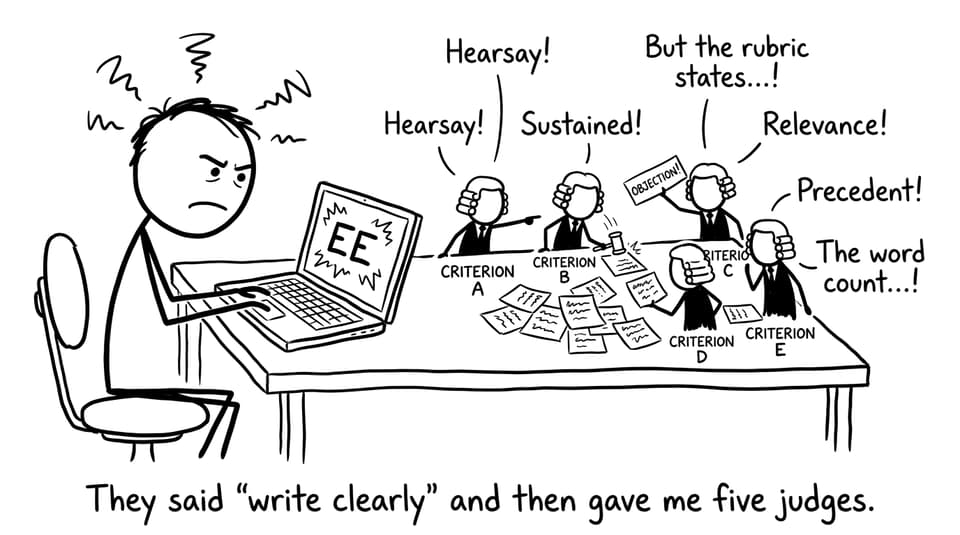
EE 2027 criteria overview (quick checklist)
Here are the five EE assessment criteria for 2027, totaling 30 marks:
- Criterion A: Framework for the essay (6 marks): research question, research methods, structure
- Criterion B: Knowledge and understanding (6 marks): knowledge, terminology, concepts
- Criterion C: Analysis and line of argument (6 marks): analysis, line of argument
- Criterion D: Discussion and evaluation (8 marks): discussion, evaluation
- Criterion E: Reflection (4 marks): evaluative reflection, growth
If you want a simple way to use this: treat your EE as five separate “systems” that must all work at the same time. A strong research question without structure won’t hold. A polished structure without evaluation won’t convince. And a brilliant analysis without reflection can still leave marks on the table.
For broader strategy and examples across subjects, keep the RevisionDojo Extended Essay hub open as your map: All IB Extended Essay Posts.
What’s new about the EE assessment criteria for 2027?
The most important shift in the EE for 2027 is not that students suddenly need new academic superpowers. It’s that the rubric language pushes you toward intentional research design and visible reasoning.
In practice, that means:
- Your framework (question + method + structure) is treated like a single unit, not three disconnected tasks.
- Your analysis is judged by whether a reader can follow the logic, not just whether you included “analysis-sounding” phrases.
- Discussion and evaluation carries the most marks (8/30), so your EE must show you can weigh evidence, limitations, and implications.
- Reflection is smaller (4/30) but easier to underperform on because students confuse “what I did” with “what I learned and how I changed.”
If you want a reliable workflow, build your EE around criterion checkpoints and then iterate. RevisionDojo is designed for that kind of loop: draft, test against the rubric, fix what matters.
For feedback aligned to criteria, the fastest route is a rubric-calibrated grader: IB Coursework Grader.
Criterion A (6 marks): Framework for the EE
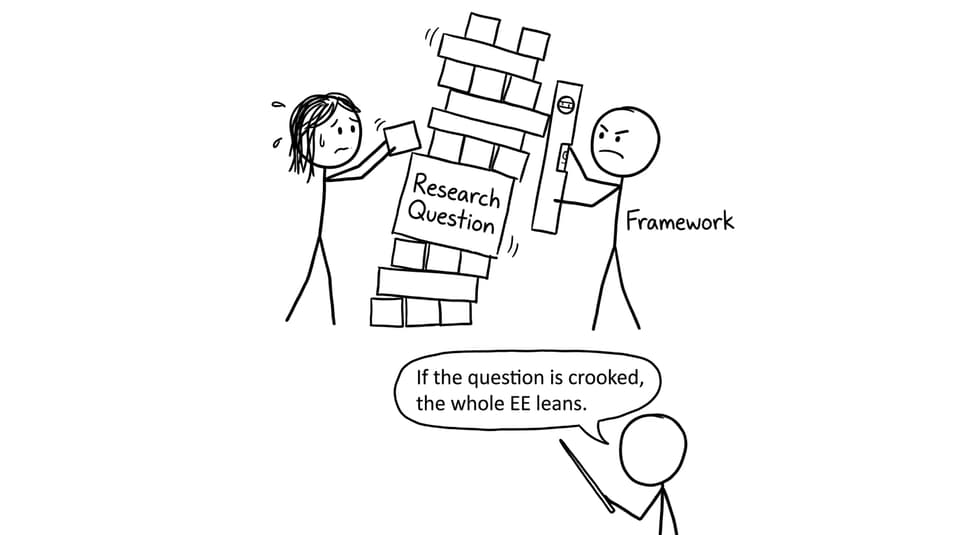
Criterion A asks a quiet but ruthless question: Did you build an essay that could plausibly succeed before the reader even cares about your topic?
It’s assessed through:
- Research question: focused, researchable, and analytical
- Research methods: appropriate to the subject and justified
- Structure: coherent sequencing that supports your argument
The trap: many EEs have a “topic” rather than a research question. Or they have a research question that is technically a question, but not a good one.
A strong EE research question tends to be:
- narrow enough to answer in 4,000 words
- arguable (not just descriptive)
- aligned with subject methods
If you’re revising your question, use a structured approach like the one in The Importance of Research Question Revision During the EE Process.
How to score higher in Criterion A (practical moves)
- Write your research question on every planning page. If a section can’t justify its existence, cut or reframe it.
- Add a “method paragraph” early that states how you will answer the question and why that method fits the subject.
- Outline your headings as a chain of reasoning (A leads to B leads to C), not as a list of themes.
If you’re unsure about formal structure expectations, use: How to Format Your EE According to IB Guidelines: Tips + FAQ.
Criterion B (6 marks): Knowledge and understanding in the EE
Criterion B is where many students accidentally play too small.
They think “knowledge” means a long background section. But in a high-scoring EE, knowledge shows up as precision:
- accurate subject terminology
- correct use of concepts and theories
- appropriate contextual understanding
- careful definitions when needed (without turning the essay into a textbook)
The real signal examiners look for is whether you understand the “rules of the subject.” A History EE reads like History. A Biology EE reads like Biology. A Literature EE reads like literary analysis, not plot summary.
How to score higher in Criterion B (practical moves)
- Keep definitions short, then immediately use them.
- Replace vague words with subject language (without becoming unreadable).
- Use the best sources you can access and show you can interpret them.
If you’re building your reading list, start here: What Are the Best Sources for IB Extended Essay Research?.
And when you need fast concept clarification (especially while exam prep is also happening), RevisionDojo’s AI Chat can help you check terminology and distinguish “popular explanations” from subject-appropriate language.
Criterion C (6 marks): Analysis and line of argument in the EE
This is the heart of the EE. It’s also where students lose marks without realizing it.
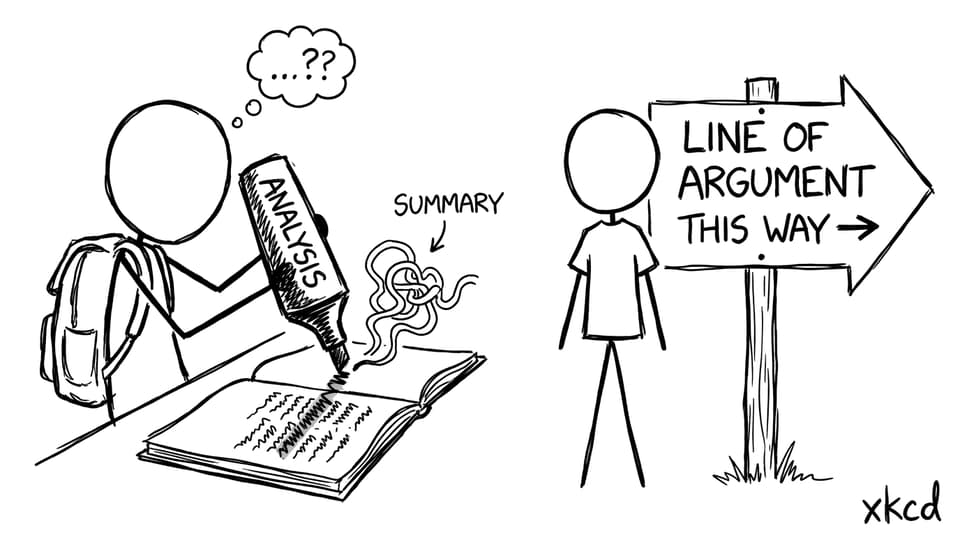
Analysis means you are doing something to the evidence: comparing, weighing, interpreting, challenging, connecting. A line of argument means those analytical moves accumulate into a direction the reader can feel.
A simple test:
- If you removed your quotations, data, or examples, would the paragraph still make a claim?
- If you removed your claims, would the paragraph become a list of facts?
Good EE writing keeps both, but prioritizes the claim.
How to score higher in Criterion C (practical moves)
- Start body paragraphs with a mini-claim that answers part of the research question.
- End paragraphs by explaining “so what?” in one or two sentences.
- Use signposting that shows progression: “This suggests… however… therefore…”
If you suspect your draft is drifting into description, read: Mistakes to Avoid in IB Extended Essays. Then run your draft through RevisionDojo’s Grading tools to see which sections are flagged as descriptive.
Criterion D (8 marks): Discussion and evaluation in the EE
Criterion D has the most marks for 2027, which is a quiet hint from the IB: the point isn’t that you found information; it’s that you can think with it.
Discussion is where you open up the implications, consider alternatives, and connect evidence back to the research question. Evaluation is where you judge quality: limitations, reliability, bias, methodology constraints, and the strength of competing interpretations.
In many EEs, “evaluation” is mistakenly saved for the conclusion as a single paragraph of apologies.
High-scoring EEs evaluate throughout.
What evaluation can look like (without sounding forced)
- “This source is useful because…, but limited because…”
- “A competing explanation is…, which fits this evidence better because…”
- “This method increases validity by…, though it reduces generalizability because…”
How to score higher in Criterion D (practical moves)
- Add a short evaluation sentence after major evidence points.
- Include at least one section that addresses a counterargument seriously.
- In your conclusion, evaluate your answer: how confident are you, and what would improve the investigation?
When you’re ready to polish the ending, use: 7 Key Tips to Write a Strong IB Extended Essay Conclusion.
And if your supervisor feedback is vague, this helps you translate it into criterion actions: How to Improve Your IB Extended Essay Draft: Expert Feedback Guide.
Criterion E (4 marks): Reflection in the EE
Reflection is worth fewer marks than the others, but it’s also the most “human” part of the EE.
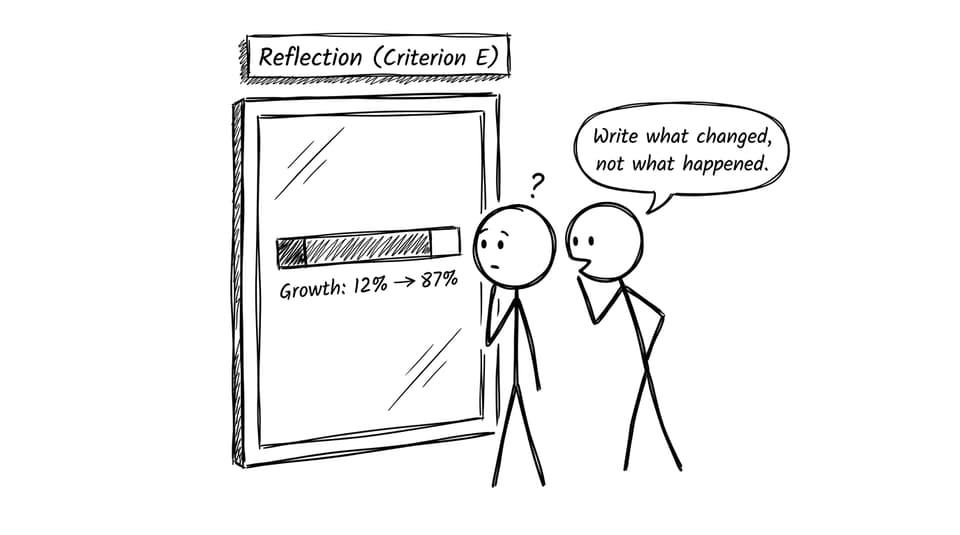
Criterion E rewards evaluative reflection and growth. Not a diary. Not a timeline. Not “I found this hard.” It’s closer to: What did you try, what happened, what did that teach you about your research choices, and what did you change because of it?
How to score higher in Criterion E (practical moves)
- Write reflection entries at decision points: narrowing the question, choosing methods, rejecting sources, changing structure.
- Use “because” language: “I changed X because Y showed me…”
- Show transferable growth: what you learned about research, not just your topic.
For reflection technique, these RevisionDojo guides are worth bookmarking:
- How Reflection Strengthens Your IB Extended Essay
- How to Reflect on Challenges in Your IB IA or EE
- How to Prepare for the IB Extended Essay Viva Voce
A simple “criteria-first” EE revision plan (that fits exam season)
When exams are close, the biggest risk is letting the EE expand to fill every empty hour. The smarter move is to revise the EE like you revise for exams: targeted, measurable, and timed.
Here’s a plan you can run in 3 focused cycles:
Cycle 1: Framework (Criterion A)
- Lock the research question.
- Confirm method fit.
- Restructure headings into a logical argument path.
Cycle 2: Argument quality (Criteria B, C, D)
- Upgrade terminology and concept precision.
- Convert descriptive paragraphs into analytical paragraphs.
- Add evaluation sentences and one serious counterargument.
Cycle 3: Reflection and polish (Criterion E)
- Write evaluative reflections about the biggest pivots.
- Tighten introduction and conclusion to match the final argument.
RevisionDojo helps you protect your exam prep time while doing this:
- Use Study Notes and Flashcards to keep subject content separate from EE writing.
- Use Questionbank to maintain daily exam practice, so the EE doesn’t silently steal your momentum.
- Use AI Chat to sanity-check argument flow and clarify concepts.
- Use Grading tools to find the highest-impact edits.
- Use Tutors if you need a fast human reset on research question scope or subject-specific method.
- Use Mock Exams and Predicted Papers for timed exam readiness while the EE is being finalized.
If you want to see what top coursework looks like in real student writing, use the Coursework Library: Coursework | RevisionDojo and IB Coursework Examples: IA, EE and TOK Exemplars.
Closing: treat the EE 2027 criteria like a set of levers
The most calming thing about the EE is also the most frustrating: it’s not graded on your stress level. It’s graded on visible choices.
The EE 2027 assessment criteria give you five levers to pull: a solid framework, precise understanding, clear analysis, real evaluation, and honest reflection. If one lever is weak, your whole EE feels heavier than it should.
If you want a criteria-first way to finish strong while still preparing for exams, build your workflow inside RevisionDojo: practice content with Questionbank, retain it with Study Notes and Flashcards, pressure-test timing with Mock Exams and Predicted Papers, and refine your writing with AI Chat, Grading tools, the Coursework Library, and Tutors when you need a fast, subject-specific breakthrough.
Your EE doesn’t need to be perfect. It needs to be deliberate. And the 2027 criteria are simply the clearest invitation to be exactly that.