



The best MYP flashcards do more than store facts. They make you retrieve an idea, explain it clearly, connect it to a concept, and apply it in an unfamiliar situation. To create effective MYP flashcards, write one precise prompt per card, answer from memory before checking, and review difficult cards more frequently than secure ones.
That sounds simple, but simple systems are easy to misuse. Decorating cards, copying notes, and rereading answers can feel productive without testing whether you can actually use the knowledge. The goal is not to build the largest deck. It is to create a small system that reveals what you know and what still needs work.
Your MYP flashcard checklist
An effective card should:
- test one idea or mental step
- use a clear question rather than a topic heading
- have a short, accurate answer
- include an example, context, or application when useful
- connect to a unit concept or assessment criterion
- return for review after a delay
- lead into written or problem-solving practice
You can build this system digitally with RevisionDojo's MYP resources, or use paper cards and labelled piles. The principle is the same: attempt the answer before revealing it.
A same-day method for creating effective MYP flashcards
Set aside 35 to 45 minutes. Choose one narrow topic from one subject, not an entire unit. A focused starting point might be cell transport, quadratic functions, source reliability, or persuasive techniques.
Choose knowledge that deserves a card
Spend five minutes scanning your class notes, teacher feedback, rubric, and relevant Study Notes. Select material you need to retrieve repeatedly:
- essential vocabulary
- formulas and conditions
- stages in a process
- command terms
- comparisons, causes, and consequences
- examples linked to concepts
- mistakes you have made before
Do not turn every sentence into a card. If a fact is obvious, rarely useful, or easily reconstructed from a larger idea, it may not deserve repeated review.
RevisionDojo's guide to MYP subjects and available resources can help you identify where Study Notes, Flashcards, and Questionbank practice fit your course.
Write prompts that force retrieval
Convert the selected material into questions. Avoid fronts such as “Photosynthesis” or “Criterion C.” These name a topic but do not tell your brain what to retrieve.
Use prompts such as:
- “What is the role of chlorophyll in photosynthesis?”
- “When should the quadratic formula be used?”
- “What makes a historical source useful but limited?”
- “How does this example connect to the unit's key concept?”
One card should generally test one answer. If the reverse side becomes a paragraph, split the card or turn the material into a practice question.
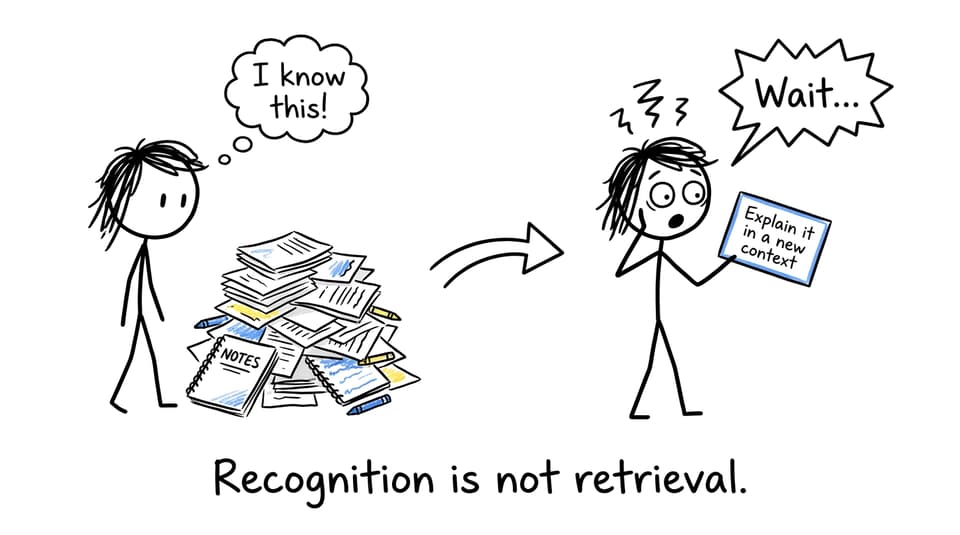
Add application to important cards
MYP learning is not limited to recalling definitions. Assessment tasks can ask students to investigate, communicate, evaluate, explain, or apply knowledge. Your deck should reflect that.
For each important concept, create related cards:
| Card type | Example |
|---|---|
| Recall card | What is diffusion? |
| Application card | Why does a larger concentration gradient usually increase diffusion rate? |
| Concept card | How can diffusion illustrate the concept of systems? |
| Error card | Why is “particles want to spread out” incomplete? |
This structure moves you from remembering a term to using it. It also matches RevisionDojo's advice on global contexts and concept-driven MYP learning: facts become more valuable when you can connect and transfer them.
Write answers for checking
Write concise answers in your own words. Include only the information needed to judge whether your retrieval was accurate. A strong answer might contain:
- a one-sentence explanation
- two or three necessary steps
- a formula with defined variables
- an example and limitation
- keywords required for precise communication
For mathematics, use flashcards for formulas, notation, conditions, and method-selection cues. Do the complete working elsewhere. The RevisionDojo MYP Math review explains why cards should support problem-solving rather than replace it.
For sciences, use cards for definitions, relationships, variables, processes, and misconceptions. Follow them with data analysis or unfamiliar-context questions, as suggested in this guide to revising MYP Sciences.
Test the deck immediately
Put your notes away. Read the prompt, pause, and say or write the complete answer before turning the card over. A vague feeling of recognition does not count.
Mark each response:
- Again: wrong, incomplete, or guessed
- Soon: correct but hesitant
- Later: correct, clear, and independently explained
Return to “Again” cards near the end of the session. Review “Soon” cards tomorrow and “Later” cards after a longer gap. Digital Flashcards can manage this rhythm, while paper users can create three piles.
Finish with application
Use the final ten minutes for two or three relevant questions from the RevisionDojo Questionbank. Remembering information and applying it are related, but they are not identical.
If you miss a question, identify the cause: missing knowledge, misunderstanding the command term, choosing the wrong method, or communicating poorly. Then create one card for that specific weakness. A deck improves by absorbing lessons from real mistakes, not by growing randomly.
How to review cards across the week
Spacing sessions across multiple days generally produces more durable learning than repeating material in one sitting. Retrieval matters too. You must attempt the answer rather than merely reread it.
Try this schedule:
- Today: create and test the deck
- Tomorrow: review every card
- Three days later: review uncertain and difficult cards
- One week later: mix the cards with another topic
- Two weeks later: test the ideas through questions and extended responses
These intervals are starting points, not rigid laws. Bring a card back sooner when you forget it and wait longer when recall remains easy. Secure cards should still return occasionally.
For students balancing many classes, the aim is maintenance rather than perfection. The guide to balancing all eight MYP subject groups offers a useful model: short Flashcard sessions keep subjects active while longer blocks develop deeper skills.
Common flashcard mistakes to avoid
Copying entire notes
Copying creates a reference library, not a retrieval system. Keep answers compact and return to Study Notes for fuller explanations.
Making cards too easy
Recognition prompts can provide accidental clues. Open questions usually reveal understanding more honestly.
Memorising without context
A definition may establish foundation knowledge, but MYP tasks can require analysis, investigation, communication, and application. Add examples, comparisons, command terms, and new situations.
Removing every correct card
One correct answer does not prove durable learning. Keep successful cards in circulation, increasing the time before they return.
Using flashcards as the whole plan
Flashcards strengthen retrieval. They cannot fully train source evaluation, essay structure, experimental design, mathematical reasoning, or timed performance. A broader set of MYP revision techniques and study tips should combine memory, application, feedback, and reflection.
Turn flashcards into a complete MYP revision loop
RevisionDojo works best when each feature has a distinct job. Use Study Notes to understand a concept, Flashcards to retrieve it, and the Questionbank to apply it. When an explanation remains unclear, AI Chat can help examine the misconception, while Grading tools can highlight weaknesses in written work.
As assessments approach, Mock Exams and suitable Predicted Papers can develop timing and concentration. The Coursework Library can clarify how strong work is structured, while Tutors provide human diagnosis when a difficulty persists. Always return to independent performance after receiving support.
A flashcard is not the destination. It is a bridge between understanding something when it is in front of you and producing it when the help disappears.
Start today with one topic and ten carefully written cards. Test them, sort them, and use your mistakes to improve the deck. RevisionDojo brings that journey into one place, making it the ultimate IB resource for turning short study sessions into connected, criteria-aware MYP preparation.