



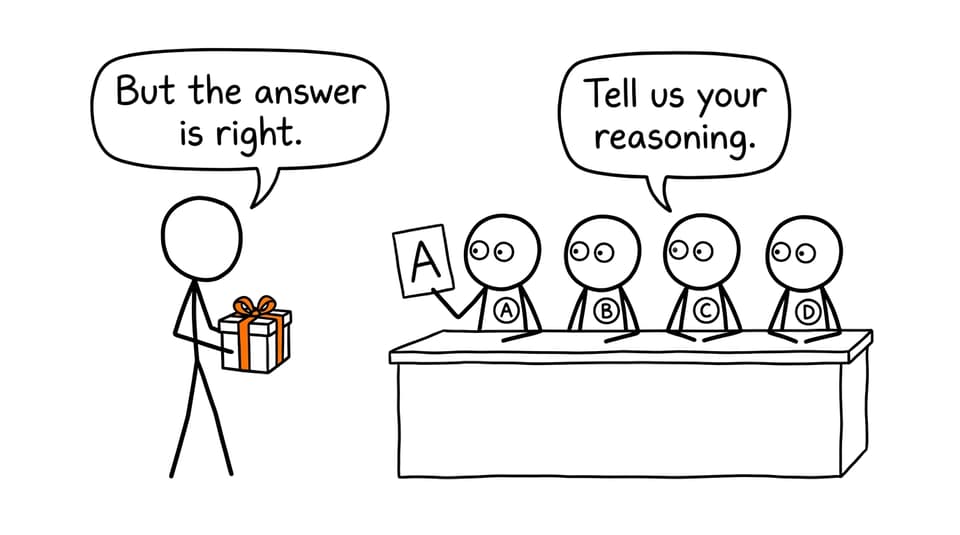
A correct answer can hide an incomplete understanding. That is one of the stranger lessons students discover in MYP Mathematics: calculation matters, but so do investigation, communication, and interpretation.
So, is RevisionDojo MYP Math good? Yes, especially for students who need structured, syllabus-aligned practice rather than another folder of disconnected worksheets. Its strongest feature is the way notes, questions, flashcards, lessons, AI feedback, and exam-building tools can be combined into one revision loop. It is most effective when students practise against the four MYP Mathematics criteria, not when they simply read explanations and count completed questions.
It is not a replacement for classroom teaching, teacher feedback, or familiarity with your school's course sequence. But used deliberately, it can become the central revision system connecting what you know, what you can apply, and what you still need to fix.
RevisionDojo MYP Math at a glance
Here is the short verdict before we examine the details:
- Best for: targeted topic practice, criteria-aware revision, active recall, and preparation for unfamiliar problems
- Core resources: Questionbank, Study Notes, lessons, Flashcards, key definitions, AI feedback, and an exam builder
- Topic range: number, algebra, functions and modelling, geometry, trigonometry, statistics, and probability
- Levels supported: dedicated Standard Mathematics resources and separate Extended Mathematics materials
- Main advantage: students can move from explanation to practice and feedback without rebuilding their study system each time
- Main limitation: no platform can know every school's exact unit order, local task design, or teacher expectations
- Best approach: use RevisionDojo alongside class materials, the relevant rubric, and feedback from your teacher
Students can begin in the MYP Standard Mathematics resource hub or explore the wider RevisionDojo MYP subject collection.
How well does RevisionDojo cover MYP Mathematics topics?
The official MYP framework organizes mathematical study around broad branches involving numerical and abstract reasoning, models, spatial reasoning, and data. Schools retain flexibility in how they arrange their taught curriculum, so students should not assume that every class follows an identical chapter order.
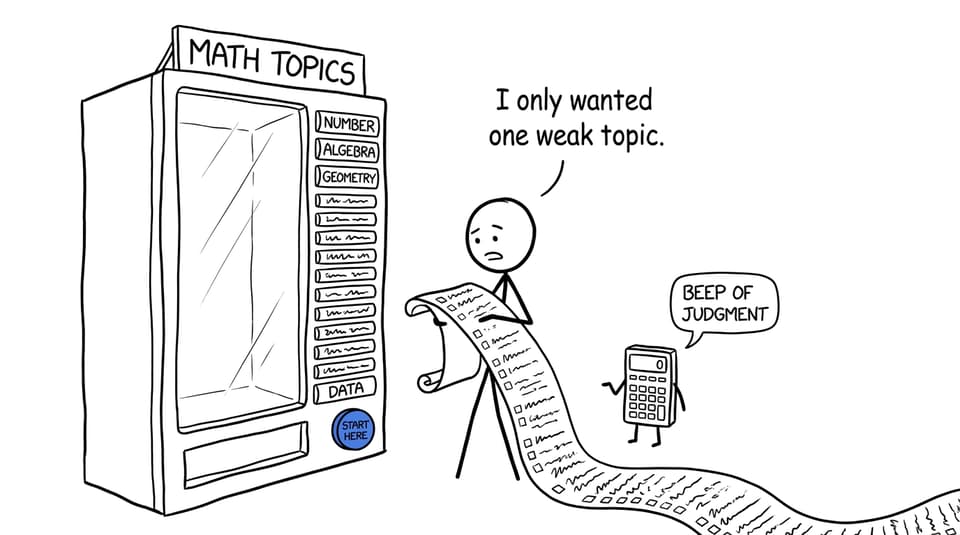
RevisionDojo translates that broad framework into searchable topics. Its Standard Mathematics hub includes foundational and later-stage material such as:
- number systems, exponent laws, scientific notation, radicals, and absolute value
- patterns, sequences, formula manipulation, and generalization
- linear equations, simultaneous equations, quadratics, relations, and functions
- coordinate geometry, linear modelling, and proportional reasoning
- surface area, volume, transformations, circles, and right-triangle geometry
- sets, Venn diagrams, single and combined probability
- sampling, histograms, univariate statistics, and bivariate data
This breadth matters because MYP questions frequently connect topics. A real-life modelling task may begin with proportion, require a linear equation, ask for a graph, and finish with an interpretation of whether the result is reasonable. Revising each chapter in isolation is necessary at first, but insufficient at the end.
The platform also separates Standard and Extended pathways. Students taking a more advanced course can use the MYP Extended Mathematics revision notes, which cover material such as bounds, function transformations, conditional probability, standard deviation, trigonometric rules, logarithms, rational expressions, graph theory, and vectors.
That separation is useful, but your teacher's course outline should remain the deciding document. The article on MYP Standard and Extended Mathematics can help clarify the difference, but students should confirm their registered course and required content with their school.
Does it support different MYP year levels?
MYP Mathematics develops across five years, while the IB publishes required age-appropriate assessment criteria for Years 1, 3, and 5. Schools use these reference points when designing expectations for the intervening years.
The names of the four criteria remain stable, but the sophistication expected from a response increases. A younger student may identify a pattern and test it with additional examples. By Year 5, a strong response is expected to generalize, justify, move between representations, and communicate a concise mathematical argument.
| Stage | Appropriate practice emphasis |
|---|---|
| Early MYP | Number fluency, basic algebra, representations, simple patterns, units, and clear working |
| Middle MYP | Multi-step problems, complex patterns, coordinate methods, probability, modelling, and fuller explanations |
| Later MYP | Unfamiliar contexts, formal generalization, justification, connected topics, evaluation, and timed digital work |
RevisionDojo is therefore most useful when the student chooses questions by readiness rather than merely selecting the broad label “MYP.” Begin with the methods currently taught in class, then increase complexity. If a question depends on content your class has not covered, save it rather than treating the struggle as evidence that you are weak at mathematics.
Criteria-based practice is the real advantage
The four MYP Mathematics criteria are equally weighted in the official framework, with each criterion offering up to eight achievement levels. They measure different kinds of mathematical performance:
- Criterion A: Knowing and understanding -- selecting and applying mathematics accurately
- Criterion B: Investigating patterns -- discovering relationships, forming general rules, and verifying or justifying them
- Criterion C: Communicating -- using notation, representations, reasoning, and logical organization effectively
- Criterion D: Applying mathematics in real-life contexts -- modelling authentic situations, interpreting results, and considering whether solutions make sense
This explains why completing fifty short calculations may produce less progress than deeply reviewing ten varied problems. Criterion A can improve through procedural drilling, but Criteria B, C, and D require explanation, interpretation, and judgment.
RevisionDojo's Questionbank and AI feedback can make this broader practice easier to organize. The important step is to identify what each response is training. The guide to how MYP Mathematics is assessed provides a helpful criteria-first explanation, while MYP Mathematics study techniques shows how to build explanation into everyday practice.
How to practise each criterion
For Criterion A, solve a focused set without notes, show the method, and check both accuracy and method selection. For Criterion B, record terms or observations in a table, state a general rule, test it with new values, and explain why it works. For Criterion C, label diagrams, use correct notation, include units, and connect each line of working logically. For Criterion D, define variables, state assumptions, apply a model, interpret the result in context, and evaluate whether it is sensible.
AI feedback is valuable for catching omissions and prompting another attempt. It should not become a substitute for thinking. Ask AI Chat to explain why a step is invalid, compare two methods, or generate a similar problem. Then close the explanation and solve again independently.
Which RevisionDojo tools add the most value?
The tools work best as a sequence rather than a menu.
Questionbank and exam builder
The RevisionDojo Questionbank supports targeted practice and instant feedback. Use small sets while learning, mixed sets while consolidating, and custom timed sets near an assessment. The exam builder is particularly useful when your weak areas cross several chapters.
Study Notes, lessons, and Flashcards
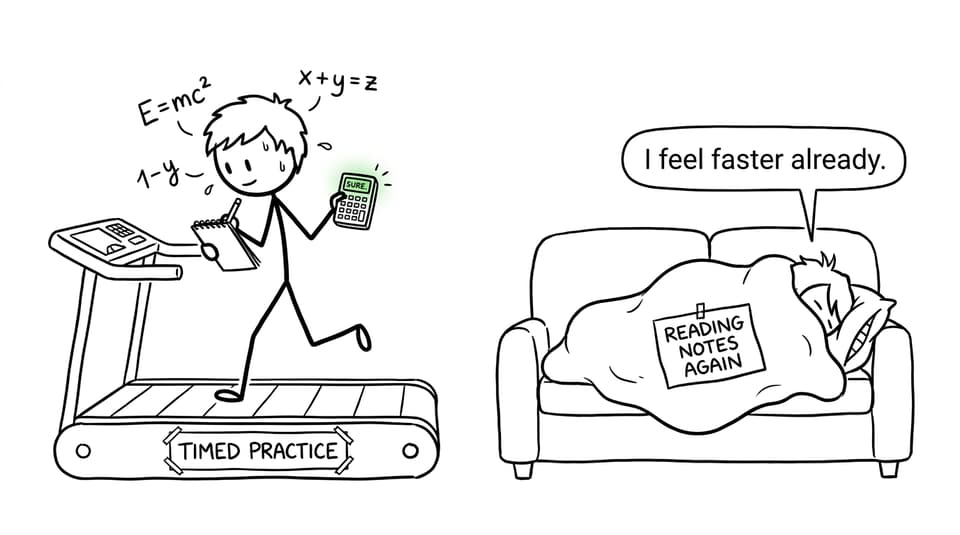
Study Notes and step-by-step lessons can rebuild a missing concept quickly. Flashcards are better suited to formulas, vocabulary, conditions, notation, and method-selection cues than to complete multi-step solutions. After reading a note, close it and reproduce the essential idea before attempting a question. Reading that never becomes retrieval often creates familiarity without reliable recall.
AI Chat and grading feedback
Jojo AI Chat can help diagnose misconceptions when an answer key alone is not enough. Ask focused questions such as, “Why is my general rule unsupported?” or “Which assumption makes this model unreliable?” Grading tools are most useful when feedback leads to a rewritten response, not when the score becomes the end of the session.
Mock Exams, Predicted Papers, and human support
Mock Exams and Predicted Papers can provide broader timed practice where available for the selected course. Availability can vary by subject and plan, so check the current RevisionDojo plans and features before subscribing for one specific resource. The Coursework Library has less direct importance for routine MYP calculation practice, while Tutors can add human explanation, accountability, and strategic support when a recurring weakness resists self-study.
A practical weekly RevisionDojo workflow
A good resource becomes useful only after it becomes a repeatable habit. Try this four-session cycle:
Session one: diagnose
Attempt five to eight questions covering your current topics. Sort every error into one of five categories: missing knowledge, wrong method, calculation error, weak communication, or poor contextual interpretation.
Session two: repair
Use Study Notes or a lesson for one weak area. Review briefly, explain the method from memory, and complete a small targeted set. Add only high-value formulas and decision rules to Flashcards.
Session three: practise by criterion
Complete one investigation or contextual task slowly. Annotate where you demonstrate Criteria A, B, C, and D. Rewrite one weak section after checking feedback.
Session four: perform under pressure
Build a mixed timed set. Work on the device you expect to use if preparing for an on-screen examination. Afterwards, spend at least as much attention understanding repeated errors as recording the score. Students approaching final MYP assessments can adapt the fuller 30-day MYP eAssessment study plan.
Where RevisionDojo has limits
RevisionDojo cannot replace the exact task sheet and rubric supplied by your school. MYP curricula are intentionally flexible, and teachers may sequence topics differently or design investigations around local contexts. Students should also verify calculator rules, assessment arrangements, and permitted technology with their school.
AI feedback deserves the same critical attention as any automated tool. Compare important advice with the rubric, worked solutions, and teacher feedback. If an explanation conflicts with your course requirements, ask your teacher rather than forcing the response to fit the platform.
Finally, an all-in-one platform can encourage passive browsing. Progress is not the number of tabs opened. It is the ability to solve, explain, justify, and interpret without support.
The final verdict
RevisionDojo is a strong choice for MYP Mathematics because it connects comprehensive topic coverage with questions, active recall, feedback, and timed practice. Its greatest value is not that everything sits in one place. It is that students can move through a complete learning cycle: diagnose, learn, retrieve, apply, review, and try again.
Start with the MYP Standard Mathematics resources, choose one genuine weakness, and complete a small question set before opening the notes. Then review the mistake through the relevant criterion. That simple shift turns RevisionDojo from a library into what MYP students actually need: a disciplined practice system built for mathematical thinking.