

Revision can feel productive long before it becomes useful. You highlight a page, reorganize a folder, or watch an explanation and finish with the comforting sense that the subject is under control. Then an unfamiliar question appears, and the knowledge refuses to move.
The best way to revise for MYP eAssessments is to use a repeating loop: identify one weakness, retrieve the relevant knowledge, apply it to an unfamiliar task, check the response against the criteria, and retry it under time pressure. This works better than rereading because MYP eAssessments ask you to use knowledge, not merely recognize it.
You can begin today with one subject, one focused task, and honest feedback. You do not need a perfect timetable or eight uninterrupted hours.
The MYP revision checklist
Before building a schedule, check that your preparation covers the assessment's actual demands:
- Confirm which subjects involve on-screen examinations, ePortfolio work, or another assessed component.
- Find the current criteria, command terms, and examination information provided by your school.
- Divide topics into strong, uncertain, and weak areas.
- Practise applying concepts to unfamiliar sources, situations, and problems.
- Complete some work on screen and under realistic time limits.
- Keep an error log that tells you what to change next time.
- Revisit mistakes within 48 hours.
- Protect sleep and breaks so concentration remains usable.
The RevisionDojo MYP resources hub provides a practical starting point for organizing subjects, notes, questions, and recall practice.
Why ordinary rereading is not enough
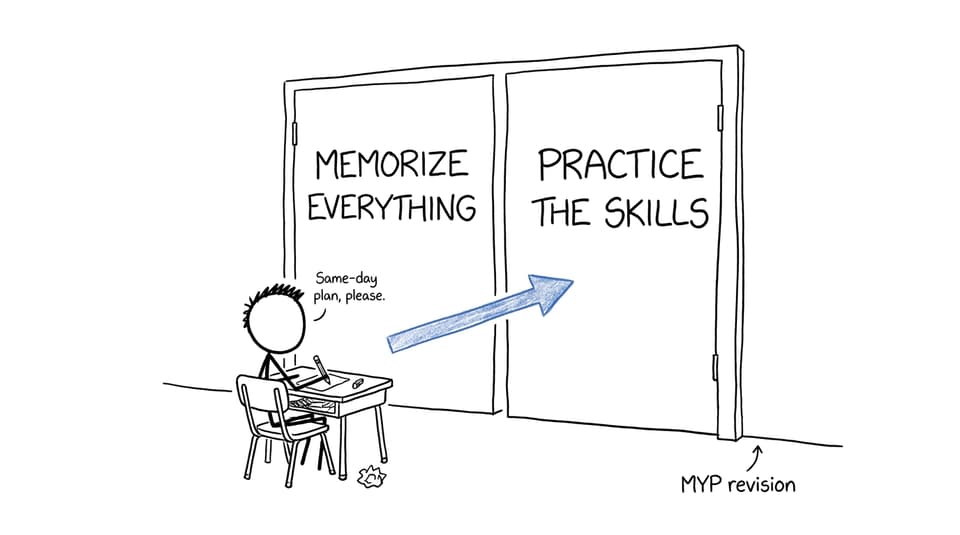
MYP on-screen examinations are built around conceptual understanding and application in complex or unfamiliar contexts. Official IB guidance also emphasizes inquiry, communication, and critical-thinking skills. That changes what useful revision looks like.
Knowing a scientific definition matters, but you may need to use it to interpret unfamiliar data. Remembering a historical event matters, but you may need to evaluate a source or compare perspectives. Knowing a mathematical method matters, but the challenge may be recognizing that method inside a real-world situation.
Effective MYP revision techniques move through four levels:
| Level | What you should be able to do |
|---|---|
| Recall | State the fact, definition, formula, or process without help. |
| Explain | Describe why it works in your own words. |
| Apply | Use it in a new problem, source, or global context. |
| Evaluate | Judge evidence, limitations, consequences, or alternatives. |
If revision stops at recall, familiarity can disguise a lack of exam readiness. The MYP revision guide offers a framework for moving from content review into criteria-based application.
A step-by-step method
Choose one narrow weakness
Do not begin with “revise science.” Choose something observable, such as balancing chemical equations, evaluating source reliability, explaining a writer's choice, or investigating a mathematical pattern.
Use teacher feedback, marked classwork, or a short diagnostic set to find the weakness. If several areas need attention, begin with the topic that is both important and repeatedly difficult.
Retrieve before reviewing
Spend five minutes writing everything you remember without opening your notes. Include vocabulary, formulas, examples, diagrams, or steps. Then compare your attempt with a concise explanation and repair only the gaps.
RevisionDojo Study Notes can provide focused clarification, while Flashcards help you retrieve definitions, processes, and command terms instead of merely looking at them.
Complete an application task
Move into practice quickly. Choose two or three questions that require the concept you just reviewed. Set a modest time limit and work without notes.
The RevisionDojo Questionbank helps isolate a topic or skill before you attempt a longer assessment. If a question is confusing, use AI Chat for a hint, simpler explanation, or similar problem. Close the support and produce the answer independently. AI should make you less dependent, not write your work.
Mark by criteria
“I understood it” is not a reliable marking system. Identify the command term and ask what evidence the response needed.
An identify question may require a concise answer, while explain needs a developed relationship. Analyse asks you to break information into parts and show connections. Evaluate requires a supported judgment, not a list of advantages and disadvantages with no conclusion.
Use teacher feedback, the relevant criteria, and RevisionDojo Grading tools to diagnose the gap. The guide to MYP assessment criteria explains how to translate criteria and command terms into visible actions.
Write an error rule and retry
Record each important mistake as a short instruction for your future self. Instead of “bad source analysis,” write: “Connect the source's origin or purpose to a specific effect on its value or limitation.” Instead of “careless maths,” write: “Write the unit after every calculated quantity and check it before submitting.”
An error log turns a disappointing answer into a reusable revision guide. After a brief delay, answer the original question again or attempt a parallel one without looking at the correction. Return to the same skill within 48 hours.
How to use a 60-minute session
A focused hour can follow this structure:
- 5 minutes: choose one weakness and complete a memory dump.
- 10 minutes: repair missing knowledge with Study Notes.
- 20 minutes: answer a targeted Questionbank set without support.
- 10 minutes: check criteria, feedback, and command-term alignment.
- 10 minutes: rewrite the weakest response or solve a parallel problem.
- 5 minutes: record an error rule and schedule the retest.
One hour is not magical. Its value comes from completing the feedback loop. Three hours of passive review can leave you uncertain; one honest attempt tells you exactly what to do next. Students preparing over a longer period can expand this approach with the 30-day MYP eAssessment study plan.
Train for digital assessment
On-screen assessment introduces friction: scrolling through stimuli, typing extended responses, navigating between tasks, interpreting multimedia, and monitoring time. These actions can consume attention that should be spent thinking.
Complete some practice on a computer in a quiet setting. Learn to plan briefly before typing, edit efficiently, and leave a final checking buffer. Use official familiarization materials provided through your school so the examination tools do not feel new on the day.
RevisionDojo Mock Exams and Predicted Papers, where available for your course, can help you rehearse pacing and decision-making. They are practice resources, not promises about exact questions. The guide to using technology for MYP eAssessments provides a digital-preparation checklist.
Adapt the method for portfolios
Interdisciplinary revision requires more than placing two subjects beside each other. You need disciplinary grounding, connected insights, clear communication, synthesized understanding, and reflection. The MYP interdisciplinary assessment guide explains how to practise those connections explicitly.
For ePortfolio subjects, replace the short question loop with an evidence loop: create, document, compare with the criteria, improve, and reflect. Save drafts, photographs, testing evidence, and feedback as the work develops. Reflection written close to the event is usually more precise than reflection reconstructed weeks later.
RevisionDojo's Coursework Library can help you examine how strong work is organized while you produce original work under your school's academic-integrity rules. The guide to MYP ePortfolio subjects explains how sustained portfolio preparation differs from on-screen revision.
Build a manageable weekly rhythm
A sensible week might include three short targeted sessions, one timed mixed set, and one review of the error log. Use Flashcards on most days, but keep sessions brief. Add a full Mock Exam only after you have repaired enough individual weaknesses for the simulation to teach you something useful.
If the same misconception survives several attempts, speak to your teacher or use RevisionDojo Tutors for human diagnosis. More effort is not always the answer. Sometimes one precise explanation saves hours of repeating the wrong method.
Make every mistake useful
The best revision system does not eliminate mistakes. It makes each mistake informative.
Begin with one weak area and one uninterrupted hour. Retrieve what you know, practise a real task, compare the response with the criteria, write an error rule, and schedule a retry. Tomorrow, the subject will not be finished, but it will be less uncertain.
RevisionDojo brings that process together as the ultimate IB resource: Questionbank, Study Notes, Flashcards, AI Chat, Grading tools, Predicted Papers, Mock Exams, Coursework Library, and Tutors. The tools matter because they shorten the distance between confusion and the next useful attempt. The deeper advantage is the habit they support: learn, apply, review, and return.