
If you’ve ever stared at a blank document and thought, “How is this supposed to prove I learned anything?” then you already understand the strange magic of the MYP ePortfolio.
It’s not a traditional test. There’s no single two-hour window where adrenaline carries you through. Instead, the MYP ePortfolio asks a quieter question: can you show your learning over time -- with evidence, choices, mistakes, improvements, and reflection?
For students aiming for the IB MYP Certificate, that question matters. Because in the MYP, your work isn’t only judged by what you know. It’s judged by what you can do with what you know.
MYP Certificate assessment: the quick overview
Here’s the clean mental map most students need before they start stressing:
-
The MYP Certificate combines different assessment types, not just exams.
-
Some subjects use on-screen eAssessments.
-
Some subjects use an ePortfolio (especially practical or creative subjects).
-
You also complete the Personal Project and meet Service as Action requirements.
If you’re planning your revision time, this matters because MYP ePortfolio work competes with exam prep for attention. A good strategy is to treat the ePortfolio like a weekly habit, not a last-minute emergency.
For a bigger picture of how MYP works as a whole, start with the Middle Years Programme (MYP) hub.
What is an MYP ePortfolio (really)?
An MYP ePortfolio is a digital submission of work produced across the course, built around IB-required tasks and assessed externally using criteria-based rubrics.
But the simplest way to understand it is this:
-
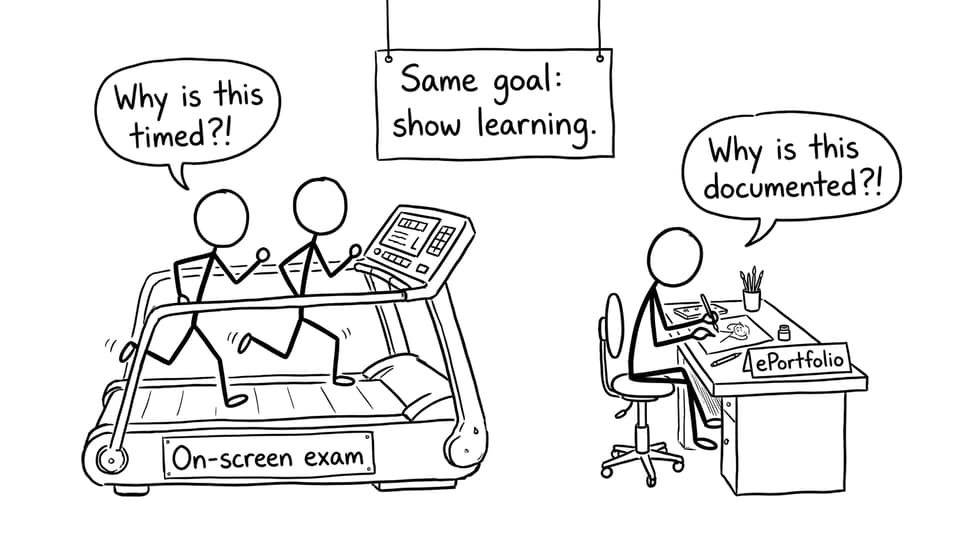
An exam measures what you can do in one sitting.
-
An MYP ePortfolio measures what you can do in a process.
That process includes planning, creating, documenting, refining, and explaining your decisions. The portfolio isn’t “extra.” It’s the assessment.
And yes -- it’s marked in a structured way. It’s not about whether the examiner “likes” your work. In the MYP, you’re rewarded for making your thinking visible.
MYP ePortfolio subjects: which ones use it?
In the MYP, ePortfolios are typically used when the learning involves performance, making, designing, or sustained skill development that a timed on-screen exam can’t capture well.
Most commonly, MYP ePortfolio subjects include:
Arts
This can include visual arts, performing arts, or media-related work depending on your school.
What to expect:
-
evidence of development (not just a final outcome)
-
creative choices explained clearly
-
experimentation, refinement, and reflection
If you’re working in an arts pathway, tools like the IB Visual Arts Process Portfolio Grader can help you practice using rubric language so your commentary is precise rather than vague.
Design
Often split into digital design or product design.
What to expect:
-
design cycle thinking (research, specifications, development, iteration)
-
prototypes, drafts, testing evidence
-
justification of decisions
Design is one of the clearest examples of MYP thinking: you’re not just showing what you built, you’re showing why you built it that way.
Physical and Health Education (PHE)
PHE ePortfolios focus on performance and improvement, but they still require the same MYP habits: evidence, reflection, and criteria alignment.
What to expect:
-
documented practice and progress
-
reflections tied to goals and outcomes
-
clear links to assessment criteria
Language Acquisition (in some cases)
Depending on your course and school choices, some language acquisition pathways can include portfolio-style assessment tasks.
What to expect:
-
evidence of skill growth
-
purposeful task selection
-
reflection on strengths and next steps
If you’re unsure what applies to your school, ask early. In MYP, clarity is a time-saving tool.
What actually goes inside an MYP ePortfolio?
Even though each subject differs, most MYP ePortfolios include three consistent ingredients.
Task responses
These are the required outputs: the performance, product, design solution, or creative work. This is what students tend to focus on first.
But the high marks usually come from what supports it.
Reflection (the hidden score booster)
Reflection isn’t decoration. In the MYP, reflection is proof.
A strong reflection does three things:
-
explains choices (“I chose X because…”)
-
shows learning (“I improved Y after feedback/test results…”)
-
connects to criteria language (not general feelings)
Supporting evidence
This is where you quietly separate yourself from the crowd.
Good evidence can include:
-
screenshots of drafts
-
photos of stages, not just final outcomes
-
short clips (if relevant)
-
feedback notes, testing results, or peer comments
Evidence turns your portfolio from a story into a case file.
How the MYP ePortfolio is assessed
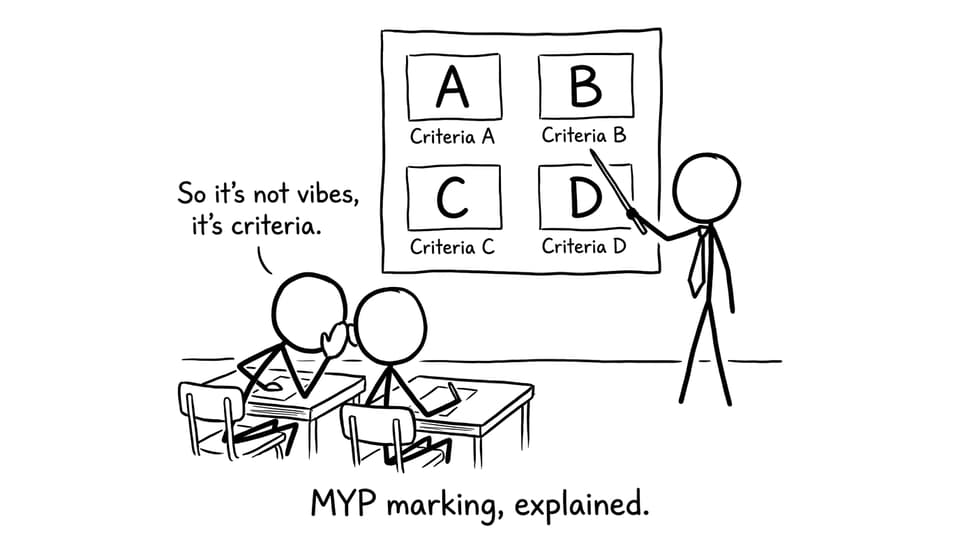
The MYP uses criteria-based assessment. That means your work is graded against specific descriptors, not against other students.
Across many MYP subjects, assessment is structured around four criteria (A to D). The wording varies by subject, but the logic stays similar:
-
understanding of concepts and context
-
skills and processes
-
creative thinking and quality of development
-
reflection and evaluation
Each criterion is typically scored from 0 to 8, combining to a total that converts to the familiar 1 to 7 scale.
If you want to get better faster, don’t just ask, “Is this good?” Ask, “Which criterion strand does this prove?” That one shift changes everything in MYP work.
A calm prep plan for MYP ePortfolios (without sacrificing exam revision)
Your biggest risk is not ability. It’s timing.
Here’s a simple MYP ePortfolio routine that works alongside exam prep:
Weekly checklist
-
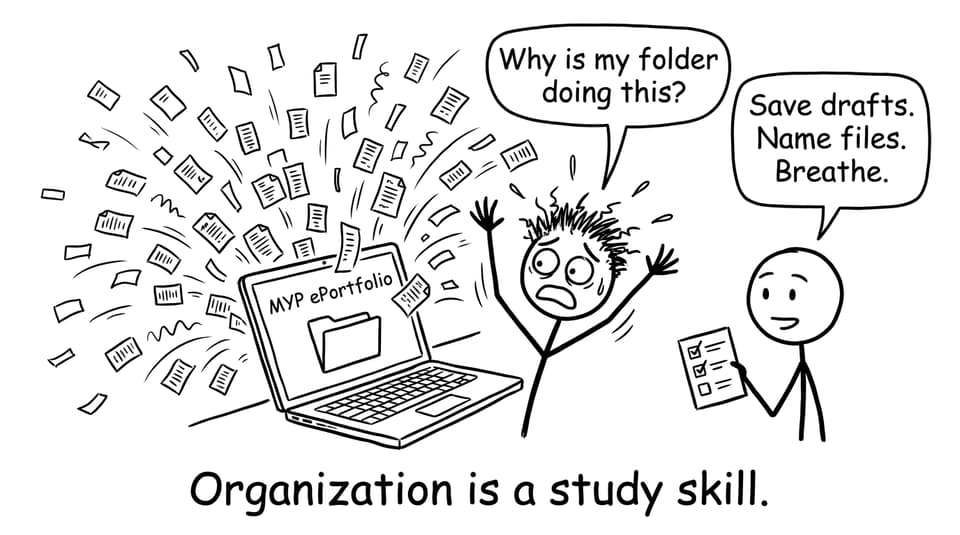
One capture session (15 minutes): file your evidence (drafts, photos, screenshots) into labeled folders.
-
One improvement session (30--45 minutes): revise one element based on criteria.
-
One reflection session (20 minutes): write a short, honest paragraph while it’s still fresh.
That’s it. Boring on purpose.
And for your wider MYP exam schedule, these guides help you structure revision without chaos:
Common MYP ePortfolio mistakes (and what to do instead)
Leaving reflection until the end
End-of-year reflection tends to become vague because you can’t remember the decision-making moments.
Do this instead: write tiny reflections immediately after milestones. In MYP, small and frequent beats epic and last-minute.
Only documenting the final product
A polished final output can still score lower if the process is invisible.
Do this instead: photograph drafts, annotate screenshots, keep short notes that explain what changed and why.
Treating criteria as a formality
If you build first and read the rubric later, you often discover you built the wrong evidence.
Do this instead: map each part of your portfolio to Criteria A--D early. If you want rubric-aligned feedback on writing and coursework structure, explore the IB Coursework Grader.
How RevisionDojo helps MYP students prepare
The best study platforms don’t just give you more content. They reduce decision fatigue.
RevisionDojo supports MYP students through the full loop:
-
Questionbank for targeted practice so exams feel predictable
-
Study Notes for fast, syllabus-aligned clarity
-
Flashcards for daily recall that stays light but consistent
-
AI Chat when you’re stuck and don’t want to spiral
-
Grading tools to align your work to criteria language
-
Predicted Papers and Mock Exams to rehearse timing and pressure
-
Coursework Library for models of what strong work looks like
-
Tutors when you want a human to diagnose what’s holding you back
If you’re balancing ePortfolio work with tests, it helps to keep your whole system in one place: start at the RevisionDojo home page and then anchor your plan in the Middle Years Programme (MYP) hub.
FAQ
Is the MYP ePortfolio easier than exams?
It’s easier in one way and harder in another. The MYP ePortfolio usually gives you more time, which reduces the pressure of a single sitting. But time can also create procrastination, and procrastination becomes stress. The difficulty is not the task itself, but sustaining organization and reflection over weeks. If you treat your MYP ePortfolio like a weekly routine, most students find it manageable. If you treat it like a deadline to survive, it becomes emotionally heavier than an exam.
What do examiners actually look for in an MYP ePortfolio?
Examiners are trained to mark against criteria, so they look for evidence that clearly matches what the rubric rewards. In the MYP, this means they value process: development, decision-making, iteration, and evaluation. They also look for clear communication, because unclear evidence is almost the same as missing evidence. Another big factor is reflection that explains not just what you did, but why you did it and what changed because of feedback or testing. If your portfolio makes the examiner hunt, you lose marks through friction. If your portfolio guides the examiner, you gain marks through clarity.
How do I prepare for MYP ePortfolios while studying for on-screen assessments?
Start by accepting that both are part of the same MYP goal: showing learning in different formats. Then split your week so the ePortfolio stays alive in small doses, while exams get the deeper blocks. A practical approach is one short ePortfolio session for documentation and reflection, plus separate exam sessions driven by questions. Use RevisionDojo’s Study Notes to refresh a concept quickly, then use the Questionbank to practice applying it under exam-style conditions. Keep Flashcards running daily so your memory doesn’t decay while you’re building coursework. When pressure rises, use AI Chat to unblock confusion fast rather than losing an hour.
Final thoughts: make your MYP ePortfolio a story with evidence
The MYP ePortfolio is not a digital scrapbook. It’s a controlled narrative: you had a goal, you made choices, you improved, and you can prove it.
If you want the most reliable way to feel prepared, build a simple feedback loop: draft, document, reflect, check against criteria, repeat. And when you need structure across both MYP ePortfolios and exams, RevisionDojo gives you the full toolkit -- Questionbank, Study Notes, Flashcards, AI Chat, Grading tools, Predicted Papers, Mock Exams, Coursework Library, and Tutors -- so your preparation feels steady instead of frantic.
Keep your folders tidy. Keep your reflections honest. Keep your MYP evidence visible. Then submit with calm confidence.
