
In the MYP, interdisciplinary learning can feel like the moment a teacher says, “Combine Science and Humanities,” and your brain answers, “Sure… but how do I get graded?”
That confusion is normal. Interdisciplinary tasks in the MYP ask you to do something school rarely trains explicitly: hold two subject lenses at once, then prove you used both to build a sharper answer than either subject could produce alone. The good news is that the MYP makes this assessable with a clear rubric. Once you understand what the criteria are really rewarding, you can prepare for interdisciplinary assessments the same way you prep for any exam: practise the skill, collect evidence, and tighten your method.
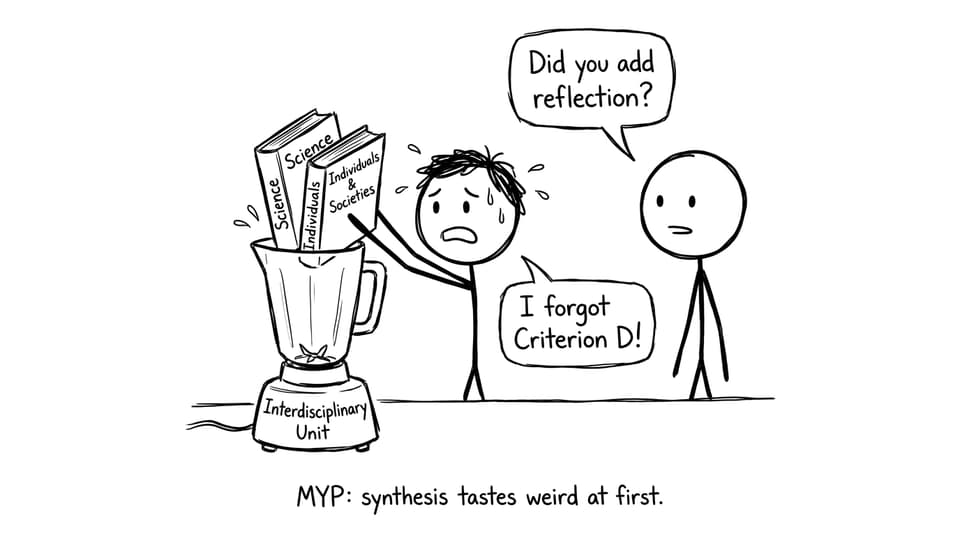
A quick MYP checklist for interdisciplinary success
Use this before you start any MYP interdisciplinary task (or revise one):
-
Identify the two (or more) subject groups involved, and list 2 key concepts from each.
-
Write one sentence finishing: “These subjects connect because…” (this forces integration).
-
Plan your response so each paragraph or section does a job for the criteria.
-
Include explicit synthesis phrases: “Taken together…”, “This suggests…”, “A tension between…”.
-
Save 5–10% of your word count or time for reflection (Criterion D).
If you want a broader revision routine around this, the MYP planning approach in MYP eAssessments: 30-Day Study Plan That Works helps you turn skills like synthesis into repeatable practice blocks.
What interdisciplinary learning means in MYP (in exam terms)
In the MYP, interdisciplinary learning isn’t “two subjects in one slideshow.” It’s evidence that you can:
-
use disciplinary knowledge accurately,
-
connect ideas across disciplines,
-
communicate a coherent outcome,
-
and reflect on what the interdisciplinary approach changed in your thinking.
That last part matters more than students expect. Interdisciplinary work is not only about the final product. It is also about making your reasoning visible.
For a bigger picture of how grading works across the programme, see How Are IB MYP Students Graded? Criteria Explained.
How interdisciplinary learning is assessed in MYP: the four criteria
Interdisciplinary assessment in the MYP is marked using four criteria (A--D). Each is scored on a 0–8 scale, for a total out of 32, which is then converted to the familiar 1–7 grade.
You’ll see the same pattern repeated across the programme: clear descriptors, evidence-based judgement, and rewards for thinking rather than memorising.
If you want a coordinator-style overview of task design (still useful for students because it clarifies what strong evidence looks like), read Assessing Interdisciplinary Learning in the MYP.
Criterion A: Disciplinary grounding (prove you know both subjects)
Criterion A is where many students accidentally underperform. In MYP interdisciplinary tasks, you must show you can stand firmly in each discipline involved. That means correct subject terminology, accurate methods, and relevant content knowledge.
A simple self-check: could a subject teacher from each discipline read your work and say, “Yes, this is valid in my subject”? If one teacher would say “This is vague,” you are leaking marks.
A practical way to strengthen grounding is to revise each subject with targeted practice. RevisionDojo’s Study Notes can help you refresh the key concepts quickly: Study Notes.
Criterion B: Synthesizing (the heart of MYP interdisciplinary work)
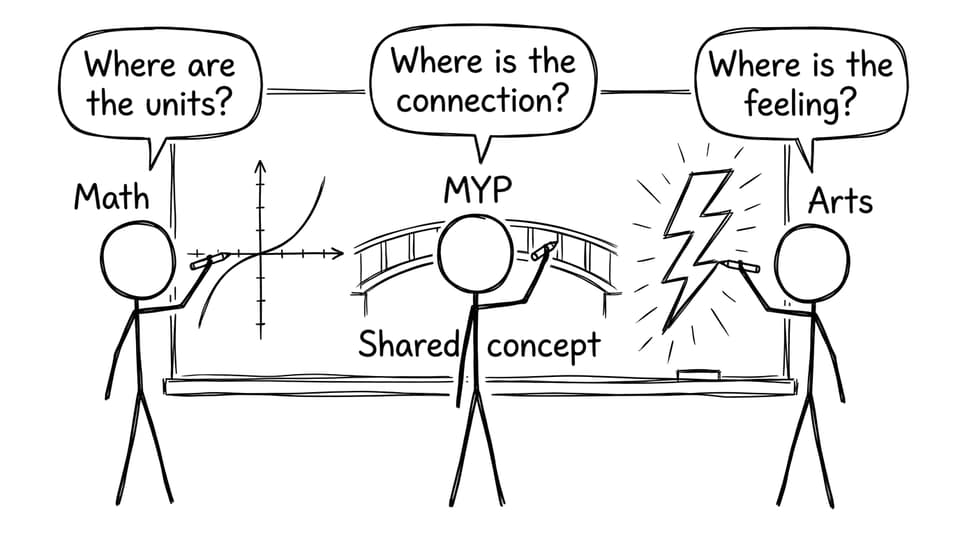
Criterion B is the difference between “parallel” and “interdisciplinary.” In the MYP, synthesizing means you combine perspectives to generate an insight, solution, or interpretation you couldn’t reach with only one subject.
What synthesis looks like on the page:
-
a shared concept (systems, change, sustainability, identity) used to connect both subjects,
-
a clear comparison that leads to a new claim,
-
a decision justified using evidence from both disciplines,
-
or a model that explains trade-offs across perspectives.
If you struggle to create that “new claim,” practise with structured prompts. Sample MYP Assessment Tasks for Every Subject Group is useful because it trains you to read tasks through the lens of criteria.
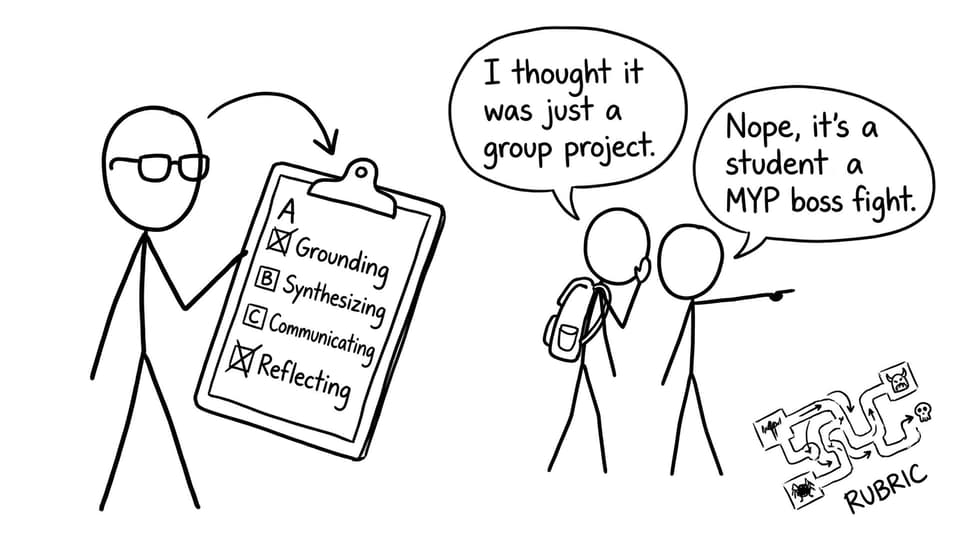
Criterion C: Communicating (make the integration readable)
In the MYP, clear communication is not “nice writing.” It is structure, signposting, appropriate format, and correct disciplinary language.
High-scoring interdisciplinary communication often includes:
-
headings that mirror the criteria or the logic of your argument,
-
short topic sentences that show how the disciplines connect,
-
visuals used as evidence (charts, diagrams, annotated data),
-
and a conclusion that restates the interdisciplinary insight, not just the topic.
If your interdisciplinary task involves Individuals and Societies, it can help to learn how criteria-based writing works in that subject specifically. See MYP Individuals & Societies Criteria Explained.
Criterion D: Reflecting (don’t summarise--evaluate)
Criterion D is where students either gain easy marks or lose them quietly. In the MYP, reflection is assessed. That means you are not writing “what I did.” You are writing what worked, what didn’t, why, and what the interdisciplinary approach changed.
Strong reflection includes:
-
what each discipline contributed (and what it couldn’t answer alone),
-
limitations of your evidence or method,
-
challenges in integrating ideas,
-
and specific next steps if you repeated the task.
If you want a strong model for reflection language and structure, the Personal Project resources transfer well to interdisciplinary tasks because they train evidence-based reflection. Start with MYP: How to Get a 7 in the Personal Project and, if you need structure, MYP Personal Project Report Structure Explained.
What MYP markers are really looking for (and what they ignore)
Think of MYP interdisciplinary marking as a search for proof.
Markers reward:
-
explicit links between disciplines (not implied ones),
-
decisions justified with evidence from both subjects,
-
clear use of key concepts and relevant terminology,
-
and reflection that evaluates the interdisciplinary approach.
Markers tend to ignore:
-
long background sections that don’t answer the task,
-
“two mini-essays glued together,”
-
impressive formatting without clear reasoning,
-
and reflection that is only feelings, not analysis.
If you’re dealing with stress or mental overload while preparing, Dealing with MYP Assessment Stress: Student Wellness Tips is a good reminder that consistency beats panic in the MYP.
A simple example of an MYP interdisciplinary assessment
Imagine an MYP unit on food security combining Sciences + Individuals and Societies:
-
Criterion A: accurate ecosystem science + accurate economic or policy understanding.
-
Criterion B: a plan that balances environmental limits with economic incentives.
-
Criterion C: a proposal with clear structure, data visuals, and correct terminology.
-
Criterion D: reflection on trade-offs, limitations, and how integrating disciplines changed the recommendation.
Notice what makes it interdisciplinary: the recommendation is shaped by both lenses, and the trade-off is addressed directly.
How to practise MYP interdisciplinary skills with RevisionDojo
The fastest way to improve in the MYP is to practise what gets assessed, then tighten your feedback loop.
A practical RevisionDojo routine looks like this:
-
Use Study Notes to rebuild grounding quickly: Study Notes
-
Drill the skill with Questionbank prompts (especially explain/analyse/evaluate): start from the Middle Years Program (MYP) hub
-
Use AI Chat to challenge your synthesis: ask it to identify missing links or propose a stronger interdisciplinary claim
-
Use Grading tools to check whether your response actually meets the criterion language
-
Build Flashcards for command terms, key concepts, and synthesis sentence starters
-
When you need realism, use Mock Exams and Predicted Papers to practise timing and stamina
-
For modelling strong work, use the Coursework Library (especially for reflection patterns)
-
If your bottleneck is strategy, not effort, book time with Tutors
For exam technique and digital readiness, Tips for Success in MYP eAssessments pairs well with interdisciplinary prep.
Closing: treat MYP interdisciplinary assessment like a skill, not a surprise
Interdisciplinary learning in the MYP is assessed in a way that’s stricter than it first appears--and that’s why it’s fair. The criteria tell you exactly what to practise: grounding, synthesizing, communicating, reflecting. When you train those skills deliberately, interdisciplinary tasks stop feeling like guesswork and start feeling like a method.
If you want that method in one place, build your routine on RevisionDojo: practise with the Questionbank, clarify concepts with Study Notes, lock in language with Flashcards, pressure-test with Mock Exams and Predicted Papers, refine with AI Chat and Grading tools, and model great work through the Coursework Library. That’s how MYP preparation becomes calm, repeatable, and score-focused--without losing the bigger point of interdisciplinary learning: seeing the world as connected.
