

The best way to prepare for MYP exams the night before is not to reread every chapter or stay awake until exhaustion wins. It is to identify the few things most likely to improve tomorrow's performance, practise retrieving and applying them, then stop early enough to sleep properly.
This matters because MYP assessment generally rewards more than stored facts. Students may need to analyse, justify, investigate, communicate, or apply knowledge in an unfamiliar context. A final-night plan should prepare you to use what you know, not simply recognise it on a page.
Allow about two focused hours and gather your teacher's guidance, relevant notes, a small set of questions, and somewhere to record mistakes.
Your night-before MYP checklist
Use this checklist before you start:
- Confirm the subject, start time, location, and permitted equipment
- Check which topics and assessment criteria are relevant
- Select three weak or high-priority areas
- Complete one short, mixed practice set
- Review errors rather than counting your score
- Create a one-page morning sheet
- Pack your materials and set alarms
- Finish studying at a fixed time and sleep
The best way to prepare for MYP exams the night before
Begin with a ten-minute exam audit
Write down tomorrow's topics, question types, command terms, duration, and criteria. Use information supplied by your teacher or school rather than guessing from an unrelated resource.
Remember that “MYP exam” can mean different things. Many assessments are created and marked by schools, while IB MYP eAssessment is an optional external route for participating schools. Your teacher's instructions are therefore the final authority.
Next, divide the relevant content into three columns:
| Confidence level | What to do tonight |
|---|---|
| Secure | Leave it alone unless it appears in mixed practice |
| Uncertain | Test it briefly and review errors |
| Weak but important | Give it one focused study block |
Choose no more than three priorities. A narrow plan that gets completed is more useful than a heroic plan that collapses at midnight. For future assessments, save the MYP Revision Guide and 30-Day MYP eAssessment Study Plan.
Run a 25-minute closed-book recall block
Close your notes. For each priority topic, write or say everything you can remember: definitions, formulas, processes, examples, diagrams, or argument structures. Then compare your attempt with a reliable source and fill only the meaningful gaps.
This is active recall. It feels harder than rereading because it exposes uncertainty. Familiar-looking material does not prove that you can reproduce or apply it tomorrow.
Use RevisionDojo's MYP resources to find focused Study Notes and Flashcards. Flashcards suit terms, formulas, and short processes; Study Notes help clarify misconceptions.
Do not turn this block into note decoration. Your goal is to retrieve, check, and correct.
Complete a 35-minute application block
Answer a small set of mixed questions without notes. Include different actions, such as defining, calculating, analysing, explaining, evaluating, or justifying. A compact set completed seriously is better than dozens of rushed answers.
For each question:
- Circle or rewrite the command term.
- Decide what the question is asking you to produce.
- Answer under a realistic time limit.
- Check the method, reasoning, and communication.
- Write one correction beginning with “Next time, I will...”
The MYP eAssessment success guide explains how command terms, unfamiliar contexts, digital habits, and pacing fit together.
RevisionDojo's Questionbank makes practice more deliberate. Use Grading tools for criterion-aligned feedback, or ask AI Chat for a hint before trying again independently. The tool should reduce dependence, not replace thinking.
Build a ten-minute error list
Your mistakes are now the most valuable material on your desk. Sort them into three types:
- Knowledge gap: You did not know a fact, formula, or concept.
- Method gap: You knew the content but chose the wrong process.
- Communication gap: Your reasoning was incomplete, unclear, or mismatched to the command term.
Fix each error once. For a knowledge gap, make one flashcard. For a method gap, redo one similar question. For a communication gap, rewrite only the weak sentence or step.
Subject-specific advice can help you recognise these patterns. Explore MYP Mathematics study techniques, MYP Sciences revision, and MYP Language and Literature revision to see how practice changes across disciplines.
Make a one-page morning sheet
Spend ten minutes creating a page you can review briefly in the morning. Include only:
- Three essential concepts or processes
- Five easily forgotten facts, terms, or formulas
- Two recurring mistakes
- Two command terms and what they require
- One reminder about pacing or checking
Do not squeeze an entire course onto the page. Its purpose is to cue memory and calm your attention, not become a miniature textbook.
If you remain uncertain, explain one difficult idea aloud. Consult Study Notes or AI Chat when you find a gap, then close the explanation and teach it again from memory.
MYP revision techniques to avoid tonight
Several activities feel productive while producing little evidence of readiness:
- Rereading whole chapters from the beginning
- Highlighting information without testing yourself
- Copying polished model answers word for word
- Attempting a full Mock Exam too late to review it
- Learning several completely new units
- Comparing your preparation with classmates online
- Continuing after fatigue has made your work careless
Predicted Papers and Mock Exams are more useful when there is time to analyse weaknesses. Tonight, choose a short section or a few representative questions instead of starting a long simulation.
The Coursework Library and Tutors can reveal quality and persistent weaknesses, but the final night is for compact corrections. RevisionDojo brings these resources together, helping you move from clarification to practice and feedback without switching between disconnected platforms.
Protect sleep as part of your preparation
Set a stopping time before you begin. Research has consistently found that sleep loss can harm memory performance, while sleep supports the attention and recall needed to interpret unfamiliar questions.
Sleep cannot rescue a semester without study. It simply means sacrificing rest for low-quality rereading is usually a poor final trade.
During your last 30 minutes, pack permitted equipment, charge your device, check travel arrangements, and set two alarms. Your aim is not a perfect evening. It is a calm handover from preparation to performance.
What to do on the morning of the exam
Review your one-page sheet for five to ten minutes, then put it away. Eat and drink as you normally would. Arrive with enough time to settle, but avoid frantic discussions about obscure topics.
When the exam begins, read command terms carefully and budget time before writing. If one question stalls you, record what you can, move forward, and return later if permitted. The guide to MYP evaluation and reporting can help you understand how criteria translate into concrete actions.
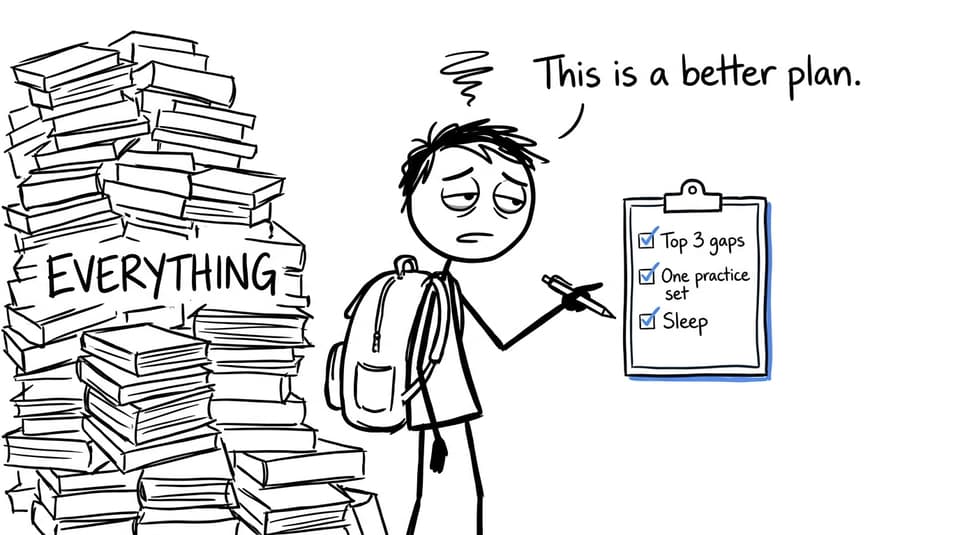
The final night cannot create months of learning. But it can organise what is already there. Choose three gaps, retrieve from memory, apply your knowledge, correct the errors, and sleep. Then let RevisionDojo's Questionbank, Study Notes, Flashcards, AI Chat, Grading tools, Predicted Papers, Mock Exams, Coursework Library, and Tutors help you build a steadier routine before the next assessment.