
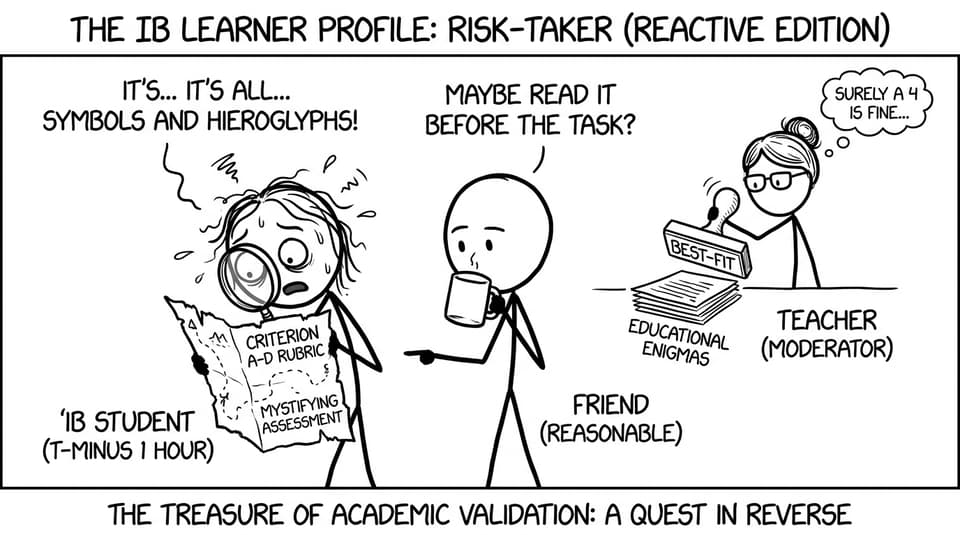
You can usually tell who understands the MYP by the way they react to a rubric.
One student sees a grid of boxes and thinks, “How am I meant to decode this?” Another sees a map: If I do these specific things, I can predict my result and improve it. That second reaction is the real purpose of evaluation and reporting in the MYP. It’s not about ranking you. It’s about making progress visible.
For IB students preparing for exams, this matters more than it first appears. The habits you build in MYP evaluation: reading criteria, using feedback, tracking skill growth; are the same habits that quietly separate calm exam-takers from stressed crammers.
If you want a good starting point for the bigger picture, begin at the Middle Years Program (MYP) hub.
Quick checklist: MYP evaluation that actually helps you
Use this as your personal “report card translator” for any MYP unit:
-
Identify which MYP criteria (AtoD) the task is targeting
-
Translate the rubric into a 3-point “do this” plan before you start
-
Collect feedback early (formative) so you can still change the work
-
Use the best-fit idea: aim for the band descriptor, not perfection in every line
-
When reporting comes back, write one next step per criterion (not one vague goal)
For more practice on turning tasks into criteria-first plans, see Sample MYP Assessment Tasks for Every Subject Group.
How MYP criterion-related assessment works (and why it’s calmer than percentages)
The MYP uses criterion-related assessment. That means you’re measured against clear standards, not compared to your classmates. In most subjects, you’ll see four criteria (AtoD), each scored on a 0-8 scale, and then combined into an overall MYP grade on a 1-7 scale.
Two details make this powerful for exam prep:
-
You can improve one skill at a time (like communication or analysis) without feeling like everything is “one big grade.”
-
You can predict what higher performance looks like because the descriptors tell you.
If you want the cleanest breakdown of the mechanics, use How Are IB MYP Students Graded? Criteria Explained. For a subject-specific example, MYP Math: Criterion A, B, C, D Explained Simply shows how criteria reward thinking, not just answers.
The best practice most students miss: build a feedback loop, not a folder
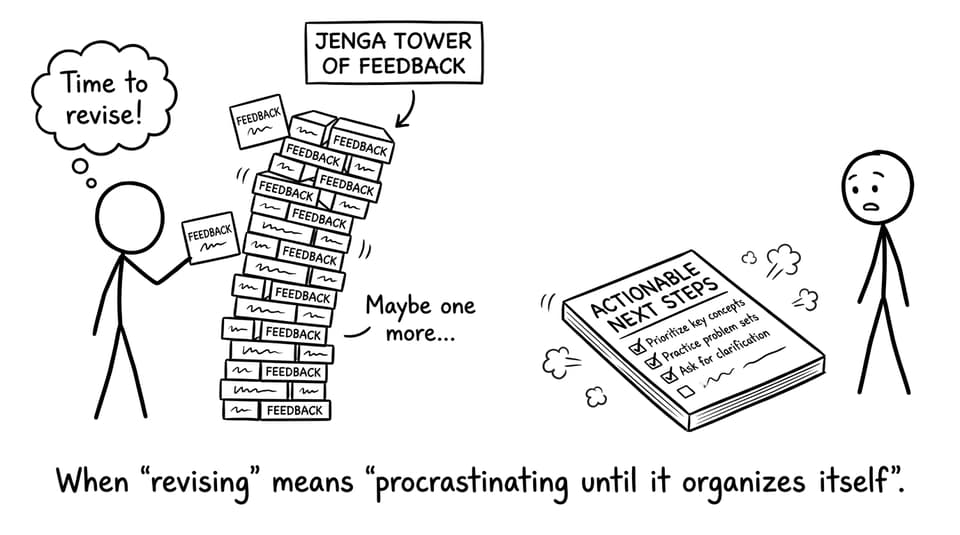
A quiet truth about the MYP is that formative work isn’t “extra.” It’s the rehearsal that makes summative performance predictable.
Here’s a simple loop that works across subjects:
-
Draft something small fast (an intro paragraph, a data table, a thesis plan).
-
Get targeted feedback (teacher, peer, or a rubric tool).
-
Rewrite only the part linked to the criterion.
-
Repeat once.
That’s what “growth” looks like in MYP terms: not doing more work, but doing the next right revision.
On RevisionDojo, students often build this loop using:
-
Study Notes to clarify concepts quickly when feedback reveals a knowledge gap
-
Flashcards to lock in command terms and criterion language (so your writing matches what’s rewarded)
-
AI Chat to ask, “What would Criterion C expect me to add here?” and get unstuck fast
-
Grading tools for rubric-aligned feedback on drafts
-
Questionbank to practise the exact skills that rubrics reward: explanation, method, justification
If you’re juggling exam prep alongside projects, the routines in MYP Revision Guide: Study Tips for Success are a good anchor.
Reporting in the MYP: what a strong report actually communicates
In the MYP, reporting is supposed to explain your learning, not just label it. A high-quality report usually includes:
-
Criterion achievement levels (AtoD)
-
The overall MYP 1-7 grade derived from the criteria
-
Specific comments on strengths and next steps
-
Evidence of skill growth, often linked to ATL (Approaches to Learning)
The best reports do one subtle thing: they make your next unit easier. When reporting is clear, you can walk into the next assessment already knowing what to keep and what to fix.
If you want to connect reporting to the skills schools track long-term, read Linking ATL Skills to Conceptual Understanding in the MYP.
Student-friendly evaluation strategies (you can use this week)
These are MYP best practices you can control, even if you can’t control the task:
Rewrite the rubric in plain language before you start
Take each criterion strand and write one sentence: “To score 7-8, I must…” This turns evaluation into a checklist, not a mystery.
Track one criterion like it’s your training plan
Choose the criterion you usually lose marks on. For one unit, make every revision session about that one skill. This is how MYP growth becomes visible.
Collect proof, not vibes
Especially in tasks like investigations, designs, or projects, keep artifacts: drafts, screenshots, data, reflections. Reporting gets easier when your learning leaves footprints.
If you’re working on bigger cycle-based work, the evidence mindset in Writing an Outstanding MYP Personal Project Report is worth borrowing even for smaller assignments.
Closing: make MYP reporting work for you, not on you
When evaluation and reporting feel stressful in the MYP, it’s usually because the system is being treated like a judgment instead of a guide. But the moment you start reading criteria as instructions, reporting becomes something else: a progress dashboard.
If you’re preparing for exams, treat each MYP report as a training log. Use it to decide what to practise next, then build a simple loop: Study Notes for clarity, Flashcards for recall, Questionbank for application, AI Chat for quick fixes, and Grading tools for rubric-aligned feedback. Add Mock Exams and Predicted Papers when available, and use Tutors when you need a human to spot the pattern you can’t see yet.
To keep exploring skill-focused strategies across the programme, browse All #MYP Posts and build your next unit around what the MYP actually rewards.