


The best MYP resources for the Personal Project are not necessarily the websites with the most material. They are the resources that solve a particular problem at the right moment.
Start with your school's current Personal Project handbook and supervisor because they define your deadlines, required evidence, submission process, and local expectations. Then use RevisionDojo for Personal Project guidance, examples, and rubric-focused draft feedback. Add library databases for credible research, a reliable digital workspace for documentation, and a citation manager if your source list becomes difficult to control.
The short ranked shortlist
| Rank | Resource | Best use | Honest reason for the pick |
|---|---|---|---|
| 1 | School handbook and supervisor | Official requirements | Your school controls deadlines and implementation details, while your supervisor provides authorized guidance and feedback. |
| 2 | RevisionDojo | Project guidance, examples, and draft feedback | It brings dedicated MYP Personal Project support into one place, although it does not replace official instructions or human judgment. |
| 3 | School library and academic databases | Credible research | Librarian-selected databases are usually more dependable than an open web search, but access varies by school. |
| 4 | Google Drive or Microsoft 365 | Planning and evidence management | Version history, folders, spreadsheets, and cloud storage make the process visible, though the student must create a sensible system. |
| 5 | Zotero | Citation and source management | It can save time and reduce missing source details, but generated citations still need to be checked against school rules. |
This ranking reflects usefulness across the whole project, not the amount of content each service offers.
What the Personal Project actually requires
The current IB framework describes the Personal Project as a process, a product or outcome, and a reflective report. It formally assesses Approaches to Learning skills, including research, self-management, communication, and critical and creative thinking.
The current assessment model uses three equally weighted criteria, each marked out of eight:
- Criterion A: Planning asks students to explain a learning goal and its connection to personal interest, establish an intended product and suitable success criteria, and present a detailed plan.
- Criterion B: Applying skills asks students to explain how ATL skills helped them pursue the learning goal and create the product.
- Criterion C: Reflecting asks students to explain the project's impact on their learning and evaluate the product against the success criteria.
Some older online guides still describe four criteria. That is precisely why your current school handbook comes first. Report format, documentation systems, meeting schedules, citation conventions, and internal deadlines can also differ between schools.
Before using any collection of MYP study resources, ask four questions:
- Is this guidance based on the current framework?
- Does it help with my exact stage of the project?
- Will it strengthen my own thinking rather than substitute for it?
- Can I confirm important requirements with my supervisor?
Why the school handbook and supervisor rank first
A search engine can produce an answer in seconds. It cannot know that your school wants a particular file name, schedules a checkpoint next Thursday, or requires evidence to be uploaded through a specific platform.
Treat the school handbook as the operating manual. Extract all deadlines, required meetings, submission components, formatting rules, and academic integrity expectations into one checklist. If the handbook and a website disagree, ask your supervisor before acting.
Supervisors are especially valuable at decision points: narrowing an ambitious goal, checking whether success criteria are measurable, deciding whether proposed research is appropriate, and identifying gaps in the evidence.
Where RevisionDojo fits among MYP revision websites
RevisionDojo ranks second because it offers a connected Personal Project workflow rather than a loose collection of generic productivity advice. Students can begin with the complete MYP Personal Project guide, explore the broader MYP resource hub, and move toward examples and criterion-focused feedback as the project develops.
That strength also defines its proper role. RevisionDojo is a support platform, not the body setting your school's requirements. Its guidance should help you interpret your work, notice missing explanations, and prepare better questions for your supervisor.
Planning a viable project
A compelling idea can still become an unmanageable project. The guide to choosing a meaningful Personal Project topic helps students test personal interest, scope, evidence potential, and feasibility. Students who need concrete possibilities can also review Personal Project ideas with measurable outcomes.
Use these resources to generate questions, not to select a ready-made identity. A good topic fits the student's genuine curiosity, available time, access to materials, and ability to collect evidence.
Understanding examples without copying
RevisionDojo's MYP Personal Project examples can show how other students organize explanations, integrate evidence, and move from description to evaluation. This Coursework Library is most useful when students compare structural choices rather than borrow language or ideas.
Your report must remain an authentic account of your decisions. Examples should reveal possible structures, not supply experiences, ideas, or sentences to reproduce.
Checking a draft against the rubric
The MYP Personal Project Grader provides structured, criterion-oriented feedback. Use it after drafting a section, while there is still time to revise. A sensible loop is to submit your own writing, inspect the comments, return to your evidence, improve the explanation, and verify uncertain interpretations with your supervisor.
AI Chat can also help students clarify terminology, challenge vague success criteria, or identify questions a reader may still have. It should act like a questioning partner, not a ghostwriter. The strongest final report contains details only the student could know because the student actually made the decisions.
The best research and organization tools
The Personal Project may involve learning nutrition, animation, engineering, local history, music production, or almost anything else. No single MYP platform can supply authoritative subject research for every possible goal.
Start with the school library. A librarian can help locate books, journals, databases, credible organizations, and age-appropriate sources. When searching the open web, investigate the author's expertise, publication date, evidence, purpose, and potential conflicts of interest. Record why a source was trustworthy and how it changed a project decision. A bibliography proves that a source existed; analysis shows that research mattered.
For organization, create one cloud folder with clear subfolders:
- official guidance and meeting notes
- research and source records
- plans and success criteria
- drafts and prototypes
- testing and feedback
- dated process evidence
- report versions
Use a spreadsheet or task board for milestones, dependencies, and revised dates. Preserve early versions rather than overwriting everything. A failed prototype, annotated draft, or changed timeline can become valuable evidence of applying ATL skills.
Zotero is useful when a project draws on many sources. Save complete publication details as soon as a source is found, attach notes, and tag sources by research question. Students must still check every generated reference against the citation style required by their school.
Match each resource to a project stage
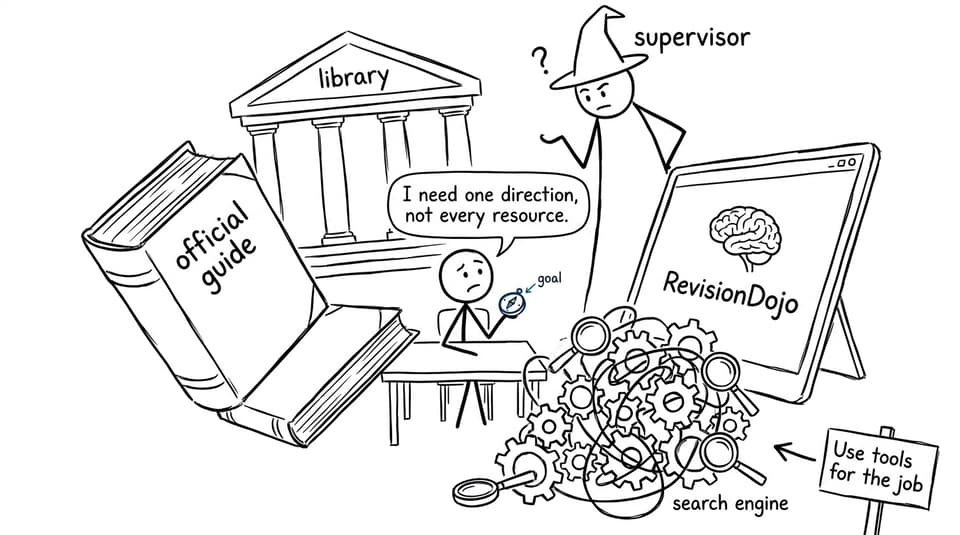
Resource overload often looks like productivity. A student opens six MYP revision websites, watches three tutorials, and ends the evening with more tabs but no stronger project. Progress comes from matching one tool to one decision.
| Project stage | Best resource combination | Useful output |
|---|---|---|
| Understanding requirements | School handbook, supervisor, RevisionDojo guide | A submission checklist and question list |
| Choosing a goal | Interest inventory, RevisionDojo topic guidance, supervisor | A focused learning goal and feasible product |
| Planning | Calendar, spreadsheet, school rubric | Milestones, success criteria, risks, and evidence plan |
| Researching | Library databases, credible organizations, Zotero | Evaluated sources and decision notes |
| Creating | Product-specific tools and cloud storage | Dated drafts, prototypes, tests, and revisions |
| Writing | Own evidence bank, examples, report guidance | Criterion-aligned explanations in the student's voice |
| Revising | Supervisor feedback and RevisionDojo Grader | Clearer reasoning and supported evaluation |
RevisionDojo's Personal Project report-writing guide is particularly useful near the writing stage. Do not wait until the end to discover what evidence the report needs. Read the requirements early, then gather evidence while the work is happening.
How parents can support without taking over
Parents are most helpful as architects of conditions, not authors of content. They can protect regular work time, help obtain reasonable materials, discuss safety, encourage backup plans, and ask the student to explain the next milestone. They can also use this guidance for supporting the MYP Personal Project.
A useful weekly conversation has three questions: What did you decide? What evidence did you save? What will you do next? These questions preserve student ownership while making avoidance harder.
Parents should resist rewriting report sections or designing the product. If a student is stuck, help them draft a message to the supervisor or find an appropriate Tutor. Human support is valuable when it develops independence; it becomes counterproductive when it conceals who did the work.
Build one calm MYP study system
The Personal Project does not happen in isolation. Students still have classes, assessments, activities, and ordinary life. This is where RevisionDojo becomes more than a project website.
Questionbank, Study Notes, and Flashcards can keep subject learning moving in shorter sessions. AI Chat can clarify misconceptions, while Grading tools support structured revision of written work. Predicted Papers and Mock Exams can help with timed preparation where relevant, and Tutors add focused human guidance. The Coursework Library provides models for analysis, but the student's own school requirements remain decisive.
The best system is therefore deliberately small: one official source, one project-support platform, one research pathway, and one organized workspace. Each has a different job. Together, they reduce the temptation to confuse searching with learning.
The Personal Project rewards something quieter than having the largest collection of resources. It rewards a student who can explain why a goal mattered, how choices were made, which skills were applied, what evidence reveals, and what changed through the process.
Begin with the school handbook. Build the project around authentic evidence. Then use RevisionDojo as the ultimate connected IB resource for guidance, examples, feedback, and the wider study workload surrounding the project.