

A high-scoring MYP project starts smaller than you think
The night before your supervisor meeting, you open a blank document and type: "MYP Personal Project Ideas". You don't want an idea. You want a good idea. Something impressive. Something that sounds like it belongs on a university application.
But here's the uncomfortable truth about the MYP Personal Project: the highest-scoring projects rarely begin with genius. They begin with constraints. A narrow goal. A clear audience. A plan that survives real life. Evidence that accumulates. Reflection that tells the truth.
If you're an IB student preparing for exams, you already know how marks work: criteria reward what you can show, not what you meant. The MYP Personal Project is the same. A "cool" product can still score average if the process journal is thin and the evaluation is vague. And an "ordinary" product can score high if the thinking is visible, structured, and honest.
This guide gives you MYP Personal Project ideas that score high, plus the hidden scoring logic behind them, so you can choose an idea that's doable and examiner-friendly.
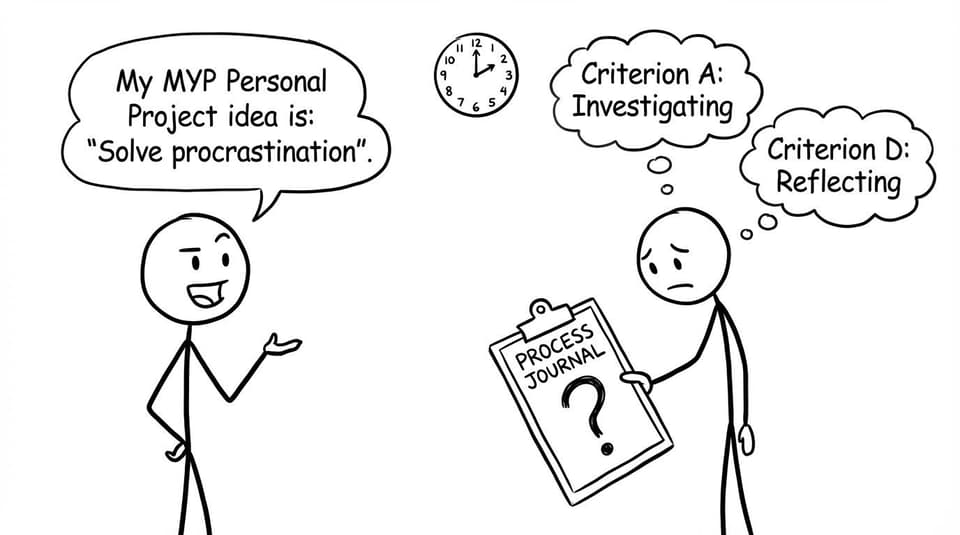
Quick checklist: what high-scoring MYP ideas have in common
Before we brainstorm, run every MYP idea through this checklist. If you can tick most of these, you're on track.
- A measurable goal (someone else can judge success)
- Early success criteria (so Criterion D is easy later)
- A single Global Context you can explain (not just name)
- Room for iteration (drafts, testing, feedback, improvements)
- Evidence you can collect weekly (screenshots, data, photos, notes)
- Reflection that can be proven (what changed because of research/feedback)
If you want a full framework, keep these open while planning:
How examiners actually "see" a MYP Personal Project idea
A useful mental model: your MYP Personal Project idea is not the product. It's the argument you'll be able to make in Criteria A--D.
A high-scoring MYP idea makes it easy to write sentences like:
- "I defined my goal as… and I measured success using…" (Criterion A)
- "My plan changed when… and here's why that was a good decision…" (Criterion B)
- "I created drafts/prototypes, tested them with…, and improved…" (Criterion C)
- "I evaluated my final outcome against success criteria and evidence…" (Criterion D)
That's why some "impressive" ideas underperform. They look big, but they don't naturally produce evidence and evaluation.
To tighten your idea fast, it helps to use a one-sentence goal template:
In the MYP, my goal is to create/do [specific product/outcome] for [specific audience] to address [specific need], connected to [Global Context].
Need help focusing it? Use Middle Years Program (MYP) Resources to ground your language in real MYP terminology and expectations.
MYP Personal Project ideas that score high (with scoring logic)
Below are idea categories that consistently score well because they naturally produce research, planning, evidence, and reflection. For each, you'll see how to make it MYP-friendly.
Skill-to-product ideas (learn something, then teach it)
These work because they create a clean story arc: beginner to capable, with proof.
High-scoring MYP idea examples:
- Create a beginner guitar guide (8--12 pages) and teach 3 peers, using feedback forms to improve the guide.
- Build a study routine workshop for younger students and measure impact through a short pre/post survey.
- Develop a language mini-course (5 lessons) with quizzes and iterate after testing.
How it scores high in MYP:
- Criterion A: research on learning methods, audience needs
- Criterion B: timeline of practice sessions + lesson creation
- Criterion C: drafts of lessons, quiz results, peer feedback
- Criterion D: evaluation using measurable learner outcomes
To strengthen the writing side, follow the structure from MYP Personal Project: Report Writing Breakdown.
Design-and-test ideas (prototype + user feedback)
These are "easy" to score high because iteration is built in.
High-scoring MYP idea examples:
- Design a habit tracker (spreadsheet/app prototype) and test it with 10 students for 2 weeks.
- Create eco-friendly packaging for a school club product and compare material options.
- Build a revision flashcard system for a tough subject unit and measure recall improvement.
How it scores high in MYP:
- You can collect screenshots, versions, and test data weekly.
- You can justify design choices using research.
RevisionDojo tip: use AI Chat (Jojo AI) to generate stronger research questions and clearer success criteria, then practise concise explanations using Study Notes as a model for "tight writing."
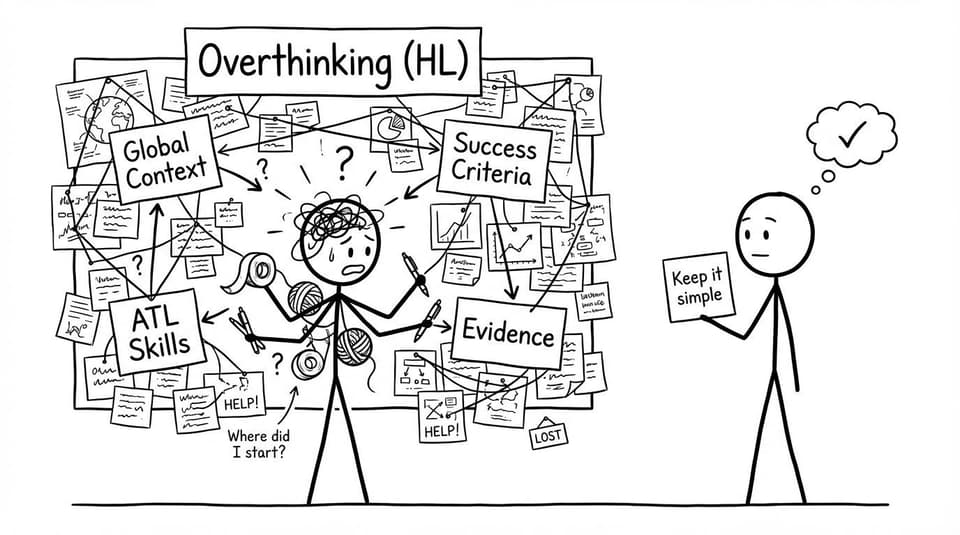
Storytelling ideas (documentary, podcast, photo essay)
These score high when you treat them like research + craft, not just "a creative thing."
High-scoring MYP idea examples:
- Produce a 6--8 minute mini-documentary about local history with at least two interviews.
- Create a 4-episode podcast about student stress and study habits, based on credible research and anonymous survey data.
- Curate a photo essay on sustainability at school with a clear narrative and audience.
How it scores high in MYP:
- Criterion A: research into topic + storytelling techniques
- Criterion C: scripts, edits, rough cuts, feedback, improvements
- Criterion D: audience response data + self-evaluation of communication
Need inspiration? See Real Examples of IB MYP Personal Projects for Inspiration.
Community impact ideas (small, measurable change)
The trap is choosing something too big ("solve plastic pollution"). The win is choosing something you can actually measure.
High-scoring MYP idea examples:
- Run a 2-week campaign to improve recycling in one school area and measure bin contamination before/after.
- Create a peer tutoring micro-program for one topic and track attendance + confidence surveys.
- Design a resource pack for new students (study routines, wellbeing, navigation) and revise it after feedback.
How it scores high in MYP:
- Strong Global Context links.
- Natural evaluation metrics.
If you're also juggling exam prep, it helps to build a system. Use RevisionDojo's Questionbank and Flashcards alongside your project to keep your academic momentum steady, not frantic.
Exam-adjacent ideas (projects that quietly improve your grades)
Yes, your MYP Personal Project can be a strategic advantage for exams if you make the product something you'll genuinely use.
High-scoring MYP idea examples:
- Build a "hardest topics" revision guide for one subject unit, tested on classmates.
- Create a command term toolkit with examples of high-scoring responses.
- Design a mock exam routine (sleep, timing, review method), test it over 4 weeks, and evaluate score changes.
How it scores high in MYP:
- Clear criteria, measurable outcomes, rich reflection.
For broader revision structure, pair this with MYP Revision Guide: Study Tips for Success.
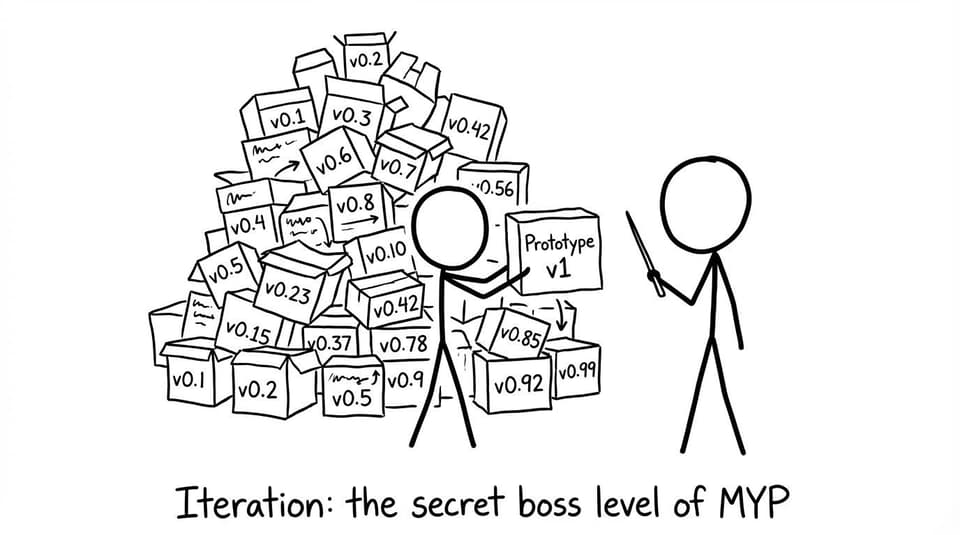
How to turn any MYP idea into a high-scoring goal
Most MYP ideas fail because they're themes, not finish lines. Try this three-step "tightening" method.
Start with "interest"
Write the most natural version:
- "I like fitness."
- "I'm interested in mental health."
- "I enjoy coding."
Add a constraint
Constraints force measurability:
- Time limit (4--6 weeks)
- Audience size (test with 8--12 users)
- Product length (10 pages, 5 episodes)
- Performance metric (accuracy, satisfaction, completion)
Write success criteria early
Create 5--8 checkable statements:
- "Includes X sections…"
- "Tested with X people…"
- "Improved after feedback at least twice…"
- "Explains Global Context connection with specific examples…"
This makes Criterion D almost automatic.
A simple evidence plan (so your MYP process journal writes itself)
High-scoring MYP projects have a boring secret: they save evidence constantly.
Try this weekly routine:
- 1 screenshot/photo of what you worked on
- 1 short note: what changed and why
- 1 data point: time spent, test results, feedback score, or checklist progress
- 1 reflection line naming an ATL skill with a real example
Then, when you write the report, you're assembling a story you already documented.
If you want a deeper breakdown, revisit Writing an Outstanding MYP Personal Project Report.
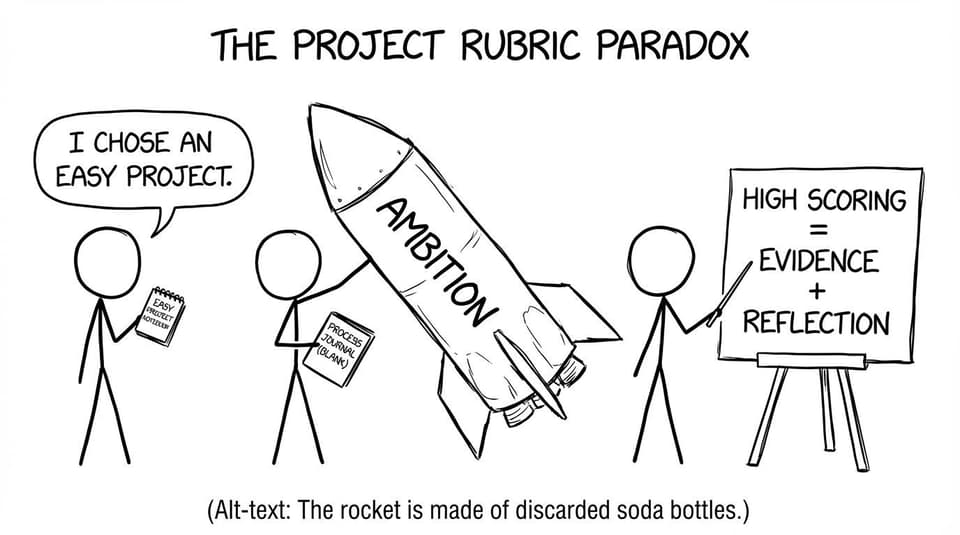
How RevisionDojo helps you score higher in MYP (without adding pressure)
It's easy to treat the MYP Personal Project like it lives in a separate universe from exam preparation. But the skills overlap: command terms, explanation quality, evaluation, and criteria-awareness.
Here's a calm, realistic setup:
- Use Study Notes to keep research explanations clear and short: Study Notes
- Use Flashcards for ATL language, Global Context phrasing, and key definitions you'll need to write precisely.
- Use AI Chat (Jojo AI) to refine your goal, generate success criteria, and improve reflection sentences.
- Use Grading tools to check whether your writing matches rubric expectations before submission.
- When your schedule tightens, use Mock Exams and Predicted Papers to stay exam-ready while your project progresses.
- If you need accountability, use the Tutors feature to get feedback on goal clarity and evaluation depth.
And if you want a hub for your whole MYP journey, start at Middle Years Program (MYP).
Closing: choose a MYP idea you can finish, then prove it happened
The best MYP Personal Project ideas that score high aren't necessarily the most original. They're the ones that create a clean chain of proof: a measurable goal, a realistic plan, visible iteration, and reflection backed by evidence.
Choose a MYP idea small enough to complete, meaningful enough to care about, and structured enough to document. Then let RevisionDojo do what it does best: keep you criteria-aware and exam-ready with Questionbank practice, Study Notes, Flashcards, AI Chat, Grading tools, Predicted Papers, Mock Exams, a Coursework Library, and Tutors. Your project becomes less of a panic and more of a process. And that's usually what high marks look like from the outside.