
The moment you start your MYP Personal Project, you’re handed a rare kind of freedom: choose what matters to you.
And that freedom can feel suspiciously like panic.
Because the best MYP topic isn’t the one that sounds impressive in a hallway conversation. It’s the one you can still care about after the third revision of your success criteria, when your process journal is due, and your other subjects are quietly demanding exam practice. A strong topic doesn’t just help you make a product. It helps you sustain attention long enough to learn something real.
If you’re an IB student balancing exams and coursework, choosing well is a strategy, not a vibe. Let’s make it practical.
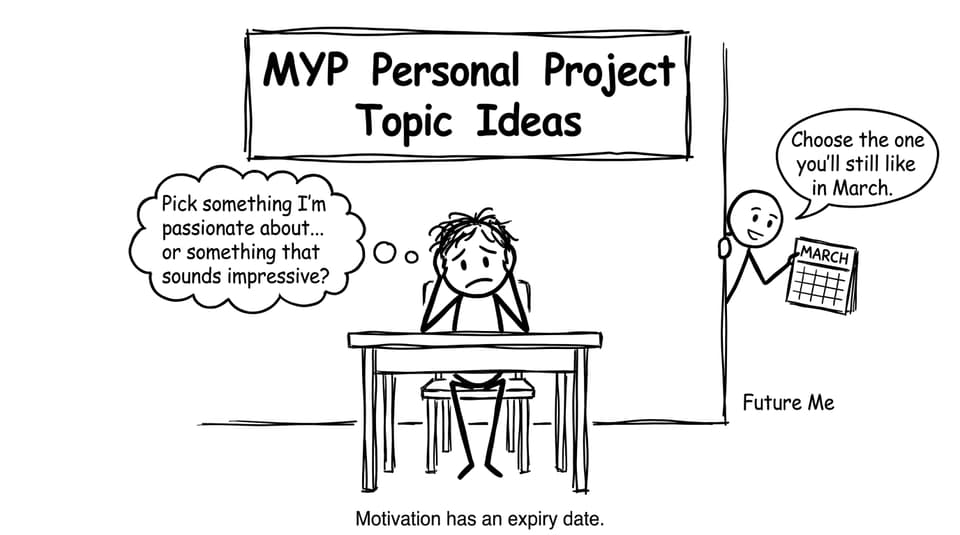
Quick MYP topic checklist (use this before you commit)
Keep this list somewhere visible. If you can answer each point in one or two sentences, your idea is probably strong.
-
Personal pull: Would I still do a smaller version of this if it wasn’t graded?
-
Clear goal: Can I finish “My goal is to…” without adding five extra commas?
-
One Global Context: Can I explain the “why” in a paragraph, not a slogan?
-
Evidence-rich process: Will I naturally create drafts, photos, logs, feedback, or data?
-
Realistic scope: Can I complete it with my time, resources, and energy?
-
Reflection potential: Will I face decisions, mistakes, and trade-offs worth analyzing?
If you want to see what top work looks like, skim a few exemplars first: IB Personal Project (MYP) Examples.
Why passion matters in the MYP Personal Project (and how it helps your exams)
The quiet truth about the MYP Personal Project is that it’s less about talent and more about follow-through. Passion helps, not because it makes you magically productive, but because it lowers the cost of returning to the work.
When you care about the topic, you don’t need heroic motivation to:
-
research properly,
-
document consistently,
-
ask better questions,
-
and write reflections that sound like thinking instead of summary.
That matters for exams too. The habits you build here, including planning, evaluating, using evidence, and staying organized, transfer into revision. If your Personal Project consumes your schedule, you’ll want a revision system that’s efficient. Many students keep their exam rhythm alive by using RevisionDojo’s MYP eAssessments: 30-Day Study Plan That Works alongside project deadlines.
The sweet spot: passion + purpose (not passion alone)
A workable MYP topic usually lives in the overlap between:
What you enjoy
This is the fuel. It can be a hobby, a curiosity, a skill you want, or a problem you keep noticing.
What your project is for
This is the steering wheel. Your purpose turns interest into an inquiry with direction: a need, an audience, a question, or an impact.
If you’re stuck, try these prompts:
-
What do I complain about that I could actually improve?
-
What do I teach my friends without being asked?
-
What would I like to be “quietly good” at by the end of the year?
-
What problem do people around me have that I could help with?
Then pressure-test your idea using a rubric lens. RevisionDojo’s MYP Personal Project Grader is useful here because it forces you to translate “cool idea” into criteria-aligned writing.
Use Global Contexts to sharpen your MYP topic (the “why” paragraph)
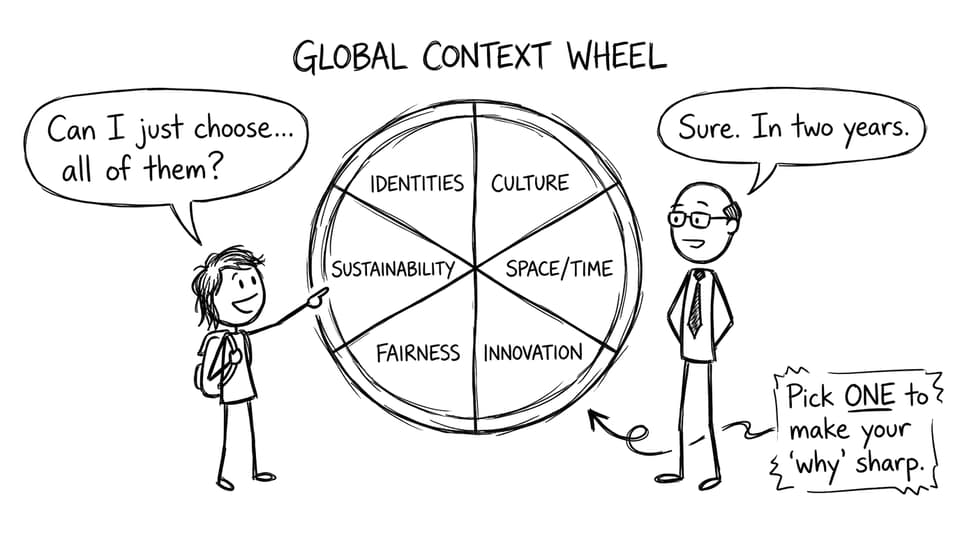
Every MYP Personal Project needs one Global Context, and the smartest move is to pick it early and return to it often. It’s your project’s meaning, not decoration.
Here are the six contexts, with practical angles you can borrow:
-
Identities and Relationships: confidence, wellbeing, community, belonging.
-
Personal and Cultural Expression: art, storytelling, language, identity.
-
Orientation in Space and Time: history, heritage, change over time.
-
Scientific and Technical Innovation: tech solutions, prototypes, systems.
-
Fairness and Development: inequality, access, rights, education.
-
Globalization and Sustainability: consumption, waste, climate, long-term choices.
If you want inspiration that still feels realistic, browse: Real Ideas of IB MYP Personal Projects for Inspiration.
Examples of strong MYP Personal Project topics (with built-in evidence)
Notice how each idea naturally produces proof: drafts, feedback, iterations, testing, or data. That’s what makes report-writing easier later.
Sustainable product with simple iterations
Idea: Design a small line of reusable shopping bags or lunch wraps.
-
Best-fit Global Context: Globalization and Sustainability
-
Evidence you’ll generate: sketches, prototypes, cost comparisons, user feedback
-
Success criteria: durability test, user satisfaction survey, material waste reduction
Teen wellbeing resource (written or multimedia)
Idea: Create a mental health awareness blog, zine, or short guide for students.
-
Best-fit Global Context: Identities and Relationships
-
Evidence you’ll generate: research notes, drafts, peer review comments, revised posts
-
Success criteria: clarity rubric, reader feedback, engagement metrics (even small)
Cultural documentary or photo essay
Idea: Produce a short documentary on cultural diversity at school.
-
Best-fit Global Context: Personal and Cultural Expression
-
Evidence you’ll generate: interview plans, consent forms, script drafts, edits
-
Success criteria: narrative coherence, respectful representation, audience response
Beginner-friendly coding tutorial series
Idea: Build a mini tutorial series that teaches one coding skill to beginners.
-
Best-fit Global Context: Scientific and Technical Innovation
-
Evidence you’ll generate: lesson drafts, test users, bug fixes, updated videos
-
Success criteria: learner quiz results, completion rate, usability feedback
Fundraiser with measurable planning and evaluation
Idea: Organize a small fundraiser for refugee education.
-
Best-fit Global Context: Fairness and Development
-
Evidence you’ll generate: budgets, timelines, promotional drafts, post-event analysis
-
Success criteria: funds raised, attendance, awareness survey before/after
To calibrate what “top band” looks like, comparing your structure to real samples helps: IB Personal Project Examples.
How to keep your MYP topic manageable (so it doesn’t eat your year)
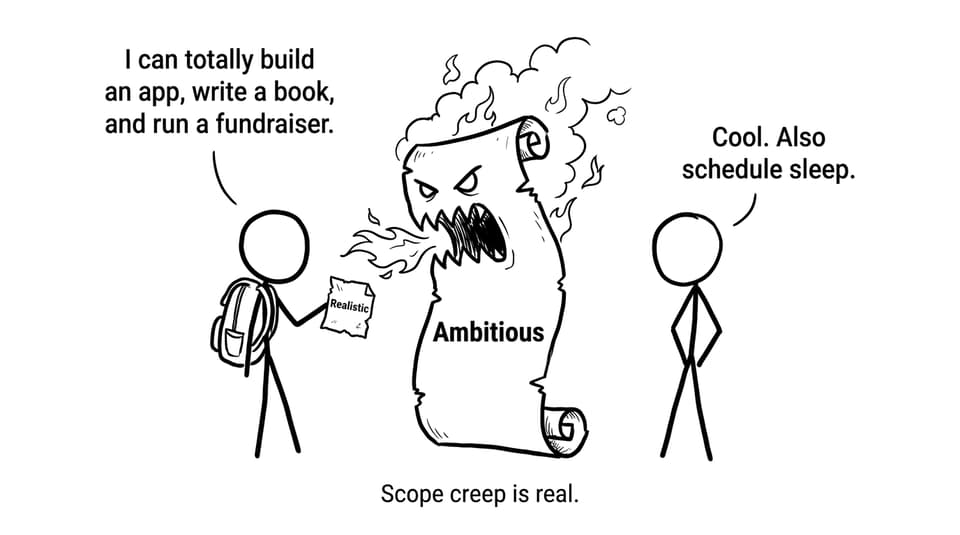
The most common Personal Project failure isn’t lack of effort. It’s a topic that quietly grows until it becomes unfinishable.
A useful rule: Your topic should be small enough to complete, but rich enough to reflect on. You want complexity in your thinking, not chaos in your workload.
Try these scope controls:
Shrink the product, not the learning
Instead of “build an app,” aim for “build one feature that solves one problem for one user group.”
Design for weekly evidence
If your project can’t produce evidence every week, your report becomes stressful. Pick a topic that naturally creates artifacts.
Build around constraints
Time, money, access to tools: constraints are not enemies. They’re what make planning real.
If you want a clear list of pitfalls that derail students, keep this open while you plan: Common MYP Personal Project Mistakes (and Fixes).
How RevisionDojo supports your MYP Personal Project (without stealing your exam time)
A Personal Project can feel like it competes with exam prep. It doesn’t have to.
RevisionDojo works best when you treat it like a calm system running in the background:
-
Use Study Notes to summarize research accurately and quickly: Study Notes
-
Use Flashcards to retain ATL language, key definitions, and command terms: IB Flashcards with Spaced Repetition (SRS)
-
Use the Questionbank to keep exam skills sharp while your project runs: RevisionDojo App: The Smarter Way to Prep for IB Exams
-
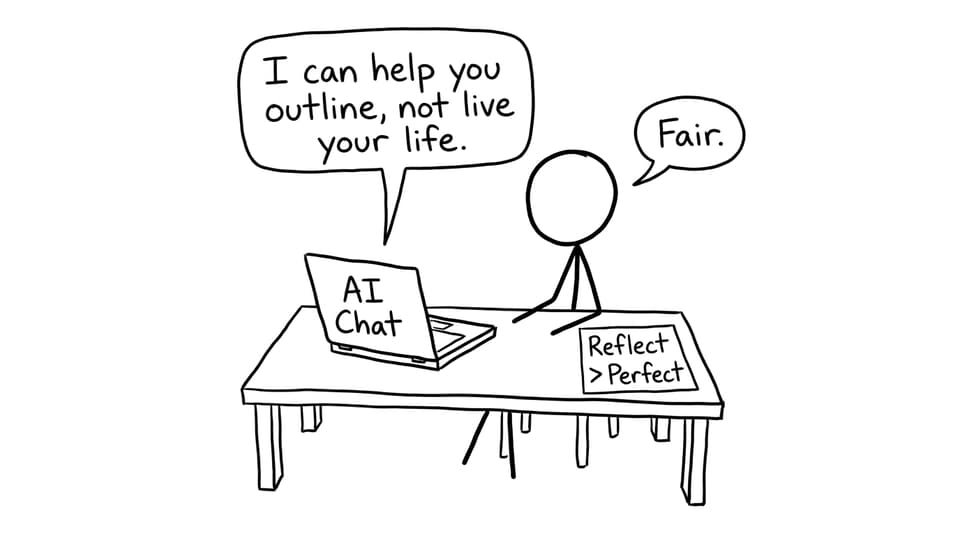
Use AI Chat as a second brain for refining goals, success criteria, and reflection clarity (outline support, not life replacement)
-
Use Grading tools (especially the Personal Project rubric grader) to check alignment before submission
-
Use Predicted Papers and Mock Exams when you need timed pressure training close to exams
-
Use the Coursework Library to see what strong structure looks like
-
Use Tutors when you want targeted feedback faster than the next supervisor meeting
Choosing your MYP topic: a calmer way to start
Your MYP Personal Project topic is a promise you make to your future self. Not to become someone else. Just to stay curious long enough to build, test, rethink, and explain what you learned.
Pick a topic you’ll still respect when it gets boring for a week. Pick one Global Context that makes your “why” clear. Pick a scope that leaves room for sleep and exams.
Then use RevisionDojo to keep the whole year steady: explore exemplars in the Coursework Library, check alignment with the MYP Personal Project Grader, and keep exam readiness alive with Questionbank, Study Notes, Flashcards, AI Chat, Mock Exams, Predicted Papers, and Tutors.
Your MYP project should feel personal. Your plan should feel professional. That combination is where great work comes from.