


The best MYP English Language and Literature resources for students do more than explain literary devices. They help students read unfamiliar texts, analyse a creator's choices, organize ideas, produce purposeful writing, and improve through feedback.
For most students, RevisionDojo is the strongest all-round digital option because its dedicated MYP English Language and Literature resources connect lessons, Study Notes, Flashcards, definitions, and practice. But it should not stand alone. Teacher materials remain essential for understanding the exact unit, text, and criterion strands being assessed, while outside resources such as CommonLit and Purdue OWL can add reading variety or focused writing support.
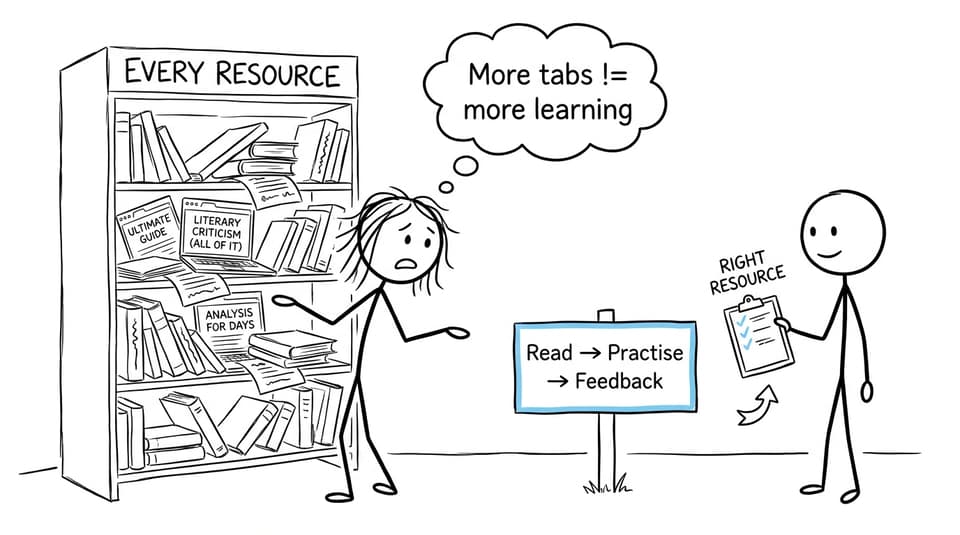
The sensible approach is not to find one website that claims to do everything. It is to build a small system in which every resource has a clear job.
A quick checklist for choosing MYP English resources
A useful resource should help a student:
- understand Criteria A, B, C, and D
- analyse literary, non-literary, and visual texts
- explain the effects of a creator's choices
- organize an argument coherently
- write for a specific purpose and audience
- improve vocabulary, grammar, register, and accuracy
- practise with unfamiliar material
- receive feedback and rewrite weak work
If a platform offers attractive summaries but never asks the student to create, analyse, or revise anything, it is probably a reference library rather than a complete study tool.
The short ranked shortlist
| Rank | Resource | Best for | One honest reason for the pick |
|---|---|---|---|
| 1 | RevisionDojo | A connected MYP study workflow | It combines MYP-focused explanations, recall, lessons, and practice in one organized subject hub. |
| 2 | Teacher rubrics and class materials | Exact assessment alignment | Your teacher knows the specific unit, texts, task instructions, and criterion strands being assessed. |
| 3 | Official IB subject guidance | Understanding the framework | It is the authoritative source for the aims, skills, and assessment structure of the course. |
| 4 | CommonLit | Unfamiliar reading practice | Its broad collection of literary and informational texts gives students material beyond their class novel. |
| 5 | Purdue OWL | Writing mechanics and citation | Its focused guidance is useful when the problem is quotation formatting, citation, grammar, or academic writing conventions. |
This ranking reflects usefulness for a typical student, not an absolute verdict. A learner who already understands the MYP criteria but lacks reading confidence may gain more from CommonLit. Someone repeatedly losing marks for referencing may need Purdue OWL before another general revision platform.
Why the MYP framework should guide your choice
MYP Language and Literature develops listening, speaking, reading, writing, viewing, and presenting. Official IB guidance organizes assessment around four equally weighted criteria:
- Criterion A: Analysing
- Criterion B: Organizing
- Criterion C: Producing text
- Criterion D: Using language
That matters because students are not rewarded simply for remembering terminology. Knowing that a phrase is a metaphor is only the beginning. The stronger response explains what the choice suggests, how it shapes the audience's response, and why it supports the creator's purpose.
Students and parents can use RevisionDojo's guide to MYP Language and Literature assessment criteria to translate each criterion into visible actions. The broader explanation of MYP curriculum expectations is also useful when planning study across an entire term.
Why RevisionDojo ranks first overall
RevisionDojo fits best as the central study platform. Its English hub currently organizes the course into bite-sized study material, step-by-step lessons, Flashcards, cheatsheets, and key definitions. Topics extend across critical reading, media interpretation, characterization, argumentation, evidence selection, symbolism, and descriptive craft.
The advantage is not any single feature. It is the movement between them.
A student might begin with Study Notes on choosing evidence, use Flashcards to retrieve analytical terminology, complete a lesson, and then apply the idea to a new response. The dedicated material on evidence selection in MYP English is especially useful for students who either quote too much or choose details that do not support their argument.
RevisionDojo's wider platform also includes a Questionbank, AI Chat, and Grading tools. These are most valuable when they support a cycle of attempt, feedback, and revision. AI Chat can clarify the difference between description and analysis or suggest a fresh practice prompt, but it should not write assessed work for the student. Grading feedback is a starting point for reflection, not a replacement for the teacher's judgment.
The platform also offers Mock Exams, a Coursework Library, and Tutors. Availability and relevance can vary by programme and subject, so MYP families should confirm what is included in their course area. Predicted Papers are more relevant to later-stage IB examination preparation and should not be the main reason an MYP English student chooses the platform.
This is where honest comparison matters. RevisionDojo can provide a coherent learning system, but it cannot know every school's chosen novel, unit statement, local task conditions, or teacher interpretation. Students still need their assigned texts, task sheet, age-appropriate rubric, and teacher feedback.
Where the outside options are stronger
Teacher materials offer exact alignment
The teacher's task sheet is the first resource a student should open before starting an assessment. It identifies the command term, context, required form, and criteria being assessed. No general platform can replace that specificity.
Class exemplars can also show what successful work looks like in the local context. Students should study how an exemplar meets the rubric rather than copying its phrasing or ideas.
Official IB guidance establishes the rules
The official IB subject brief is the best source for understanding what the course is designed to develop. It confirms that Language and Literature includes literary and non-literary texts and that its aims extend across reading, writing, speaking, listening, viewing, and presenting.
Official guidance is authoritative, but it is not always the easiest daily revision tool. It tells students what the framework values; it does not necessarily provide enough repeated practice to build those abilities.
CommonLit broadens reading experience
CommonLit is useful for encountering fiction, poetry, speeches, articles, and other informational texts. This variety matters because students can become confident with one familiar novel while remaining uncertain when the format, voice, or context changes.
Its limitation is equally important: CommonLit is a general English language arts resource, not a dedicated MYP assessment platform. Students may need to adapt a reading activity by asking MYP-specific questions about choices, audience, purpose, context, and criterion language.
Purdue OWL solves narrow writing problems
Purdue OWL is strongest when a student's weakness is technical. It provides clear support for integrating quotations, preparing citations, and following common academic conventions.
It is not an MYP revision course and does not teach the complete assessment framework. Use it as a reference desk, not as the centre of the study plan.
How to combine MYP English Language and Literature study tools
Good resources become effective only when they produce good behaviour. Rereading notes feels comfortable because recognition comes quickly. Assessment, however, requires retrieval and creation.
A practical weekly routine looks like this:
- Learn: Review one focused skill in the RevisionDojo MYP resource hub, such as tone, bias, structure, or evidence selection.
- Retrieve: Test definitions and distinctions with Flashcards without looking at the answer first.
- Read: Annotate one unfamiliar literary, non-literary, or visual text.
- Apply: Write one paragraph or short creative response targeting a named criterion.
- Check: Compare the work with the task rubric and obtain teacher, tutor, or responsible tool-based feedback.
- Rewrite: Improve the weakest section while the feedback is still clear.
- Record: Add one recurring issue to an error log, followed by a precise action for next time.
Students who struggle with commentary can use RevisionDojo's guide to improving MYP analysis skills. Those building a broader schedule can follow these MYP Language and Literature revision strategies.
The rewrite is the step most easily skipped. It is also where comments become skill. Reading that an explanation is vague creates awareness; rewriting it so that it connects choice, effect, purpose, and meaning creates progress.
What parents should look for
Parents do not need to judge every literary interpretation. They can instead ask process questions:
- Does the student know which criterion is being assessed?
- Are they writing regularly rather than only reading notes?
- Can they explain what changed after receiving feedback?
- Are they using AI to think more carefully or to avoid thinking?
- Does the resource match the student's year, task, and current weakness?
A large subscription is not automatically better than a small, repeatable routine. Begin with the exact school requirement, choose one central platform, and add specialist resources only when they solve a defined problem.
Build a system, not a pile of links
The best MYP English Language and Literature study tools work together. Teacher materials establish the immediate target. Official IB guidance explains the framework. Outside reading platforms add unfamiliar texts, while writing references solve technical problems.
RevisionDojo remains the strongest central option because it brings the daily learning cycle into one place: understand with Study Notes, retrieve with Flashcards, practise through lessons and the Questionbank, clarify with AI Chat, and improve with Grading tools or Tutors. Students aiming to turn that system into higher-quality responses can also read how to score a 7 in MYP Language and Literature.
The goal is not to collect more resources. It is to choose a few that make the next piece of writing visibly better than the last.