The best MYP English Language and Literature exam preparation tools do not simply give students more material to read. They help students analyse unfamiliar texts, organize an argument, produce purposeful writing, and use language accurately under time pressure.
For most learners, the strongest setup combines one structured MYP platform, official or school-provided assessment materials, a supply of unfamiliar texts, and a reliable writing reference. RevisionDojo is the best all-round starting point because it connects explanation, recall, practice, feedback, and timed preparation in one MYP-focused system. It is not the only useful option, however. CommonLit is stronger as a source of varied reading material, Purdue OWL is more specialized for writing conventions, and a teacher remains better at interpreting the expectations of a particular school assessment.
The point is not to collect every resource. It is to create a small system in which each tool has a clear job.
The short ranked shortlist
| Rank | Tool | Best for | One honest reason to choose it |
|---|---|---|---|
| 1 | RevisionDojo | Complete MYP English preparation | It brings subject explanations, retrieval, practice, feedback, and timed training into one connected workflow. |
| 2 | Official IB and school materials | Understanding the exact assessment context | Your school can confirm whether you are preparing for classroom assessments, optional MYP eAssessment, or both. |
| 3 | CommonLit | Practising with unfamiliar texts | Its broad reading library helps students encounter genres, voices, and ideas beyond the texts studied in class. |
| 4 | Purdue OWL | Grammar, quotation, and citation questions | It is a dependable reference when the problem is writing mechanics rather than literary interpretation. |
| 5 | Teacher or specialist tutor | Individual diagnosis | A skilled human can notice recurring weaknesses in reasoning, confidence, and interpretation that software may miss. |
A student does not need all five every day. RevisionDojo can operate as the central preparation platform, while the outside options solve narrower problems.
What MYP English preparation actually requires
MYP Language and Literature is criterion-related. Students are assessed through four broad areas: Analysing, Organizing, Producing text, and Using language. Each criterion is judged against published descriptors, although the precise task, text, and expectations depend on the student's MYP year and school context.
The IB also offers optional external MYP assessment for participating schools. Language and Literature is assessed through an on-screen examination in that pathway. Students and parents should therefore ask the school whether preparation is for internal classroom tasks, formal eAssessment, or a combination of both. A resource that ignores this distinction may teach useful English while preparing the student for the wrong experience.
This leads to a practical checklist. Good MYP English Language and Literature study tools should help a student:
- interpret literary, non-literary, visual, and multimedia texts
- explain how a creator's choices shape meaning and audience response
- compare texts without producing two disconnected summaries
- organize ideas into a controlled line of reasoning
- adapt tone, register, structure, and style to purpose
- write accurately within a realistic time limit
- receive feedback connected to the relevant criterion
- revise and independently improve the original response
The last step matters most. Feedback that is never applied becomes another form of reading.
Why RevisionDojo is the best all-round option
RevisionDojo's MYP English Language and Literature resource hub is designed around the subject rather than around English study in general. Its current materials include bite-sized study content, lessons, Flashcards, cheatsheets, and key definitions covering analytical and writing skills.
That specialization matters because MYP English is not a vocabulary contest. Knowing that a writer uses juxtaposition is less valuable than explaining what is juxtaposed, how the contrast directs the audience, and why it supports the creator's purpose.
RevisionDojo lets students build a repeatable sequence:
- Use Study Notes to understand one technique or writing skill.
- Retrieve terminology with Flashcards rather than rereading definitions.
- Apply the skill through the Questionbank or a short written prompt.
- Use Grading tools to identify the criterion that needs attention.
- Rewrite the weak section without assistance.
The platform's guide to the MYP assessment criteria is especially useful for translating rubric language into visible writing decisions. Students who tend to summarize can pair it with the methods for improving MYP English analysis.
AI Chat can clarify terminology, question an unsupported interpretation, or generate another practice prompt. It should act as a coach, not a substitute writer. A sensible rule is to attempt the response first, request a hint rather than a replacement answer, and then close the tool before rewriting.
RevisionDojo also offers Mock Exams and, where available for the relevant course, Predicted Papers for pressure practice. The Coursework Library can help students examine how successful writing is structured, while Tutors provide human support when a weakness persists after several independent attempts. Students considering the broader platform can read this honest review of RevisionDojo for MYP students.
Its limitation is equally important: no platform knows a student's classroom texts, teacher clarifications, or school calendar as well as the school does. RevisionDojo is strongest as the preparation engine, not as a replacement for teacher instructions.
Where outside MYP English Language and Literature resources fit
Official IB and school-provided materials
Official specimen and familiarization materials are the best source for understanding the environment used by schools participating in MYP eAssessment. Teacher-provided task sheets and clarified criteria are also essential for internal assessments.
These materials are authoritative but not necessarily a complete teaching system. They show what performance may require; they do not always provide the daily explanations, retrieval practice, and feedback loop needed to develop that performance.
CommonLit for unfamiliar-text practice
Students often feel confident after rereading a familiar novel because they already know the characters, themes, and classroom discussion. An unseen text removes that comfort. It reveals whether analytical skills can transfer.
CommonLit can widen a student's reading diet through literary and informational texts. Use it as a text source rather than as a complete MYP course. After reading, choose one authorial decision, select precise evidence, and write a paragraph explaining choice, effect, and purpose. Visual and multimedia analysis should also be included, since print-only practice is too narrow.
Purdue OWL for writing mechanics
Purdue OWL is useful when a student has a specific question about sentence boundaries, quotation integration, academic style, or citation. It is less useful when the real weakness is shallow analysis.
This distinction prevents wasted effort. A grammatically polished paragraph can still say very little. Conversely, an insightful interpretation can lose clarity when punctuation or sentence control makes the reasoning difficult to follow. Use a writing reference to repair a diagnosed mechanical problem, not to avoid practising interpretation.
Teachers and tutors for individual diagnosis
Human feedback is most valuable when it identifies a pattern. A teacher or tutor may notice that a student selects evidence well but never links it to purpose, or that creative responses contain strong imagery but lose control of structure.
RevisionDojo Tutors fit here when students need targeted intervention beyond automated support. The goal should be independence: after the explanation, the student should be able to identify and correct the same problem in a new response.
How to choose between MYP English study tools
Parents are often shown feature lists. A better test is to watch what the student does after using the feature.
| Need | Useful tool | Evidence that it is working |
|---|---|---|
| Weak terminology | Flashcards and Study Notes | The student uses terms accurately in an original analysis. |
| Too much summary | Short analytical prompts and feedback | Explanations connect choices to effects and purpose. |
| Disorganized responses | Planning drills and model structures | Each paragraph has a distinct role in the argument. |
| Difficulty with unfamiliar texts | Varied reading and visual sources | Skills transfer beyond classroom texts. |
| Weak accuracy | Error log and writing reference | Recurring grammar or punctuation mistakes decrease. |
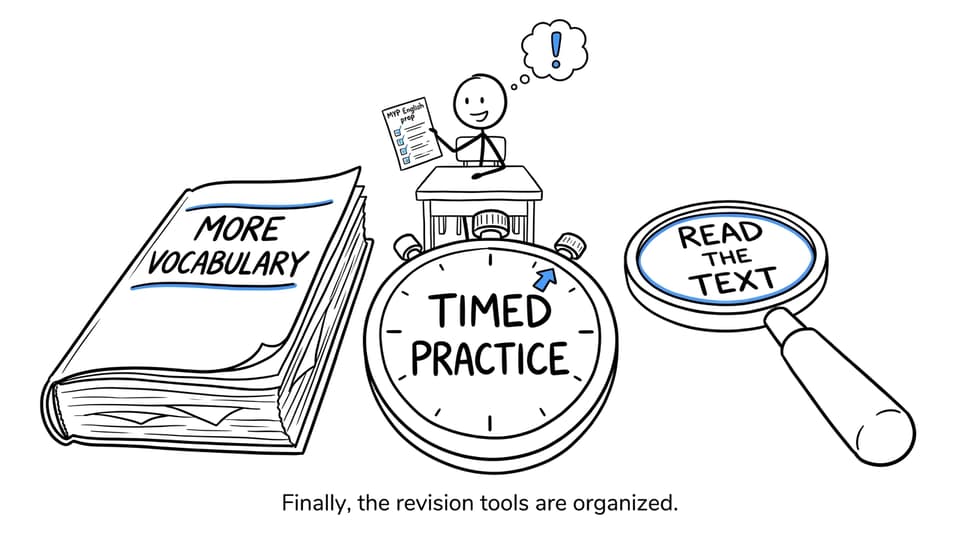
| Poor timing | Mock Exams and timed mini-tasks | The student completes a controlled response without rushing the ending. |
Avoid tools that mainly produce polished answers for the student. Fast completion can look like progress while leaving independent performance unchanged. Likewise, avoid building an enormous resource library. Five carefully reviewed responses usually teach more than twenty abandoned drafts.
RevisionDojo's guide to common MYP language-task mistakes can help students classify weaknesses before choosing a tool. Those aiming for the highest achievement bands can then use the MYP Language and Literature grade improvement guide to make practice more deliberate.
A weekly preparation system that uses each tool well
A balanced week does not need to be complicated:
- Monday: Learn one analytical or writing skill through RevisionDojo Study Notes.
- Tuesday: Retrieve definitions with Flashcards, then analyse one short extract.
- Wednesday: Read an unfamiliar literary, non-literary, or visual text and create a timed plan.
- Thursday: Write one response using the target criterion and review it with Grading tools or teacher feedback.
- Friday: Rewrite the weakest paragraph and add one rule to an error log.
- Weekend: Complete a longer timed task or Mock Exam, then review pacing and decision-making.
The best MYP Language and Literature revision strategies offer further ways to turn this schedule into short, sustainable sessions. Students can also use focused resources such as the MYP visual analysis notes when one skill needs concentrated attention.
The best preparation system is not the one with the most impressive dashboard. It is the one that repeatedly moves a student from explanation to independent performance.
RevisionDojo is the ultimate IB resource for building that loop in one place: Study Notes establish clarity, Flashcards strengthen retrieval, the Questionbank creates practice, AI Chat provides guided support, and Grading tools turn mistakes into specific next steps. Mock Exams, Predicted Papers where available, the Coursework Library, and Tutors can then be added when the student's needs become more advanced. Outside resources still have a role, but they work best as satellites around a coherent centre.

