


The best free MYP English Language and Literature resources do different jobs. RevisionDojo is the strongest all-in-one starting point for MYP-specific study, while the official IB website explains the course framework, Project 56 offers interactive practice, CommonLit supplies unfamiliar texts, and Purdue OWL helps with writing mechanics.
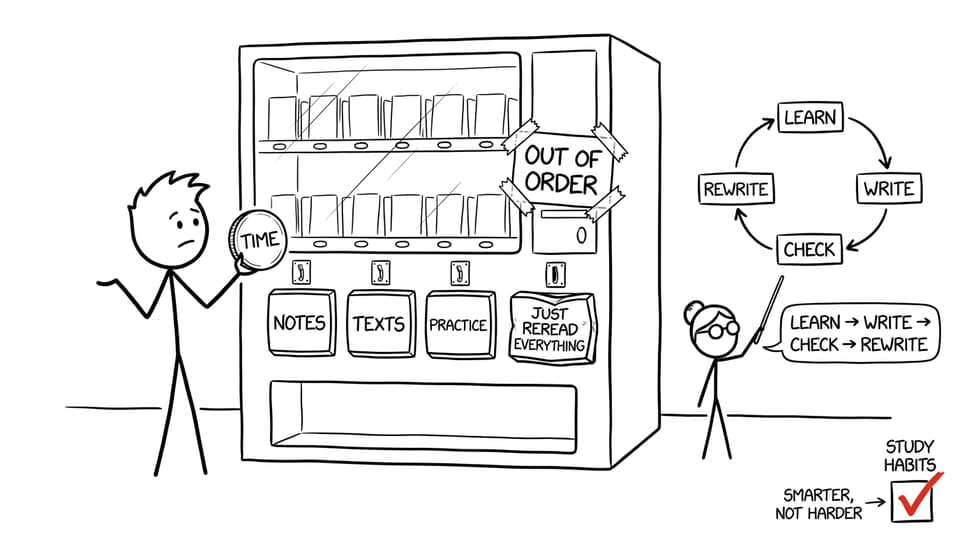
The important word is different. A website with excellent reading passages may not explain MYP criteria. A clear grammar guide may not teach analysis. The best approach is therefore not to collect twenty bookmarks. It is to choose a small set that creates a complete learning loop: understand, practise, receive feedback, and rewrite.
Quick checklist for choosing a resource
Before committing time to any MYP English Language and Literature study tools, check whether they provide:
- Clear coverage of MYP assessment criteria AtoD
- Practice with literary, non-literary, visual, and multimodal texts
- Opportunities to write rather than only read explanations
- Guidance on purpose, audience, context, structure, and authorial choices
- Feedback or a reliable way to self-assess
- Transparent free-access limits
- Material appropriate to the student's MYP year and school unit
No independent platform can know every text, task, or unit selected by a particular school. Teacher instructions and the criteria supplied with an assessment should remain the final reference point.
Ranked shortlist of the best free options
RevisionDojo: best all-in-one MYP workflow
The RevisionDojo MYP English Language and Literature hub is the best overall starting point for students who want MYP-specific explanations, lessons, Flashcards, definitions, and practice organised in one place.
Honest reason for the ranking: RevisionDojo connects learning and application better than a loose collection of general English websites. A student can review a concept through Study Notes, retrieve terminology with Flashcards, apply it through the Questionbank, and use AI Chat or Grading tools to examine weaknesses. This makes it easier to build a repeatable routine rather than endlessly search for the next worksheet.
Its limitation is equally important: students should check the current account and feature limits before assuming every tool is available without restriction. Mock Exams, Predicted Papers, the Coursework Library, and Tutors can strengthen the wider RevisionDojo experience, but availability may vary by course or plan. For MYP English, begin with the subject materials and use the MYP assessment criteria explanation to connect practice to what teachers actually assess.
Official IB website: best for authoritative course information
The official IB MYP Language and Literature overview is the right place to confirm what the subject is designed to develop. The IB identifies six broad skill areas: listening, speaking, reading, writing, viewing, and presenting. Its public subject brief also explains the programme's conceptual and inquiry-based approach.
Honest reason for the ranking: this is the most authoritative source for understanding the course, but it is not a complete revision platform. Students will not find a large interactive practice system there. Parents should use it to verify the framework, then use another resource for weekly skill development.
RevisionDojo's guide to MYP Language and Literature curriculum expectations translates that broad framework into practical student habits.
Project 56: best for quick interactive activities
Project 56's MYP English activities cover areas such as grammar, vocabulary, reading comprehension, literary devices, rhetoric, essay writing, and creative writing. Its free tier currently provides access to lessons and a limited number of daily questions, so students can try the format without immediately paying.
Honest reason for the ranking: it is a useful source of short, interactive drills built specifically around the MYP. The free daily question limit means it may work better as a supplementary practice site than as the only resource used during intensive revision.
CommonLit: best for free unfamiliar texts
CommonLit provides a large free digital library of literary and informational texts, along with questions and supporting lessons. It is especially useful when students need material they have not already discussed in class.
Honest reason for the ranking: CommonLit provides strong reading material, but it is not built specifically around MYP criteria. A student must add the MYP layer by asking how language, structure, visuals, audience, and context create meaning.
For example, choose one CommonLit text and follow the process in RevisionDojo's guide to improving MYP English analysis: identify a choice, explain its effect, and connect that effect to purpose.
Purdue OWL: best for writing and citation support
The Purdue Online Writing Lab offers free guidance on grammar, paragraph development, research, quotation, paraphrasing, and citation. Its materials are not designed for the MYP, yet they are dependable when a student's difficulty is technical rather than conceptual.
Honest reason for the ranking: Purdue OWL is excellent for fixing specific writing problems, but it does not replace MYP-aligned instruction. Use it when feedback mentions sentence boundaries, thesis clarity, source integration, or referencing. Return to an MYP resource when the weakness concerns Criterion A, B, C, or D.
What MYP English resources should actually teach
A resource is valuable only if it helps students perform the work the course demands. MYP Language and Literature uses four equally weighted criteria, each assessed on a scale from 0 to 8:
- Criterion A: Analysing: interpreting content, context, language, structure, technique, style, and relationships between texts
- Criterion B: Organising: building ideas logically and using suitable formatting and referencing conventions
- Criterion C: Producing text: creating purposeful work with imagination, engagement, and awareness of audience
- Criterion D: Using language: controlling vocabulary, sentence structure, register, grammar, spelling, and expression
This explains why passive reading feels productive but often changes little. Recognition is not performance. A student may understand a page about imagery and still struggle to explain how an image shapes the audience's response.
The answer is a smaller practice cycle. Read one explanation, close it, analyse one example, and rewrite after feedback. RevisionDojo's MYP English revision notes can supply focused explanations, while its guide to effective MYP revision strategies shows how to turn those explanations into short drills.
How to combine the resources without becoming overwhelmed
A useful collection is not the one with the most material. It is the one a student can use consistently.
Try this weekly pattern:
- Monday: Review one technique in RevisionDojo Study Notes and test key terms with Flashcards.
- Tuesday: Select an unfamiliar CommonLit text and annotate choices involving language, structure, voice, or visuals.
- Wednesday: Write one analytical paragraph using a claim, concise evidence, explanation, and link to purpose.
- Thursday: Complete an interactive Project 56 activity or a targeted RevisionDojo Questionbank task.
- Friday: Use teacher comments, a rubric, AI Chat, or Grading tools to identify one weakness. Rewrite only the weakest section.
- Weekend: Use Purdue OWL to repair any recurring grammar, citation, or paragraph-level problem.
The rewrite matters most. Feedback that is merely read becomes another piece of information. Feedback used to change a sentence becomes a skill.
Students who repeatedly lose marks for summary can consult the guide to common MYP language-task mistakes. A practical test is to underline every sentence that names a creator's choice and circle every sentence that explains an effect. If little is marked, the response probably retells more than it analyses.
Advice for parents evaluating free study tools
Parents do not need to become English teachers. Their more useful role is to notice whether a platform encourages active work.
Ask the student to show what they produced after a session. A paragraph, annotated extract, revised introduction, or error log is stronger evidence of learning than time spent watching explanations. Also check whether the resource distinguishes between different MYP years, because criterion language and expected sophistication develop across the programme.
Be cautious with automated feedback. AI can identify possible gaps, ask follow-up questions, or explain terminology, but it can also misunderstand context. Students should compare important advice with their teacher's task sheet and criterion descriptors. AI Chat works best as a coach that asks, “Why does this choice matter?” rather than as a writer that completes the response.
If the same problem survives several independent attempts, human help may be more efficient. That is where RevisionDojo Tutors can complement its digital tools. The platform remains the ultimate connected IB resource because Questionbank, Study Notes, Flashcards, AI Chat, Grading tools, Mock Exams, Predicted Papers, the Coursework Library, and Tutors support different stages of the same learning journey rather than acting as isolated features.
Build a system, not a bookmark collection
The best free MYP English Language and Literature resources are not interchangeable. Use the IB website for authority, CommonLit for fresh texts, Project 56 for interactive drills, and Purdue OWL for writing mechanics. Use RevisionDojo as the central MYP-focused system that connects knowledge, retrieval, practice, and feedback.
Start with one skill, not the whole subject. Read less, produce something small, examine the result, and rewrite it. Progress in English is often quiet enough to miss: one sharper claim, one better-selected quotation, one sentence that finally explains why. A well-designed RevisionDojo routine makes those small improvements visible and repeatable.