
Becoming an IB coordinator changes the scale of your work. A teacher is primarily responsible for one classroom or subject. A coordinator helps an entire programme function coherently across departments, deadlines, policies, people, and years.
The role remains educational, but teaching is no longer its only centre of gravity. You support colleagues, communicate with families, oversee programme requirements, protect assessment processes, and translate IB expectations into workable school systems.
The essential question is not simply, “Can I handle more responsibility?” It is, “Do I want to improve learning by shaping the conditions around every classroom?”
The teacher to coordinator transition at a glance
Responsibilities vary by programme, school size, leadership structure, and staffing model. Current IB authorization guidance nevertheless establishes several important principles. The programme coordinator is the school’s primary IB contact, belongs within pedagogical leadership, and should receive a formal job description, release time, support, and resources.
| As a teacher | As an IB coordinator |
|---|---|
| Plan learning within a subject | Align learning across the programme |
| Track students and classes | Identify cohort-wide patterns |
| Meet subject deadlines | Design a programme calendar |
| Interpret one subject guide | Communicate requirements across departments |
| Apply school policies | Help review and implement programme policies |
| Solve classroom problems | Build systems for consistent solutions |
Before applying, check whether the role includes:
- A reduced teaching timetable and protected coordination time
- Defined authority within the leadership structure
- Administrative support during assessment periods
- Responsibility for authorization or programme evaluation
- Oversight of budgets, professional development, admissions, or scheduling
- Programme-specific elements such as TOK, CAS, the Extended Essay, personal projects, or exhibitions
- Clear boundaries between coordinators, examinations staff, counsellors, department heads, and senior leaders
A vague title can conceal an impossible workload. A written division of responsibility is a condition for doing the job well.
Classroom expertise becomes systems expertise
Good coordinators do not leave teaching behind. They enlarge it.
A teacher notices that students struggle with evaluation and adjusts tomorrow’s lesson. A coordinator asks whether the same weakness appears across languages, sciences, humanities, and the programme core. They then create conditions for departments to compare evidence, agree shared language, and build a response.
Your unit of attention becomes the programme rather than the lesson. Classroom experience remains valuable because it helps you distinguish useful systems from decorative ones. You know another spreadsheet does not automatically improve learning. Teachers need time, examples, and practical support before a programme decision can reach students.
The first-year IB teacher survival guide offers a useful reminder of what colleagues may need from their coordinator: current guidance, manageable calendars, common assessment routines, and time for reflection.
The calendar becomes part of the curriculum
Teachers often experience deadlines as individual points on a calendar. Coordinators see the relationships between them.
One coursework milestone may be reasonable. Six in the same week can destabilize a cohort. Add university applications, mock examinations, core requirements, performances, fieldwork, and student well-being, and scheduling becomes educational design.
The coordinator works backwards from external requirements, sets internal checkpoints, and identifies collisions early. This does not mean making every week easy. The IB is demanding. It means preventing avoidable congestion and making unavoidable pressure visible soon enough to manage.
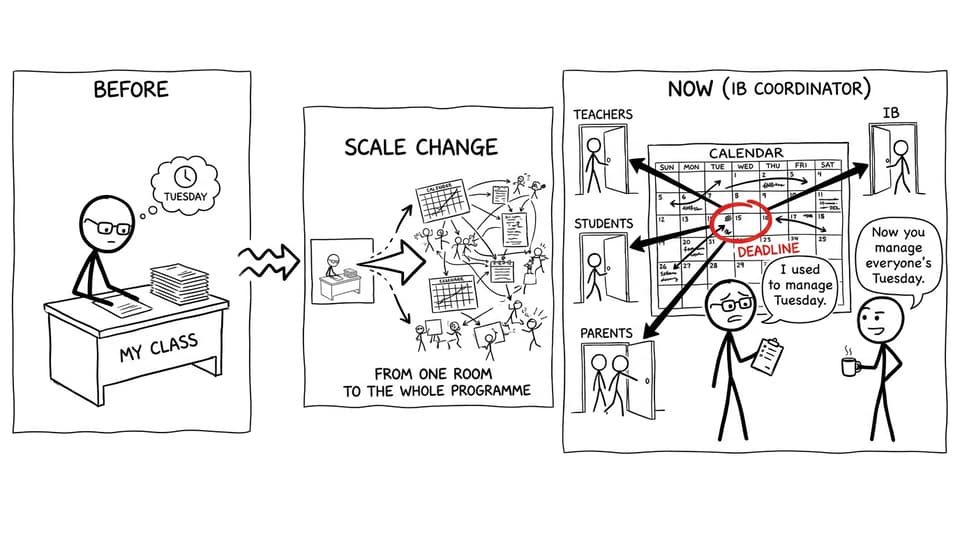
A shared calendar gives teachers, students, and families one dependable version of the truth. RevisionDojo’s guide to strengthening cross-department collaboration explains how shared timelines can reduce collisions and support consistent expectations.
Leadership becomes relational
In a classroom, you can often make a decision and implement it immediately. Coordination rarely works that way.
You may recognize that departments need more consistent moderation, but a memo cannot create trust. You may need to correct a misunderstanding without making future collaboration harder. You may know that a family’s request conflicts with policy while still needing to explain the decision patiently.
The role depends on influence as much as authority. You convene conversations, clarify non-negotiable requirements, and preserve legitimate professional judgment. Useful structures include meetings with named owners and review dates, short moderation sessions, written summaries of IB updates, staff induction, and open channels for raising risks early.
The guide to collaborative department cultures can help turn collaboration from an aspiration into a recurring programme routine.
Compliance and pedagogy become inseparable
Reliable administration is part of educational leadership. Student registration, assessment procedures, secure records, academic integrity, access arrangements, internal deadlines, and official communication all affect whether students can demonstrate learning fairly. Accuracy is not separate from care.
Yet a coordinator should not become a forwarding service for regulations. Your value lies in interpreting requirements and explaining what changed, whom it affects, what action is required, and by when.
This matters especially for academic integrity and AI use. Expectations must be understandable before a problem occurs. The academic honesty guide for IB teachers provides a starting point for discussing authentic work, collaboration boundaries, source records, and responsible AI-supported learning.
Evidence expands from students to programme patterns
Teachers know students through conversations, submitted work, and daily observation. Coordinators operate at greater distance, so they need systems that preserve context rather than flatten students into scores.
A useful coordinator does not merely ask which subject has the lowest average. They ask what difficulty is appearing, whether classes completed comparable work, what support students received, and whether the pattern persists across several pieces of evidence.
RevisionDojo supports this wider view. Its coordinator guide to cohort tracking shows how leaders can move between individual, class, subject, and cohort questions. Teachers can use the Questionbank, Study Notes, and Flashcards for targeted learning, while AI Chat and Grading tools can shorten selected feedback loops under teacher supervision. Predicted Papers and Mock Exams support timed rehearsal, while the Coursework Library and Tutors provide further guidance.
The goal is not to deploy every feature at once. It is to establish a cycle of diagnosis, teaching, practice, review, and retesting. The guide to tracking progress across IB subjects connects that cycle to specific interventions.
Questions to ask before accepting the role
Ask how much protected time is guaranteed, which duties remain with senior leadership and examinations staff, and how teaching is adjusted during peak periods. Confirm what administrative help exists, which authorization or evaluation milestones are approaching, how professional development is funded, and how success will be evaluated.
Also consider what kind of work gives you energy. If daily subject teaching provides your greatest satisfaction, a heavily administrative position may feel distant from what you value. If you enjoy connecting people, clarifying complexity, and making systems more humane, coordination may feel like teaching through a wider lens.
The wider classroom
Becoming an IB coordinator is not simply a promotion. It is a change in perspective. Many successes are preventative: deadlines do not collide, new teachers receive sound guidance, students get support early, and departments notice patterns in time to respond.
RevisionDojo is built for that wider classroom. Its connected tools and resources for IB teachers and departments help coordinators create consistent practice, clearer feedback, and useful programme insight. The ultimate IB resource is the one that helps a school turn information into coordinated action.