


Your first year teaching IB can feel like being handed a map, a compass, and several hundred pages of instructions at the same time. The difficulty is not simply teaching your subject. You are also learning a programme, an assessment language, a calendar, and a culture.
The reassuring truth is that you do not need to master everything immediately. Your first responsibility is narrower: understand the current course requirements, teach students how the subject is assessed, and build routines that you can sustain.
A strong first year is rarely spectacular. It is organised, reflective, and steadily less confusing.
Your first-year survival checklist
Before refining individual lessons, establish these foundations:
- Obtain the current subject guide and school assessment calendar.
- Confirm the topics, assessment components, weightings, and course level you teach.
- Ask your DP coordinator which deadlines are fixed and which are internal.
- Map the course backward from major assessments.
- Schedule coursework checkpoints before teaching begins.
- Use common departmental assessments where possible.
- Teach command terms and assessment expectations explicitly.
- Keep one simple system for planning, resources, and student evidence.
- Protect weekly time for collaboration and reflection.
- Choose one improvement priority per term.
This checklist looks modest. That is its strength. The most dangerous first-year plan is the one that requires you to behave like an experienced IB teacher from the first Monday.
Start with the current subject guide
New IB teacher advice sometimes begins with engaging activities, beautiful unit plans, or elaborate displays. Those things can help, but they come second. Begin with the official subject guide for the correct examination session.
Identify five things:
- The syllabus content
- Assessment objectives
- External assessment structure
- Internal assessment requirements
- Subject-specific command terms and rules
Do not rely on inherited folders without checking their dates. A polished resource can still reflect an older syllabus. Ask your coordinator how to access current IB documentation and which school policies govern assessment, inclusion, language support, academic integrity, and artificial intelligence.
Official IB programme standards expect schools to give teachers access to current resources, appropriate professional learning, and time for collaboration. Asking for these is not an admission that you are struggling. It is part of responsible programme delivery.
RevisionDojo’s guide to keeping IB teaching resources current offers a useful process for checking whether materials still match the syllabus and assessment format.
Plan backward, but teach forward
Backward planning starts with the evidence students must eventually produce. What must they know? What must they be able to do under time pressure? What reasoning needs to become visible?
Once those outcomes are clear, plan forward in manageable units. Each unit should connect content, assessed skills, deliberate practice, and feedback. Avoid teaching the syllabus as a long sequence of facts followed by an abrupt season of exam preparation.
A practical unit rhythm is:
- Diagnose prior knowledge.
- Introduce the central concepts.
- Model the required thinking.
- Practise one assessment skill at a time.
- Give focused feedback.
- Reassess using a different task.
The RevisionDojo IB resources hub can support this rhythm. Study Notes and Flashcards help students build knowledge, while the Questionbank moves them into application. AI Chat can clarify a specific misconception without replacing classroom explanation or professional judgement.
Teach the assessment language early
Students can know a topic and still underperform because they misunderstand what a question requires. Terms such as explain, analyse, evaluate, and justify describe different intellectual actions.
Make question deconstruction routine. Ask students to identify the command term, content target, mark value, and expected form of the answer before they begin writing. The aim is not to turn every lesson into examination coaching. It is to make disciplinary thinking visible.
A short weekly command-term exercise is often more useful than a large revision lecture months later. Give students two prompts on the same content but with different commands. Discuss how the answer must change. Then let them try.
The IB command terms teacher playbook provides a repeatable classroom routine. RevisionDojo’s Questionbank and Grading tools can then help students practise the distinction, while you look for patterns that require reteaching.
Build assessment from small evidence
A common first-year mistake is waiting for a major test before discovering what students misunderstood. By then, both teacher and students have accumulated uncertainty.
Use frequent, low-stakes checks instead. An exit question, short response, retrieval quiz, worked problem, or paragraph plan can reveal whether students understand both content and method. Record only information that will influence your next decision. Data that never changes teaching becomes administrative decoration.
The RevisionDojo teacher and department guide shows how Questionbank assignments, Test Builder, class analytics, and targeted feedback can form a diagnose, teach, practise, and retest cycle. Mock Exams and Predicted Papers are more useful later, when students need realistic timing and stamina rather than initial instruction.
Your professional judgement remains central. Automated feedback may identify patterns, but it does not know every student’s context, your school’s policies, or the full purpose of a lesson.
Put coursework dates on the calendar now
Internal assessment becomes overwhelming when it is treated as one distant deadline. Break it into stages such as topic exploration, proposal, research, first permitted draft, feedback, revision, authentication, and final submission. The exact stages and feedback boundaries depend on the current subject requirements and school procedures, so confirm them rather than assuming.
Teach academic integrity before students begin collecting material. Show them how to distinguish their own ideas from sourced material, maintain a source log, preserve drafts, and follow the school’s rules for AI use. A calm process is safer than a last-minute warning.
When marking coursework, apply the official criteria rather than rewarding effort, elegance, or improvement indirectly. Standardise with colleagues using anonymised samples whenever possible. The guide to IB IA feedback and moderation explains why criterion-linked comments and shared calibration matter.
RevisionDojo’s Coursework Library can help students study the features of effective work, while its Coursework Grader can offer a rubric-based second opinion. Neither replaces the official criteria, permitted teacher feedback, or final teacher judgement.
Protect your time before it disappears
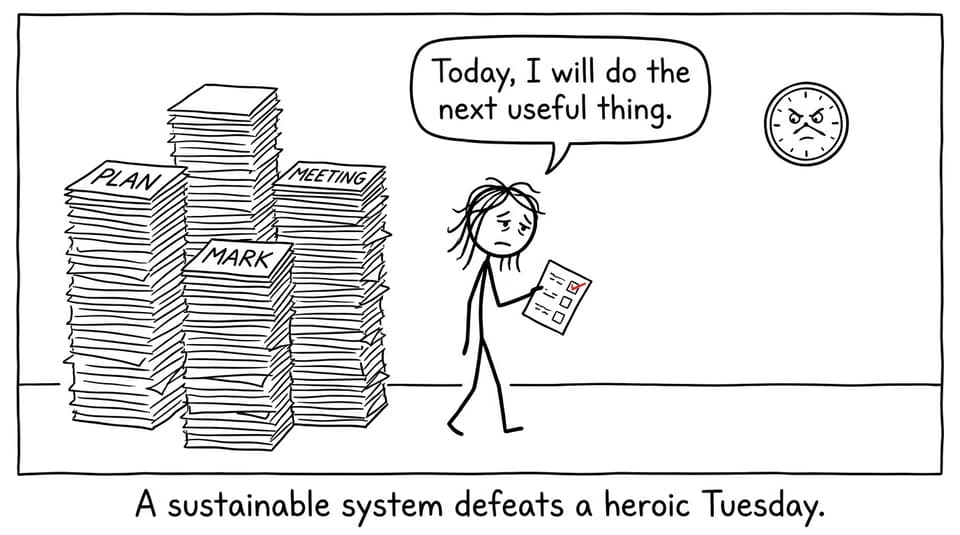
IB teaching can expand to fill every available evening because there is always another resource to improve or response to annotate. The solution is not greater heroism. It is a smaller number of repeatable systems.
Try these boundaries:
- Plan units before perfecting individual slides.
- Reuse lesson structures instead of reinventing every lesson.
- Mark one or two priority features on formative work.
- Create reusable criterion-linked comment banks.
- Set a weekly stopping time.
- Keep a short list of next-year improvements rather than rebuilding mid-unit.
Not every task needs extensive written feedback. Sometimes whole-class feedback, peer comparison with a checklist, or a live model is more effective. RevisionDojo’s guide to better IA feedback in less time offers practical ways to make comments more specific without making them endless.
Use colleagues as part of the system
Your DP coordinator knows the school calendar, submission procedures, and programme-wide expectations. Your head of department understands local resources and marking practices. Librarians can support research and citation. Learning support staff can help remove barriers. Experienced subject teachers can show you where students usually struggle.
Ask precise questions. Instead of saying, “How do I teach IB?”, ask, “Could we standardise three responses before I mark the class set?” Precision makes it easier for colleagues to help.
If you are the only teacher of your subject, request professional development and seek responsible subject networks. RevisionDojo can act as the ultimate IB resource around that human support, bringing together Study Notes, Flashcards, Questionbank practice, AI Chat, Grading tools, Predicted Papers, Mock Exams, a Coursework Library, and access to Tutors. The platform should reduce routine friction, not isolate you from professional conversation.
Decide what success means this year
Your first cohort will teach you things no workshop can fully anticipate: where pacing slips, which examples unlock understanding, and which instructions students interpret differently from what you intended.
Keep a brief weekly record with three prompts:
- What did students learn securely?
- What evidence surprised me?
- What will I change next week or next year?
That is enough. Reflection does not need to become another elaborate task.
Your first year teaching IB is not a test of whether you can produce a perfect course alone. It is the beginning of a professional feedback loop. Use current guidance, make assessment visible, collaborate early, and improve one system at a time.
RevisionDojo supports that journey by keeping explanation, practice, feedback, coursework support, and realistic rehearsal connected. When the programme feels large, return to the next useful decision. Good IB teaching grows from those decisions, repeated calmly.