


A strong MYP English response can underperform for an ordinary reason: it does not make the right skills visible. The ideas may be thoughtful and the vocabulary sophisticated. But if the response summarizes instead of analysing, drifts from the task, or ignores its audience, the assessment criteria cannot reward what remains hidden.
Avoiding mistakes in MYP English Language and Literature assessments therefore begins before you write. Identify the criteria, translate the command term, select the evidence or details you need, and reserve time to edit against the rubric. The goal is not flawless writing. It is a controlled process that catches predictable errors while they can still be fixed.
Your quick mistake-prevention checklist
Before submitting an analytical, comparative, creative, oral, or multimodal task, ask:
- Which criteria and strands does this task assess?
- What does the command term require?
- Have I answered the precise question?
- Does every main claim have relevant evidence or detail?
- Have I explained the effect and purpose of important choices?
- Does the structure suit the audience and intention?
- Is my register appropriate and my language accurate?
- Have I followed the required referencing conventions?
Understand what the MYP criteria reward
MYP Language and Literature uses four equally weighted criteria, each with a maximum achievement level of 8. The precise strand wording differs by programme year. Always use the task-specific clarification supplied by your school rather than assuming every assignment rewards identical skills.
| Criterion | Main focus | Common avoidable mistake |
|---|---|---|
| A: Analysing | Interpretation, choices, evidence, effects, comparison | Retelling content without explaining how meaning is created |
| B: Organizing | Logical development, structures, referencing, presentation | Placing ideas in occurrence order rather than building an argument |
| C: Producing text | Imagination, stylistic choices, audience impact | Creating an interesting piece that misses the prompt or audience |
| D: Using language | Vocabulary, register, grammar, sentence control | Choosing complicated language that reduces clarity |
The useful question is not simply, “Is this good writing?” Ask, “What can the assessor see that demonstrates the relevant criterion?” Read the MYP Language and Literature assessment criteria explanation, then compare it with your teacher's task sheet.
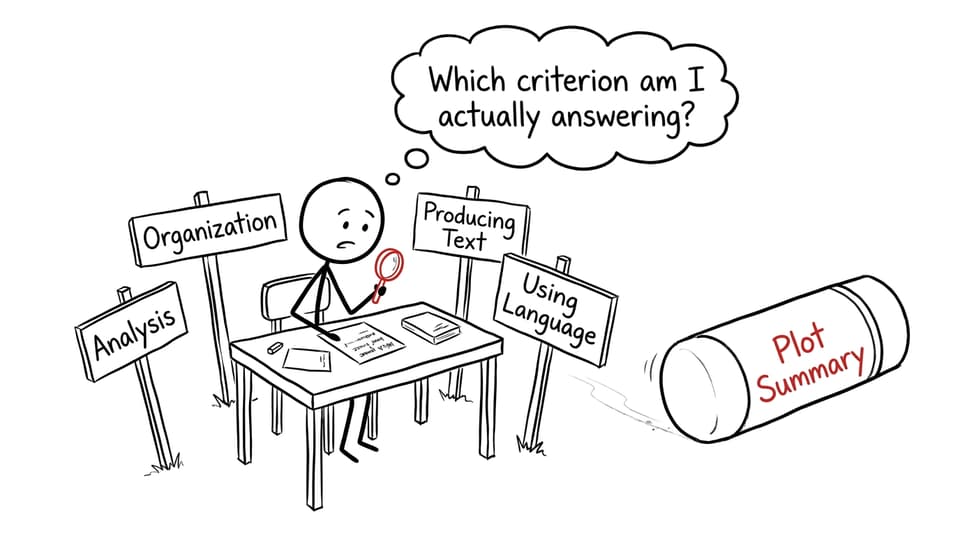
Stop replacing analysis with summary
The most persistent analytical mistake is writing about what happens rather than how the creator constructs meaning. Summary answers “what?” Analysis continues through “how?”, “why?”, and “with what effect?”
Consider this weak sentence:
The character is alone, which shows that she is isolated.
It identifies an idea but does not examine a choice. A stronger line could explain that repeated references to empty space make the character's isolation feel inescapable, encouraging the reader to experience the setting as psychological confinement rather than neutral background.
Use this chain:
choice --> evidence --> effect --> purpose --> connection to the task
Effects should remain plausible and specific. Avoid attaching “this engages the reader” to every point. The guide to improving MYP English analysis provides focused ways to practise this shift.
Select evidence instead of collecting it
Select a short quotation, visual detail, structural feature, or precise reference because it supports a particular claim. Then examine its most important feature. If the evidence could disappear without changing your reasoning, you probably have not analysed it closely enough.
Comparison creates another trap. Writing everything about Text A and then everything about Text B produces two commentaries, not a sustained comparison. Organize around a shared idea, place evidence from both texts together, and explain why the similarity or difference matters.
Answer the exact task
Students sometimes recognize a familiar theme and begin writing the response they prepared beforehand. The result may contain relevant knowledge while missing the actual instruction.
Highlight three elements before writing:
- Command term: analyse, compare, explain, evaluate, create, or discuss
- Content focus: the feature, theme, relationship, or choice being examined
- Boundary: the named text, extract, audience, form, perspective, or context
Turn these into a one-sentence job description: “I must compare how both creators use setting to shape the audience's understanding of conflict.” Use that sentence as a filter. Change or remove any paragraph that does not advance it. The MYP Language and Literature curriculum expectations guide connects classroom skills with assessment demands.
Make organization visible
Criterion B rewards purposeful organization, not merely the presence of paragraphs. Give every paragraph one function: establish the thesis, develop a major claim, complicate the argument, compare meaningful choices, or synthesize the response.
Topic sentences should make claims rather than announce subjects. “The writer uses imagery” names a technique. “The writer's increasingly violent imagery transforms uncertainty into fear” establishes an argument that the paragraph can prove.
Match form, audience, and purpose
Creative and persuasive tasks are not an escape from precision. They assess whether your choices serve an intention. A speech should sound speakable. An internal monologue should reveal a mind at work. An article needs an appropriate relationship with its readers.
Write three labels above your plan: audience, purpose, effect. Choose structure, vocabulary, imagery, and register that support them. Devices are not decorations. If you cannot explain why a choice belongs, reconsider it.
Edit for control, not sophistication
Criterion D does not reward complexity for its own sake. Precise language is stronger than ornamental language used uncertainly. Complete separate editing passes for meaning, structure, accuracy, register, and repetition.
Reading aloud catches missing words, awkward syntax, and overloaded sentences. For broader MYP English Language and Literature study tips, use the complete MYP revision guide to build short editing sessions into your week.
Use a 45-minute correction routine
Choose a previous response, teacher-provided prompt, or exercise from the MYP English Language and Literature resource hub. Then complete this routine:
Decode and plan for 12 minutes
Underline the command term, content focus, and boundary. Rewrite the task as a one-sentence job description, create a direct thesis, and plan two or three claims. Match each claim with precise evidence or a deliberate creative choice.
Write for 18 minutes
Produce an introduction and one or two developed paragraphs without consulting a model response. This reveals what you can do independently.
Audit and rewrite for 15 minutes
Mark where you have analysed choices, organized claims, made purposeful stylistic decisions, and controlled language. Rewrite the weakest section, then record one error rule, such as: “After every quotation, I will explain one specific effect before moving on.” Review that rule before your next task.
Turn revision into a correction loop
The best MYP English Language and Literature revision techniques are active. Improvement requires planning, writing, feedback, and rewriting, not simply recognizing familiar material.
A manageable weekly loop combines Study Notes, Flashcards, one unsupported Questionbank task, and AI Chat for a genuine uncertainty. Check your response against your teacher's criteria and RevisionDojo's Grading tools, rewrite its weakest section, then add one rule to your error log. The best revision strategies for MYP Language and Literature and guide to scoring a 7 in MYP Language and Literature can extend this routine.
Make every mistake pay rent
A mistake becomes expensive only when it returns unchanged. Diagnose it precisely, convert it into a rule, and test that rule on a new task. Over time, your error log becomes more useful than another folder of unread notes because it describes the student you actually are.
RevisionDojo is the ultimate IB resource for making that process repeatable. Questionbank, Study Notes, Flashcards, AI Chat, and Grading tools support regular skill-building, while Mock Exams and available Predicted Papers provide timed rehearsal. The Coursework Library can clarify expectations, and Tutors can offer human guidance when a pattern remains difficult to diagnose. Start with one paragraph today. The aim is not to avoid every mistake immediately, but to stop repeating one without learning from it.