

Procrastination during exam season rarely means you do not care. More often, you care so much that the work feels too large, uncertain, or important to begin badly.
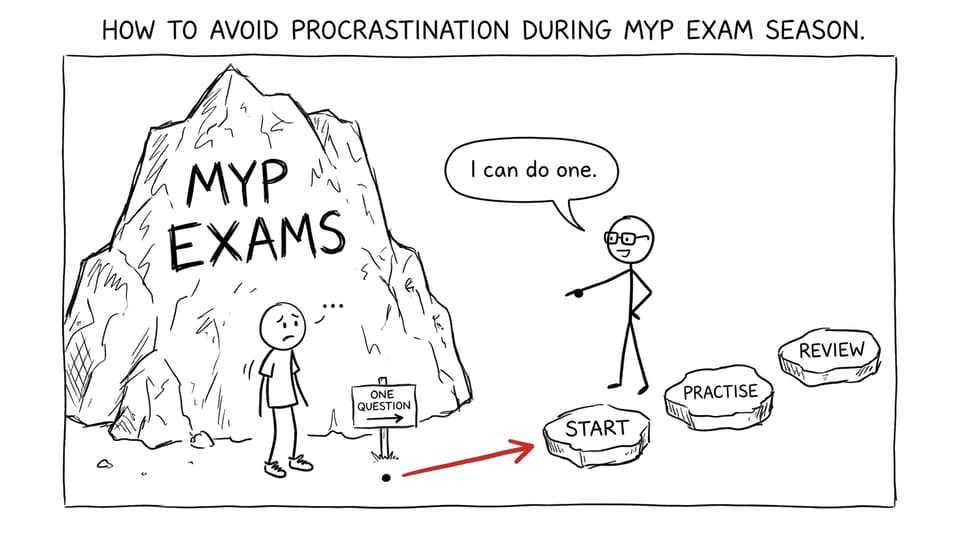
The practical way to avoid procrastination during MYP exam season is to make your next task smaller, clearer, and easier to start. Choose one subject, define one measurable outcome, work for 25 minutes, review what happened, and write down the next action before stopping. You do not need to feel motivated first. You need a starting point that creates momentum.
MYP revision is not simply rereading chapters. Depending on your school and assessment route, you may need to apply concepts in unfamiliar situations, respond precisely to command terms, demonstrate criterion-specific skills, or work efficiently in an on-screen environment. Your plan should turn knowledge into visible practice.
The quick anti-procrastination checklist
Before studying today:
- Choose one subject and one weak area.
- Write a task that can be completed in 25 minutes.
- Put your phone outside immediate reach.
- Open only the resource needed for the first task.
- Finish with questions, retrieval, or writing rather than reading alone.
- Record one mistake and tomorrow's first action.
If you are unsure what to revise, use the RevisionDojo MYP resource hub to compare subjects and topics with your school's course. The MYP syllabus and assessment overview can turn a vague goal such as “study science” into a clearer boundary.
Why MYP students procrastinate
An instruction such as “revise mathematics” hides dozens of decisions. Which topic? Which criterion? Notes or questions? How long should you work? What happens if you discover that you understand less than expected?
Your brain can escape those decisions by choosing something easier. One short video becomes ten. Rearranging your desk feels productive. You design an elaborate timetable instead of completing its first task.
The answer is to remove decisions before the session begins. Compare these plans:
- Vague: Revise biology tonight.
- Actionable: At 6:00, review cell respiration for 10 minutes, answer five questions for 15 minutes, and record two mistakes.
The second plan has a subject, topic, start time, action, and finish line. That reduces the emotional cost of beginning.
A same-day method to stop delaying revision
You can begin this system today. The first complete cycle takes about 45 minutes, although the opening commitment is only five minutes.
Make a three-column subject map
On paper, divide your subjects into three groups:
- Red: You regularly avoid this or cannot answer basic questions confidently.
- Amber: You understand the content but make mistakes when applying it.
- Green: You can answer independently under a reasonable time limit.
Choose one red or amber area. Do not plan the entire exam season yet. Identify the next useful move. For a broader framework, the MYP Revision Guide explains how to combine concepts, criteria, command terms, and reflection across a weekly schedule.
Define a five-minute entry task
Your first task should feel almost too easy. Try one of these:
- Answer two mathematics questions.
- Recall five scientific definitions without notes.
- Plan one Language and Literature paragraph.
- Explain one historical source in three sentences.
- Write what analyse, evaluate, or justify requires.
Set a five-minute timer and begin. You may stop when it ends, but continuing usually feels easier because the uncertainty has disappeared. Starting is no longer an abstract promise. It is something you have already done.
Run one 25-minute focus block
Use one defined outcome:
- 5 minutes: Recall what you know without looking.
- 15 minutes: Complete a small Questionbank set or written task.
- 5 minutes: Check answers and identify the cause of each mistake.
RevisionDojo keeps this loop in one place. Use Study Notes to repair a specific gap, Flashcards to retrieve information, and the Questionbank to apply it. You can also use focused guidance on MYP mathematics revision techniques, MYP science revision, or MYP Language and Literature strategies.
Turn mistakes into instructions
Writing “wrong” beside an answer does not tell you what to change. Convert the mistake into an error rule:
- “When the command term is explain, I will connect the cause to the result.”
- “I will include units before finalising a calculation.”
- “I will identify the author's choice before discussing its effect.”
- “I will support an evaluation with evidence and a limitation.”
This connects feedback to your next attempt. The RevisionDojo guide to MYP assessment criteria can help you identify whether the problem concerns knowledge, the command term, or missing criterion evidence.
Prepare tomorrow's first move
Before closing your materials, write:
Tomorrow, at [time], I will [specific action] for [number] minutes.
For example: “Tomorrow, at 5:15, I will retry the five equations I missed today for 20 minutes.” Leave the required page, tab, or notebook ready. Tomorrow's version of you should not need to reconstruct today's thinking.
Build an environment where focus is easier
Willpower is unreliable when distractions remain within reach. Change the environment before trying to change your personality.
Put your phone in another room for one focus block. If you need it as a timer, use airplane mode or a physical timer. Close unrelated tabs, disable notifications, and keep paper nearby for distracting thoughts. Write them down rather than acting on them.
Breaks also need boundaries. Choose water, stretching, or a brief walk instead of opening an endless feed. A five-minute digital break can consume the next study block.
When you become stuck, use AI Chat for one precise explanation, then close it and reproduce the idea independently. Use Grading tools to understand where a response falls short, not merely to obtain a result. When a misconception persists, Tutors can provide human diagnosis and accountability.
Use active MYP study tips
Rereading feels reassuring because the material looks familiar. Exams require you to produce an answer without that familiarity beside you.
Use this sequence:
- Understand one small concept with Study Notes.
- Close the explanation and retrieve it from memory.
- Apply it through a Questionbank task.
- Review feedback and write an error rule.
- Retry the skill later under a time limit.
As exams approach, add Mock Exams and relevant Predicted Papers, where available, to practise timing and sustained attention. Use the Coursework Library to examine how strong work is structured, while following your school's academic integrity requirements. The MYP eAssessment preparation guide adds guidance on command terms, digital habits, pacing, and criteria-aware review.
Plan for bad days
A study system that works only when you feel energetic is not really a system. Create a minimum routine for difficult days:
- Five Flashcards.
- Two practice questions.
- One reviewed mistake.
- One written next step.
This may take 10 minutes. It will not complete your preparation, but it preserves continuity and stops one unproductive afternoon from becoming a lost week.
For a longer schedule, adapt the 30-day MYP eAssessment study plan to your school's subjects, deadlines, and assessment format. Keep the daily entry task small even when the overall plan becomes more ambitious.
Start before you feel ready
The hardest part of exam revision is often not the question. It is the moment before the question, when every possible task competes for your attention.
Make that moment smaller. Pick one subject. Complete one five-minute entry task. Continue for 25 focused minutes, turn mistakes into instructions, and prepare tomorrow's first move.
RevisionDojo is the ultimate IB resource because it supports that entire journey: clarity through Study Notes, retrieval through Flashcards, application through the Questionbank, support through AI Chat and Tutors, feedback through Grading tools, and realistic preparation through Mock Exams and relevant Predicted Papers. The goal is not a dramatic night of studying. It is a repeatable next step, taken today.