



The quiet moment when TOK becomes real
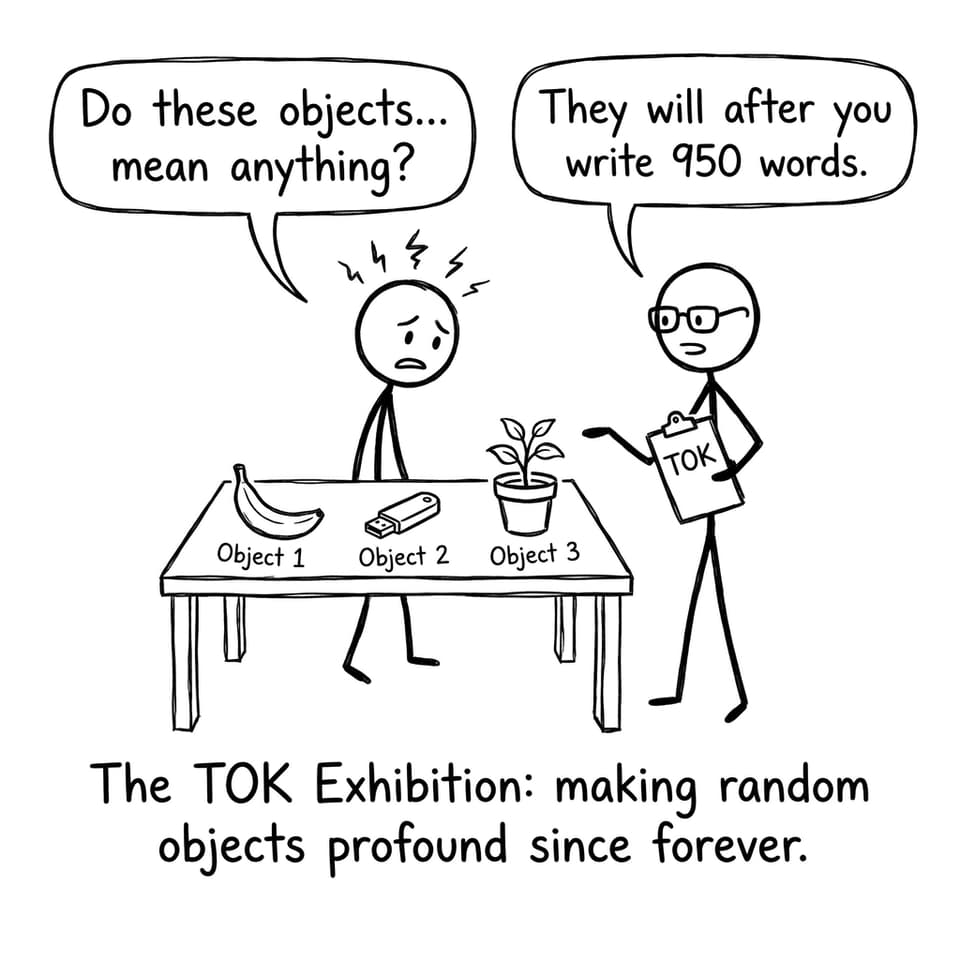
The first time most students feel TOK in their bones isn’t in a class debate about certainty. It’s later, at home, staring at three objects on a desk and thinking: How am I supposed to make this mean something?
That discomfort is the point. The TOK exhibition prompts are designed to pull knowledge out of the textbook and drop it into ordinary life: your photos, your receipts, your screenshots, your family heirlooms, your lab results. Suddenly, knowledge isn’t a definition. It’s a decision: what to trust, what to question, and why.
This guide explains what the TOK exhibition prompts are, what they’re really asking you to do, and how to choose one that sets you up for a sharper, calmer exhibition.
What are the TOK exhibition prompts?
TOK exhibition prompts are the official set of 35 prescribed prompts given by the IB for the TOK exhibition. Each prompt is an open-ended question or statement about knowledge: how it’s created, justified, shared, controlled, or challenged.
Your job is to:
-
choose one prompt
-
select three real-life objects (or images of real objects)
-
write a single commentary of up to 950 words total (references excluded)
The prompts are not “topics.” They’re lenses. They’re meant to generate tension: reasonable people should be able to disagree, and your objects should make that disagreement visible.
If you want the bigger assessment picture, keep these guides open as you plan: IB TOK Exhibition: Your Complete Guide to Success and IB Theory of Knowledge (TOK) Requirements Explained.
A fast TOK checklist for picking a prompt
Before you commit to a prompt, run this quick TOK checklist:
-
Can I think of three specific objects in 3 minutes?
-
Do the objects create three different angles (not three versions of the same idea)?
-
Does the prompt naturally invite justification (evidence, authority, interpretation, values)?
-
Can I connect it to at least one Area of Knowledge without forcing it?
-
Can I write about it with real-world context, not abstract theory?
For a full planning walkthrough, use TOK Exhibition Step-by-Step Guide to Excel.
Examples of TOK exhibition prompts (and what they’re really asking)
You’ll see many lists online, but the most useful move is translating a TOK prompt into a job description for your commentary.
Here are five common examples (and the deeper question hiding inside each):
“What counts as knowledge?”
This prompt is really about standards. Who sets the rules for what qualifies as knowledge? What gets excluded? Your objects should help you compare different “gatekeeping systems” (science, school, social media, tradition).
“Who owns knowledge?”
This is about control and access: intellectual property, cultural knowledge, data, medical research, Indigenous knowledge systems. Strong objects here usually have a clear trail of power: who can use the knowledge, who profits, who is left out.
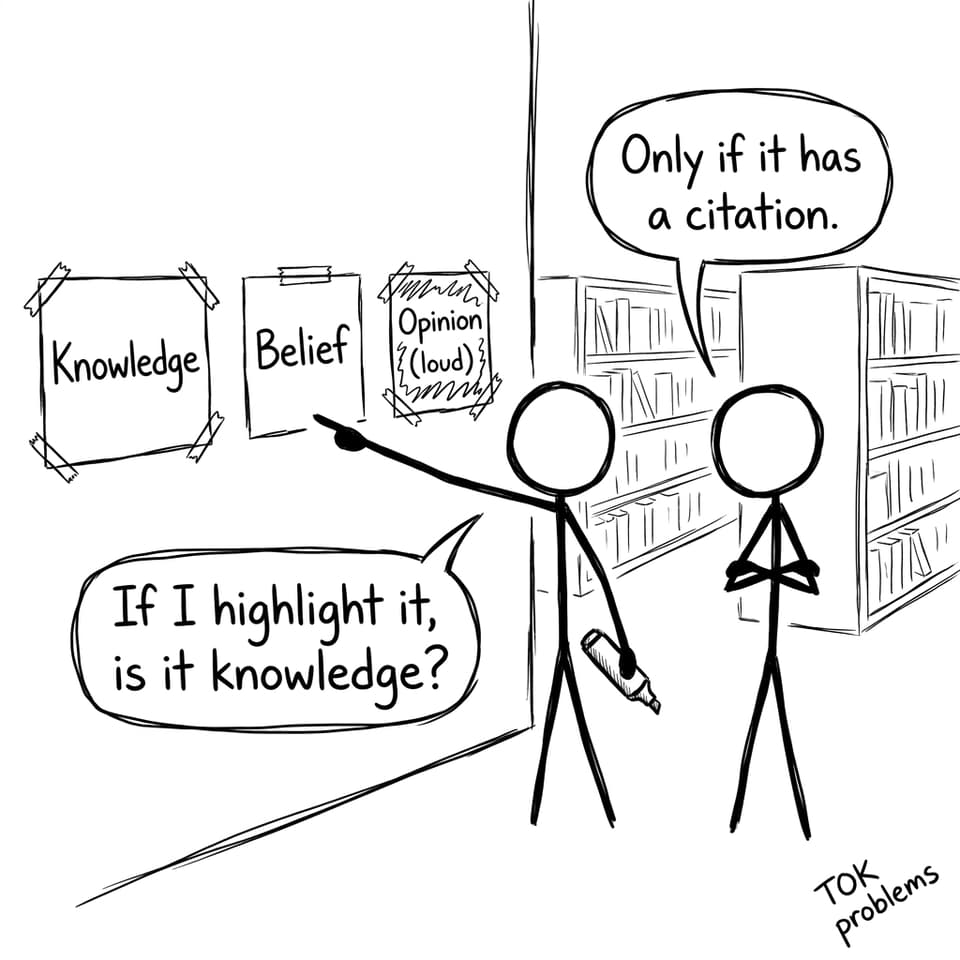
“How can we distinguish between knowledge, belief, and opinion?”
This prompt rewards precision. You’re not listing definitions; you’re showing how a belief becomes treated like knowledge (or how knowledge collapses into opinion). Objects that work well include headlines, textbooks, community rules, or scientific claims presented to the public.
“How does the context influence our knowledge?”
Context is the invisible hand behind interpretation. Your objects can show how the same information changes meaning across time, culture, language, audience, or medium.
“What are the ethical implications of knowledge?”
Ethics prompts are about consequences. Not “ethics is important,” but who is harmed or helped when this knowledge is produced or shared? The best objects here often contain a moral trade-off.
If you’re also juggling the essay, this comparison helps: TOK Essay vs Exhibition: 7 Key Differences and Tips for IB Success.
How to approach TOK exhibition prompts (the method that saves time)
Most TOK exhibitions struggle for one predictable reason: students describe objects and hope meaning appears. Instead, build each object paragraph around a simple spine.
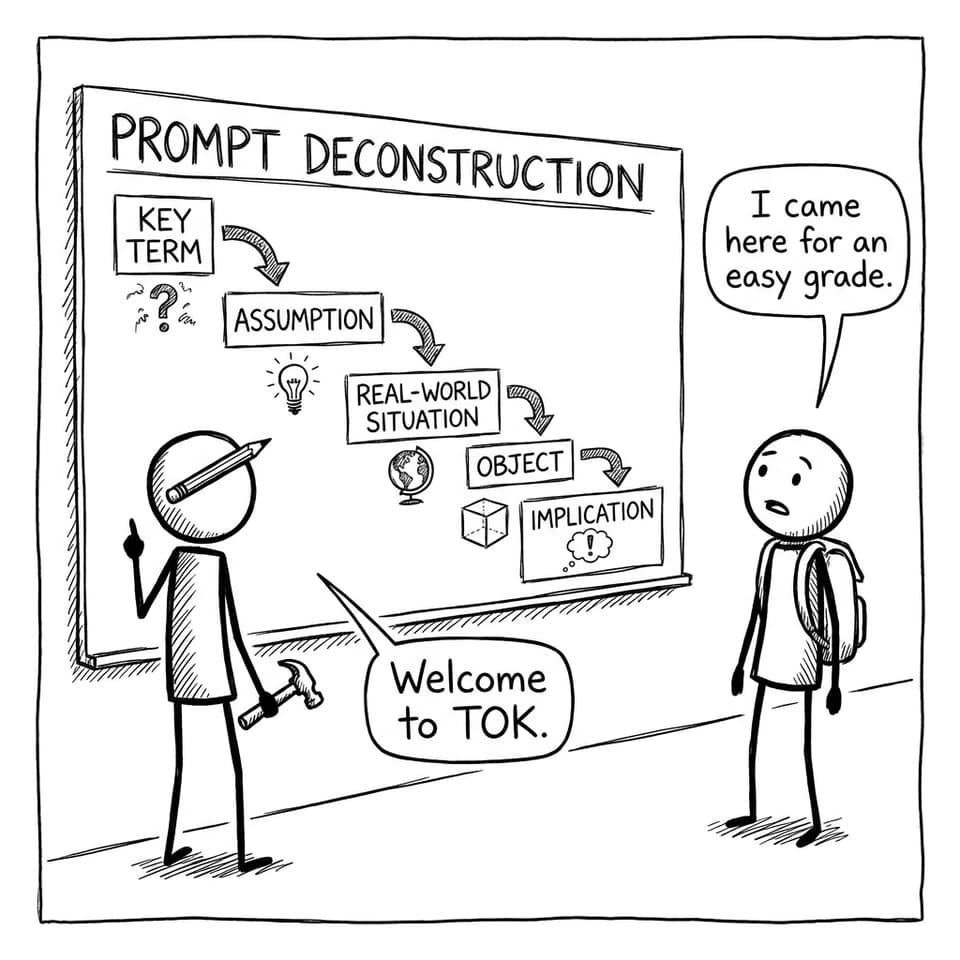
Deconstruct the prompt into 3-4 “hinge words”
Circle the words that force a decision.
Example: “What counts as knowledge?”
-
counts (according to what criteria?)
-
knowledge (in which community or AOK?)
Then write one sentence: In this exhibition, ‘counts’ will mean… and ‘knowledge’ will mean… That sentence becomes your control panel.
Choose objects that disagree with each other
A high-scoring TOK exhibition often has internal friction: Object 1 suggests one answer; Object 2 complicates it; Object 3 exposes a limitation or a consequence.
If you need object inspiration, start here: Best TOK Exhibition Object Ideas (Easy, Unique & High-Scoring) and Selecting the Right Objects for Your TOK Exhibition.
Write commentary that does more than “connect”
In TOK, “this relates to the prompt because…” is the entry ticket, not the destination. The destination is justification and implication.
A strong object paragraph usually includes:
-
Context (what it is, where it comes from, why it matters)
-
Explicit link to the TOK prompt
-
A knowledge move (evidence, bias, authority, interpretation, values)
-
A consequence (so what changes if we accept this as knowledge?)
For a writing-focused guide, use How to Create an Engaging TOK Exhibition Commentary.
How RevisionDojo helps you turn a prompt into a markband
TOK can feel like trying to grab fog. RevisionDojo makes it concrete.
-
Use Study Notes to clarify key TOK terms (claims, justification, perspectives) without overcomplicating.
-
Build confidence with Flashcards for prompt language, AOK links, and evaluator vocabulary.
-
Stress-test your thinking by asking AI Chat to generate counterclaims and alternative interpretations for each object.
-
Calibrate quickly with the IB TOK Exhibition Grader, which translates the rubric into plain English feedback.
-
When you want breadth, the Questionbank and Mock Exams help you practice the kind of precise explanation that TOK rewards.
-
If you’re stuck, Tutors can help you choose a prompt with real depth and stop you from writing three mini-essays that don’t connect.
And if you want one hub for everything TOK, bookmark IB Theory of Knowledge Resources.
Closing: choose a prompt you can live inside
A good TOK exhibition prompt isn’t the one that sounds impressive. It’s the one that gives you three objects with real tension and enough room to think honestly on the page.
Pick a prompt that makes you curious, not just compliant. Then build three object paragraphs that do what TOK was always meant to do: show how knowledge is shaped by evidence, context, and people.
When you’re ready to turn that plan into a final draft, RevisionDojo helps you move faster and with more confidence, from Study Notes and Flashcards, to AI Chat, the TOK Exhibition Grader, and expert Tutors who can help you find the sharpest version of your argument.