
If TOK feels like the one IB subject that grades your brain while it’s thinking, you’re not imagining it. One day you’re revising biology definitions, the next you’re asking whether “evidence” means the same thing in history as it does in the natural sciences. That whiplash is the point. TOK is the IB’s way of turning you into a student who can hold uncertainty, argue clearly, and still make a judgement.
This guide breaks down the TOK requirements for 2025: what you must submit, how it’s assessed, and what to do this week to stay calm and score well.
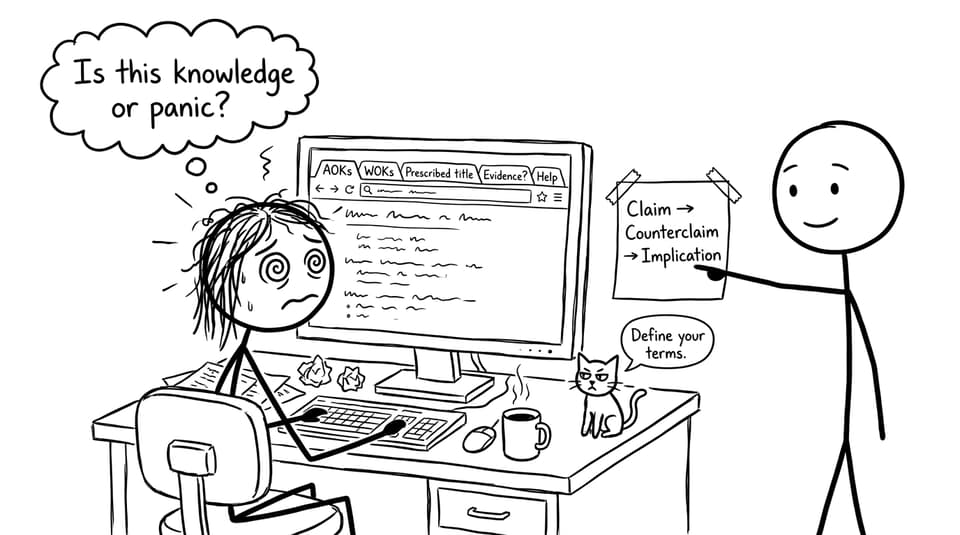
TOK requirements at a glance (save this)
Here’s the clean checklist of TOK assessment components:
-
TOK essay: maximum 1,600 words, based on one prescribed title; externally assessed.
-
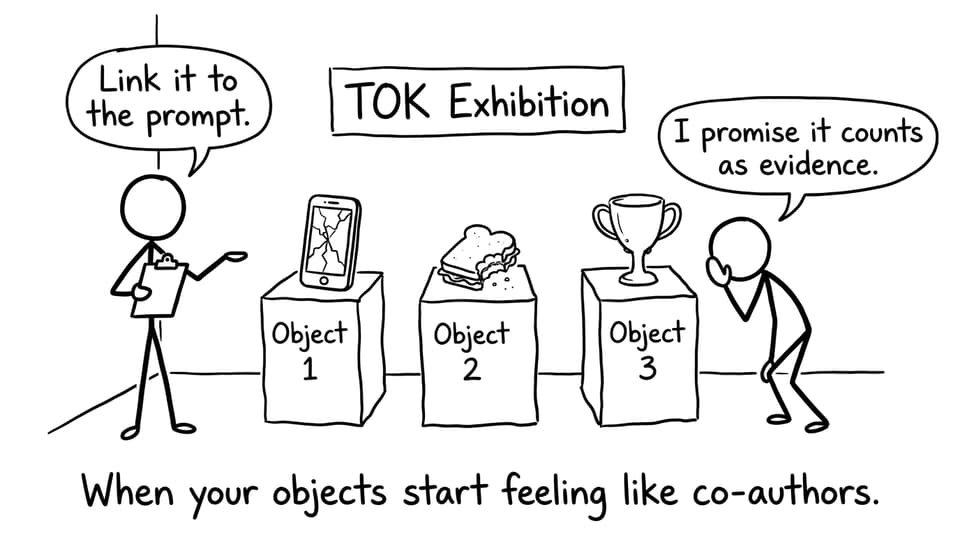
TOK exhibition: three objects (or images of objects) linked to one of 35 prompts, with a written commentary up to 950 words total; internally marked by your teacher and externally moderated.
-
Both are mandatory for the IB Diploma.
-
TOK combines with the EE to contribute up to 3 core points.
If you want a single home base while planning, keep IB Theory of Knowledge (TOK) Resources open as your map.
TOK essay (1,600 words): what it really demands
The TOK essay sounds simple: pick a prescribed title and write. In reality, strong TOK writing does three quiet things: it defines terms carefully, builds a real argument, and keeps returning to the title like it’s a compass.
Key requirements:
-
Choose 1 of 6 prescribed titles released by the IB for your session.
-
Explore a central knowledge question using at least two Areas of Knowledge (AOKs).
-
Use claims and counterclaims, supported by specific real-life examples.
-
Remember: your teacher can guide you, but they can’t “fix” your final essay.
For structure help, use IB Theory of Knowledge 4.2 the TOK Essay and the planning logic in Structuring for Success in IB TOK Essays. If titles confuse you, TOK Essay Titles: What Are Knowledge Questions? turns “topic panic” into a workable KQ.
TOK exhibition (3 objects): what gets marks
The TOK exhibition is where the course stops being abstract. Your job is to show how TOK shows up in the world around you. Not in a poetic way. In a precise way.
Requirements to remember:
-
Pick one prescribed prompt (from the 35).
-
Select three specific objects (or images of objects) that connect to that prompt.
-
Write one commentary (up to 950 words total, references excluded).
-
Only the commentary is assessed, not how “pretty” the display is.
Start with IB TOK Exhibition: Your Complete Guide to Success, then refine object choice using Selecting TOK Exhibition Objects That Score and expectations from How Is the TOK Exhibition Graded?.
TOK assessment: weighting, deadlines, and the “E” risk
TOK isn’t “extra.” It’s a core requirement, and the stakes are real.
-
The TOK essay is 67% of your TOK result.
-
The TOK exhibition is 33%.
-
If you receive an E in TOK, you risk not being awarded the full IB Diploma (even if your subject grades are strong).
The practical takeaway: treat TOK like a project with milestones. Draft early, then iterate.
How RevisionDojo helps you actually improve in TOK
TOK gets easier when feedback is fast and specific.
-
Use IB TOK Essay Grader and IB TOK Exhibition Grader to pressure-test drafts against rubric language.
-
Study what good looks like in IB Theory of Knowledge (TOK) Examples.
-
Build habits with the broader RevisionDojo toolkit: Study Notes to clarify concepts, Flashcards for key terms, AI Chat to interrogate your own claims, and Grading tools to revise with intent.
For a skills-first approach, TOK Thinking and Skills: How to Succeed in IB TOK is a strong reset.
FAQ: TOK requirements and common confusion
Is TOK just “philosophy,” or is it scored like a normal IB subject?
TOK is philosophical in the sense that it questions how knowledge works, but it’s scored very concretely through the essay and exhibition. You’re not rewarded for sounding deep, you’re rewarded for being clear and evaluative. In TOK, “to what extent” matters because you must weigh conditions, limits, and implications. That’s why a claim without a counterclaim often reads like a speech, not analysis. If you write with a visible line of reasoning, examiners can award marks confidently. If your writing is vague, they can’t.
What’s the biggest mistake students make in the TOK essay?
The most common mistake is writing a subject essay that happens to mention TOK words. A TOK essay must stay focused on the prescribed title as a knowledge problem, not as a topic to explain. Another frequent issue is using examples as decoration: named examples are good, but only if you explain what the example shows about knowledge. Students also forget to define key terms in their own context, which makes the argument slippery. Finally, many essays avoid judgement because it feels risky, but TOK rewards careful judgement. The goal is not certainty, it’s justified evaluation.
What makes a TOK exhibition object “good”?
A good TOK object is specific, real, and capable of creating a genuine knowledge issue. It should do more than match the prompt thematically; it should help you answer it. Strong objects also bring distinct perspectives, so your three objects don’t repeat the same point three times. Context matters: where the object comes from and why it’s credible (or not) often becomes your analysis. The writing should move from object description to knowledge-focused commentary quickly. If your paragraph could apply to any similar object, it’s probably too generic.
Final thoughts: make TOK smaller, then make it stronger
TOK becomes manageable the moment you treat it like two clear outputs: a 1,600-word TOK essay and a three-object TOK exhibition with a 950-word commentary. Build one step at a time, and keep your work tethered to the exact wording of the title or prompt.
When you want that steady, practical workflow, use RevisionDojo as your TOK headquarters: start with IB Theory of Knowledge (TOK) Resources, draft with guidance, check your progress with the Grading tools, and learn faster by comparing against high-scoring examples. Your future self (and your word count) will thank you.