


Political legitimacy is one of those ideas you only notice when it breaks.
A rule changes, a protest starts, a leader refuses to step down, a court decision is ignored. Suddenly the real question isn’t “Who has power?” but “Who has the right to use it?” In IB Global Politics, that gap between power and rightful authority is where some of the best analysis lives.
This article explains what political legitimacy means, why it matters domestically and internationally, and how to write it into high-scoring IB Global Politics exam responses.
What political legitimacy means in IB Global Politics
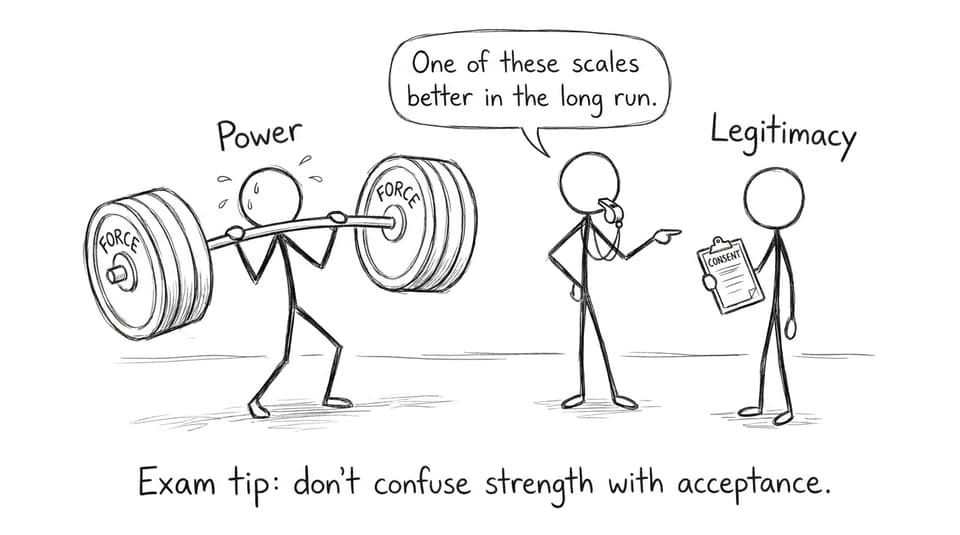
Political legitimacy is the widely held belief that an authority has a rightful claim to rule and that its decisions deserve obedience. The key word is belief: legitimacy exists in people’s minds, in shared norms, and in whether rules feel justified.
In IB Global Politics, legitimacy is not the same as:
-
Power (the ability to influence outcomes)
-
Authority (a recognised right to command, which usually depends on legitimacy)
-
Coercion (forcing compliance without acceptance)
When you’re revising, pair legitimacy with nearby concepts like sovereignty, governance, human rights, rule of law, and recognition. These connections help you move from definition to evaluation.
A quick checklist: how legitimacy is built (and lost)
Use this as a fast planning tool for IB Global Politics essays and source questions:
-
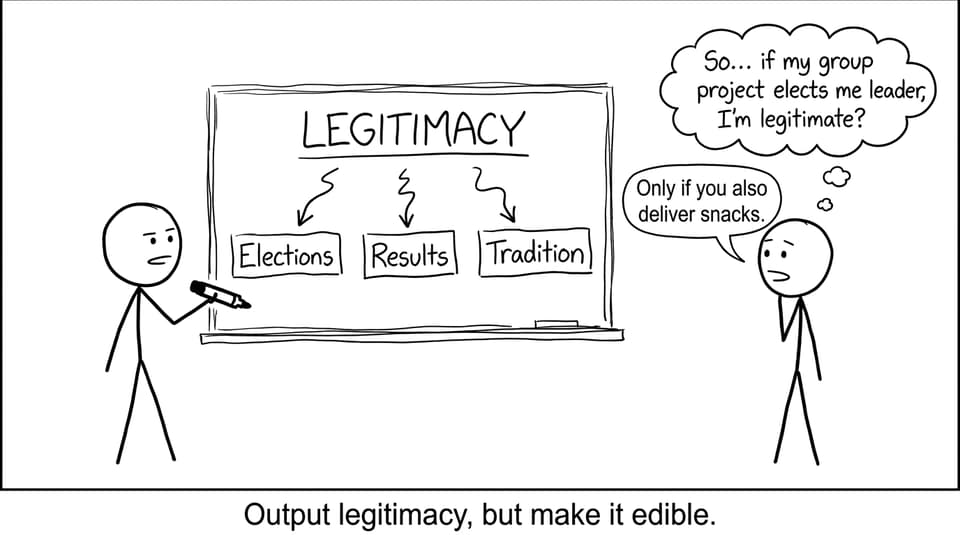
Procedures: elections, constitutions, rule of law, fair institutions
-
Performance: security, services, economic stability, crisis response
-
Values and norms: rights protection, anti-corruption, justice, equality
-
Tradition and identity: history, religion, ideology, national myths
-
International recognition: diplomacy, UN participation, treaties, trade access
Legitimacy weakens when these pillars crack: corruption scandals, repression, election fraud claims, economic collapse, or violations of domestic and international norms.
Domestic legitimacy: why people comply without being forced
Domestic legitimacy is about whether people inside a state see the government as having the right to rule. When legitimacy is strong, compliance becomes cheaper: fewer resources are needed to police, censor, or intimidate.
In IB Global Politics, you can frame domestic legitimacy using two classic angles:
-
Input legitimacy: “Was the process fair?” (elections, constitutional limits, independent courts)
-
Output legitimacy: “Did the government deliver?” (safety, welfare, stability)
High-level analysis comes from trade-offs. For example, a state might deliver strong economic outcomes while restricting civil liberties, creating a legitimacy debate that varies across groups, generations, or regions.
If you want structured definitions and exam-ready phrasing, the IB Global Politics Glossary is useful for tightening your opening sentences under time pressure.
International legitimacy: why recognition shapes real outcomes
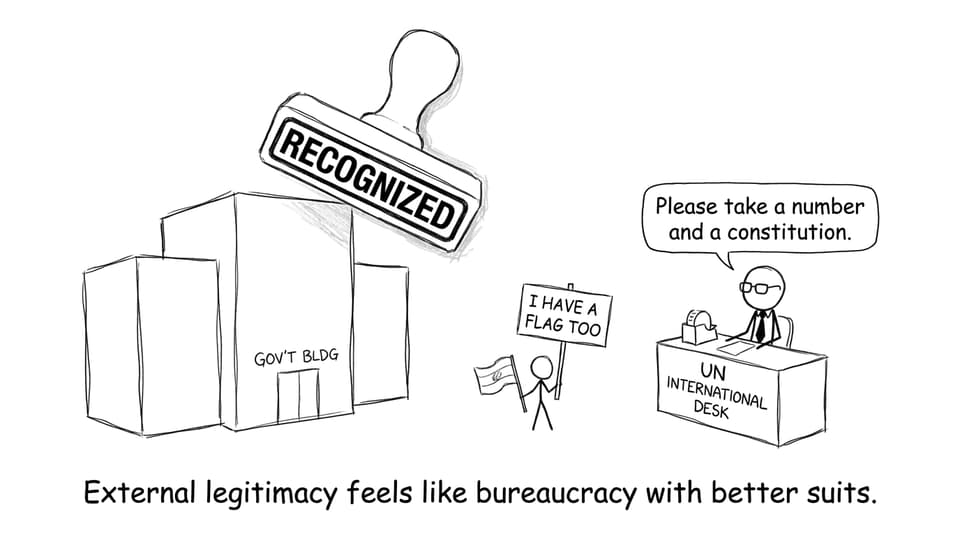
International legitimacy is about whether other states and institutions accept an actor as a rightful participant in global politics. It can shape:
-
Diplomatic recognition and access to negotiations
-
Trade and investment opportunities
-
Membership and voice in international organisations
-
Credibility when making legal or moral claims
And it often overlaps with norms: compliance with international law, human rights standards, or expectations around democratic governance can influence how others treat a regime.
For deeper revision pathways, start at the IB Global Politics Resources hub and move directly into targeted practice using the Legitimacy Questionbank.
How to use political legitimacy in exam answers
In IB Global Politics, legitimacy scores marks when you treat it as a cause-and-consequence engine, not a vocabulary word.
For Paper 1 source questions
Define legitimacy in one clean sentence, then apply it to the sources:
-
Who is granting or denying legitimacy?
-
What evidence shows acceptance (or refusal)?
-
Is the challenge domestic, international, or both?
Then add evaluation: legitimacy can be partial, contested, or uneven across groups.
For Paper strategy, the Paper 1 Guide Notes help you build habits that fit the time limit.
For Paper 2 essays
Use legitimacy to structure paragraphs:
-
Claim: legitimacy strengthens stability by reducing reliance on coercion.
-
Evidence: a precise case detail.
-
Explanation: connect the detail back to the concept.
-
Evaluation: legitimacy can be maintained through performance even if procedures are weak (and vice versa).
To tighten your essay planning, keep the Paper 2 Guide nearby.
Bringing it home: legitimacy is the invisible part of power
If power is the steering wheel, legitimacy is the road surface. You can still drive without it, but every turn becomes risky, expensive, and loud.
For IB Global Politics revision, the fastest upgrade is to practise legitimacy as an argument tool: define it, apply it to a real context, then evaluate how it shifts stability and recognition. Build that skill with RevisionDojo’s IB Global Politics Revision Notes, drill exam technique using the Legitimacy Lessons, and sharpen structure with the Case Studies in IB Global Politics guide.
When the exam question asks why authority holds or collapses, IB Global Politics is really asking whether people still believe the rule is rightful. And that is political legitimacy.