
International intervention is the kind of idea that sounds simple until you have to defend it in an essay. Someone steps in, the fighting stops, civilians are safer, and the world moves on. But in IB Global Politics, the highest marks come from noticing what happens after the headline moment: who grants legitimacy, whose sovereignty is stretched, and whether peace survives the exit.
In other words, asking “How effective is international intervention in conflicts?” is really asking: effective for whom, at what cost, and for how long? That framing is pure IB Global Politics.
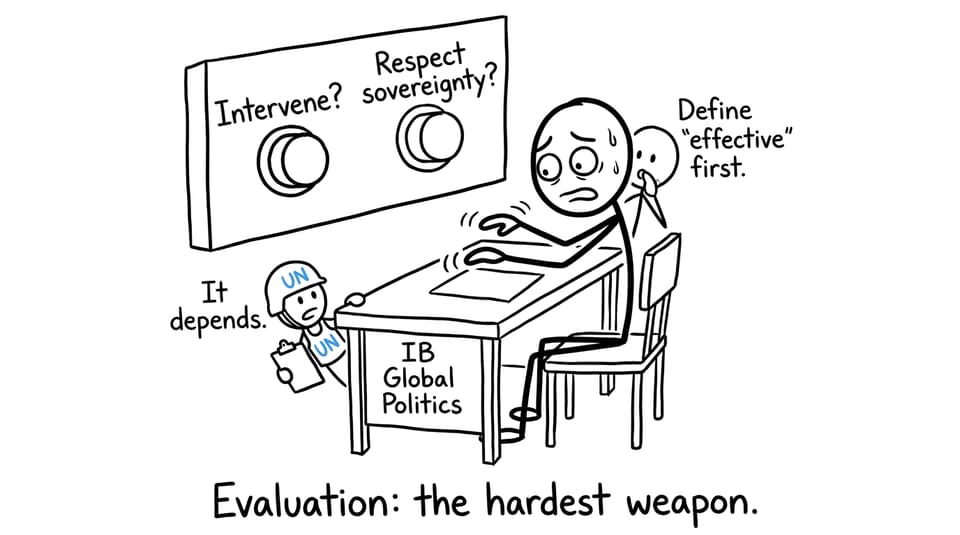
A quick IB Global Politics checklist for “effectiveness”
Use this mini-checklist as a fast plan before you write:
-
Goal clarity: civilian protection, regime change, ceasefire, state-building?
-
Time horizon: short-term security vs long-term political settlement
-
Legitimacy: UN mandate, regional support, local consent
-
Sovereignty costs: invited, coerced, or imposed?
-
Unintended consequences: power shifts, dependency, conflict spillover
-
Commitment: what happens when interveners leave?
If you want topic-specific help, start with RevisionDojo’s IB Global Politics hub: Global Politics - IB Resources.
When international intervention can be effective in IB Global Politics
Reducing immediate violence
One strong argument is that international intervention can lower short-term violence. Peace enforcement, peacekeeping, or limited strikes can deter armed groups and open humanitarian access. In IB Global Politics, you can link this to human security and the tension between protecting people and respecting borders.
To tighten your definitions in exam language, RevisionDojo’s glossary helps: IB Global Politics Key Definitions.
Supporting negotiation and peacebuilding
Intervention is not only soldiers. Diplomatic pressure, mediation, sanctions, and election support can create bargaining space or raise the cost of continuing war. But in IB Global Politics, you should evaluate whether these tools build positive peace or just pause violence.
For structured peacebuilding ideas, use: Notes for Peacebuilding.
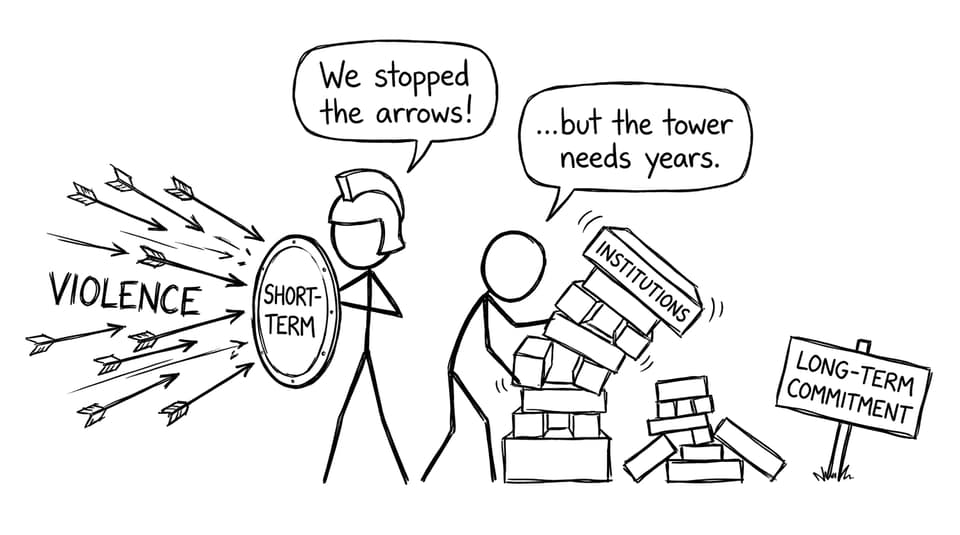
Why international intervention often disappoints in IB Global Politics
Legitimacy is the fuel (and it runs out fast)
Even a tactically successful intervention can fail politically if it is seen as neo-imperial or selective. Without broad international backing or local consent, cooperation weakens and resistance grows. In IB Global Politics, legitimacy is not a moral extra, but it is a practical variable that shapes outcomes.
To practise writing that judgement under time pressure, try: IB Global Politics Topic Legitimacy Questionbank (SL/HL).
Unintended consequences and power shifts
Intervention changes incentives. It can empower certain factions, create dependency on external funding, or freeze a conflict without solving exclusion, inequality, or weak governance. In IB Global Politics, this is where evaluative language matters: “effective in stopping X, but ineffective in addressing Y.”
Sovereignty pushes back
Sovereignty is not just a principle; it is a barrier to access and compliance. States can block monitors, restrict aid corridors, or frame intervention as violation of independence. This is why the sovereignty debate is central to IB Global Politics, not a side note.
Further reading: Is State Sovereignty Declining in the 21st Century? IB Guide.
Selectivity and political interests
Powerful states intervene where interests are high and ignore conflicts where benefits are low. That pattern undermines trust and makes future intervention harder to legitimate. This is a classic IB Global Politics insight: global governance is shaped by power politics.

How to turn this into a top-scoring IB Global Politics paragraph
In essays, the difference between mid and top bands is evaluation. Build paragraphs like this:
-
Claim: intervention can reduce immediate violence
-
Concept link: legitimacy, sovereignty, human rights, security
-
Case evidence: one relevant example (kept tight)
-
Evaluation: short-term vs long-term, unintended consequences, selectivity
-
Mini-judgement: “conditionally effective”
For case study technique, use: How to Use Case Studies in IB Global Politics. For essay structure help, see: How to Structure IB Global Politics Paper 2 Essays and How To Write A Top-Scoring IB Global Politics Essay.
Conclusion: the exam-ready judgement
International intervention is not simply effective or ineffective. In IB Global Politics, the best conclusion is that intervention is conditionally effective: it can reduce violence and support diplomacy, but its success depends on legitimacy, respect for sovereignty (or at least managing that tension), and long-term commitment.
To practise this skill the fastest way, use RevisionDojo’s Questionbank for timed prompts, Study Notes for concept clarity, Flashcards for definitions, AI Chat to test counterarguments, and Grading tools to tighten evaluation. Add Predicted Papers and Mock Exams for full exam runs, then draw stronger examples from the Coursework Library or get targeted help from Tutors. If you’re revising IB Global Politics seriously, RevisionDojo is built to turn “it depends” into a clear, defended judgement.