

In the exam room, case studies can feel like a safety blanket. You know the facts, you know the headlines, and you can tell the story from beginning to end. But in IB Global Politics, that instinct is exactly where marks quietly slip away. Examiners don’t reward the best storyteller. They reward the student who can take a real-world example, slice out the useful proof, and attach it directly to the question’s concepts.

What examiners want from IB Global Politics case studies
A case study in IB Global Politics is not “content.” It’s a tool. Its job is to do three things:
-
Prove a claim you’ve made (or complicate it)
-
Apply a key concept (sovereignty, legitimacy, human rights, development, security, etc.)
-
Evaluate by showing limits, trade-offs, or alternative interpretations
If you want a strong foundation quickly, start by building your case study bank inside the IB Global Politics hub, then connect your examples to the right theme using the Global Politics Cheatsheets.
The “claim first” method (the fastest upgrade)
Most students lead with the event. High scorers lead with the argument.
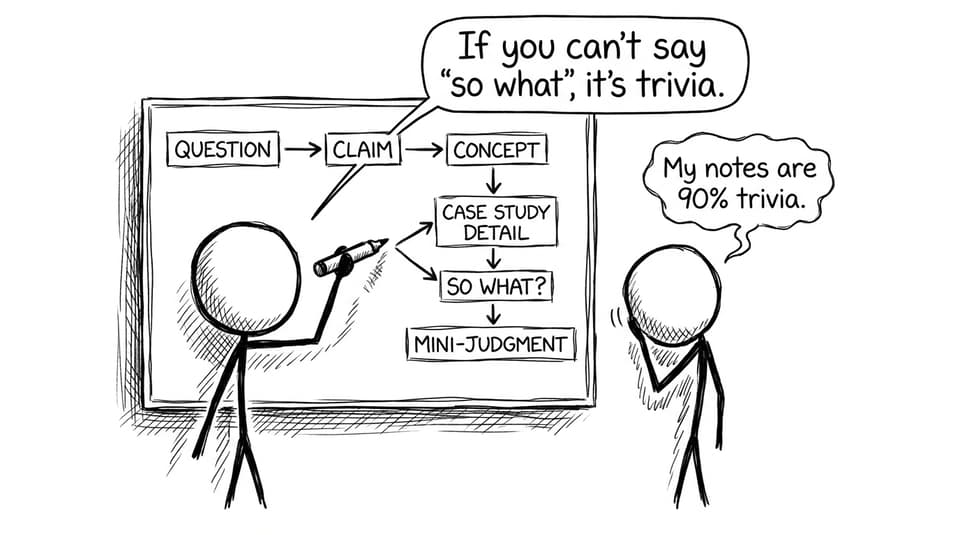
Try this paragraph rhythm:
-
Answer the question with a clear claim.
-
Name the concept you’re applying.
-
Add two to three selective details from your case study.
-
Explain how those details prove the claim.
-
Add a mini evaluation (context, limitation, counterexample).
When you practise, use an exam-style prompt from RevisionDojo’s IB Global Politics Framing Global Politics Questionbank so your structure becomes automatic under pressure.
Be selective: depth beats a long timeline
A case study is strong when it is precise, not when it is long.
For example, if you’re writing about legitimacy, you don’t need every political speech and every election result. You need a few details that clearly show:
-
who claimed authority,
-
why people accepted or rejected that authority,
-
and what the consequences were.
RevisionDojo’s notes on legitimacy help you choose details with purpose, especially External challenges to state legitimacy.

Link your case studies explicitly to key concepts
In IB Global Politics, “I mentioned a country” is not analysis. The link must be explicit.
Useful sentence starters:
-
“This illustrates sovereignty because…”
-
“This policy affects human rights by…”
-
“This actor gains power through…”
-
“The outcome challenges development assumptions because…”
If you need a quick concept refresh, RevisionDojo’s topic pages (like Power) are built for fast, exam-ready clarity.
Add evaluation: use your case study to show complexity
Evaluation is often the difference between a mid-mark answer and a top-mark answer in IB Global Politics.
Ways to evaluate without rambling:
-
Show unintended consequences
-
Compare short-term success vs long-term costs
-
Note context dependence (what worked here might fail elsewhere)
-
Offer a counterclaim using the same case study, framed differently
To train this skill, practise under Paper conditions using the Paper 2 Guide Notes and the Paper 2 Guide Questionbank.
A simple RevisionDojo routine to master IB Global Politics case studies
Here’s a calm, repeatable loop:
-
Study Notes: review one concept you keep misusing (5-10 minutes)
-
Flashcards: drill definitions and “concept-to-example” prompts using Flashcards (10 minutes)
-
Questionbank: write one paragraph using the claim-first method (20 minutes)
-
AI Chat + Grading tools: paste your paragraph and ask for criterion-style feedback (10 minutes)
When you want full exam rehearsal, use IB Global Politics Predicted Papers or the subject set at Global Politics Predicted Papers. For coursework-linked examples, the IB Global Politics Coursework Exemplars can also sharpen how you handle real-world evidence.
Conclusion: treat case studies like evidence, not stories
The easiest way to improve in IB Global Politics is to stop using case studies as a narrative and start using them as proof. Lead with a claim, link it to a concept, choose only the details that matter, and evaluate what the case study can’t fully explain. That’s how your examples become analysis.
If you want one place to build that skill fast, RevisionDojo is designed for it: Questionbank for exam-style practice, Study Notes and Cheatsheets for clarity, Flashcards for recall, AI Chat and Grading tools for feedback, plus Predicted Papers, Mock Exams, the Coursework Library, and Tutors when you need the next level. Start with the IB Global Politics hub and turn your case studies into marks.