Practice IB Global Politics Topic Legitimacy with authentic exam-style questions for both SL and HL students. This question bank focuses on the exact syllabus content for Legitimacy and mirrors Paper 1, 2, 3 style where relevant.
Get instant solutions, detailed explanations, and build confidence with questions aligned to IB examiner expectations.
Source A
Adapted from "Recognition and the Right to Rule," World Order Studies, 2022.
For a state, international recognition can be decisive. Recognition by other governments and admission to bodies such as the United Nations allow a state to sign treaties, borrow from international lenders, trade freely and defend its interests abroad. Contested entities that lack broad recognition, such as Somaliland, Kosovo or Taiwan, may govern effectively and enjoy strong domestic support yet remain excluded from full membership of the international community. Some scholars therefore argue that external recognition is the ultimate test of statehood. Others counter that recognition follows power and interest: states recognise those they wish to, and a government with deep domestic legitimacy and effective control can endure for decades despite limited recognition.
Source B
Adapted from "Consent of the Governed," Journal of Democratic Theory, 2021.
The oldest argument about legitimacy locates it not abroad but at home. On this view, a government is legitimate when those it governs consent to its rule, expressed through free elections, the rule of law and respect for rights. External recognition, however useful, cannot manufacture this domestic acceptance: foreign governments recognised many authoritarian rulers who were despised by their own populations. The Arab uprisings of 2011 showed how quickly internationally recognised leaders can fall once domestic consent evaporates. Legitimacy that is not grounded in the acceptance of the governed, the argument runs, is brittle whatever its standing abroad.
Using both sources and your own knowledge, evaluate the claim that international recognition is the most important source of a state's legitimacy.
Source A
Source B
Adapted from "Where Authority Comes From: The Foundations of Political Legitimacy," International Governance Review, 2021.
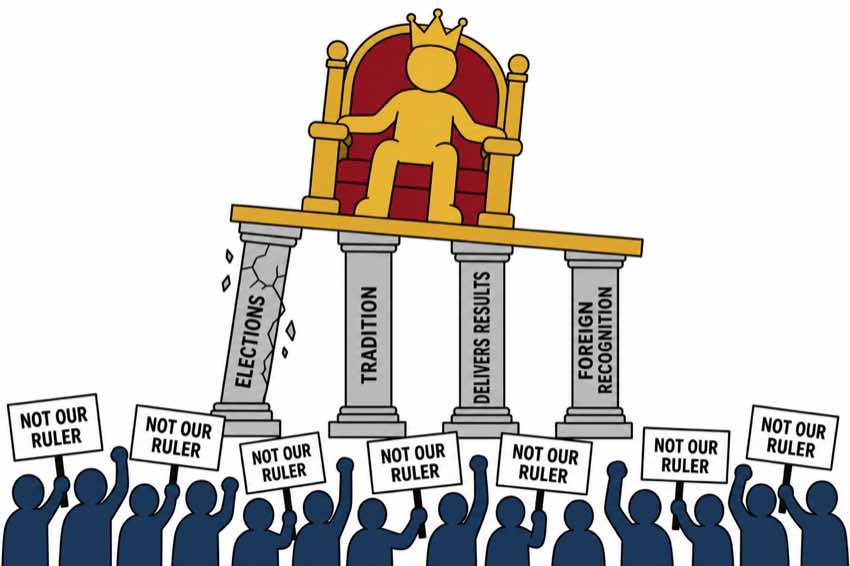
Legitimacy is the widely held belief that an authority has the right to rule and that its commands ought to be obeyed. It is distinct from raw power: a regime may control territory through force yet still be seen as illegitimate by those it governs. Scholars identify several overlapping sources. Some rulers draw on tradition and long-established custom; others on a charismatic leader who inspires personal loyalty. In most modern states, legitimacy rests on legal-rational foundations: leaders gain office through constitutional rules and competitive elections, and citizens accept their authority because the process is seen as fair. A further source is performance, or "output" legitimacy: governments that deliver security, prosperity and public services can earn acceptance even where democratic procedures are weak. Because these sources overlap, the erosion of one need not be fatal, but a regime that loses several at once faces a crisis of authority.
Source C
Adapted from "Recognition Denied: The Taliban and Myanmar's Generals," Journal of Contemporary Statehood, 2023.
Two regimes that seized power by force have struggled to convert control into acceptance. When the Taliban recaptured Kabul in August 2021, they controlled almost all of Afghanistan's territory, yet by 2023 no state had granted them full diplomatic recognition; their seat at the United Nations remained held by representatives of the ousted government. Their exclusion of women from secondary education and public life became a central obstacle to international acceptance. Myanmar's military, which overturned the 2020 election result and detained the elected leadership in February 2021, faced mass civil disobedience, armed resistance and near-total loss of domestic legitimacy. In both cases, effective control of the state did not produce the recognition, at home or abroad, that the rulers sought. Authority imposed by force, these examples suggest, is not the same as authority that is accepted.
Source D
Adapted from "Delivering Legitimacy: Performance and Consent in One-Party States," Comparative Politics Today, 2022.
Not all durable governments rest on the ballot box. In several one-party and dominant-party systems, rulers cultivate what analysts call performance legitimacy: the claim to a right to rule based on results rather than elections. In China, decades of rapid growth, poverty reduction and infrastructure expansion have been presented by the Communist Party as evidence of its competence, and surveys consistently record high reported trust in the central government. Yet performance legitimacy carries a specific vulnerability. Because it is earned through delivery, it can be lost through failure: an economic slowdown, a mishandled public-health crisis or visible corruption can rapidly corrode consent that took decades to build. Governments resting mainly on results, unlike those with an electoral mandate, cannot easily fall back on the argument that the people freely chose them.

Using Source A, identify three sources from which a government's legitimacy can be drawn.
With explicit reference to Source B and one example you have studied, explain how competitive elections can confer legitimacy on a government.
Compare and contrast what Source C and Source D reveal about how governments acquire legitimacy.
Using at least three of the sources and your own knowledge, evaluate the claim that a government's legitimacy depends more on its performance than on the way it came to power.
Source A
Text extract (adapted): "When a government answers peaceful protest with mass arrests, internet blackouts and lethal force, it may silence the streets, but it does something to itself in the process. Each act of repression tells citizens that the state fears their voice rather than answers to it. What began as a demand for reform curdles into a question about the regime's very right to rule."
Using Source A, explain how a government can lose legitimacy through the repression of its own citizens.
Discuss the extent to which regional organizations threaten state sovereignty.
Source A
Text extract (adapted): "The generals who seized power in Myanmar in February 2021 command the ministries, the courts and the army. Yet across the country civil servants walked out, doctors refused to serve, and millions treated the parallel National Unity Government as their real authority. The junta holds the machinery of the state, but not the belief of the people it governs."
Source B
Data (adapted from public records): International standing of two governments that took power by force.
Afghanistan (Taliban administration since 2021): number of United Nations member states granting it formal diplomatic recognition by 2024 = 0.
Myanmar (military administration since 2021): the ousted government's envoy retained the country's United Nations General Assembly seat through 2024; the junta was not seated.
Both administrations exercise effective control over most of their territory.
Source C
Text extract (adapted): "A government earns the right to rule by keeping the peace, protecting property and delivering what people need to live. Where order and services are provided, citizens comply and outsiders deal with it, whatever the story of how it first took power. Effectiveness, over time, becomes legitimacy."
Source D
Text extract (adapted): "No amount of order can manufacture consent. A regime is legitimate only when the governed accept its right to command them, and that acceptance must be freely given, not extracted at gunpoint. Control tells you who holds the guns; legitimacy tells you whom the people would obey without them."
Using Source B, identify three things the data suggest about how governments that take power by force are treated internationally.
Using Source A, explain how a government can hold control over a state while lacking legitimacy.
Compare and contrast what Source C and Source D suggest about the main source of a government's legitimacy.
Using the sources and your own knowledge, evaluate the claim that a government's legitimacy depends more on the consent of the governed than on its control of territory.