


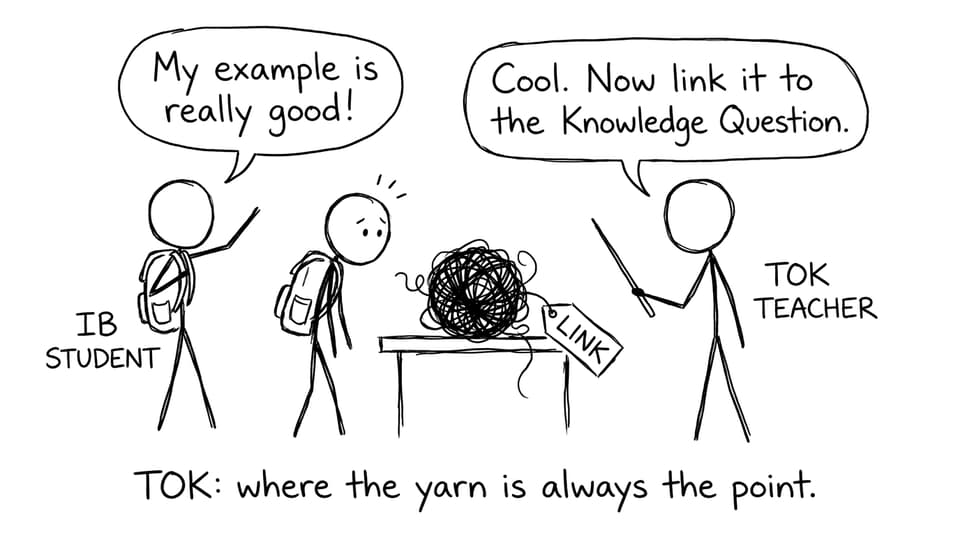
If you have ever written a brilliant real-world example in TOK and then felt it just… sits there, you are not alone. It is the most common quiet problem in IB writing: the paragraph looks busy, but the thinking is missing. Examiners are not grading your ability to recall events. They are grading whether you can turn events into a knowledge problem.
That conversion is an art. And, like most arts, it gets easier when you learn a repeatable method and a few sentence starters that keep you from drifting into storytelling.
The TOK checklist: example to KQ in 60 seconds
Use this micro-checklist whenever you add an example in TOK:
-
State the KQ (or the part of the prescribed title) your paragraph is answering.
-
Name the knowledge claim (what you are saying about how knowledge works).
-
Place the example in one sentence (context only).
-
Explain the mechanism: why does the example support the claim?
-
Add a limitation: what could weaken your reading of the example?
-
Return to the KQ with a judgment (even a tentative one).
If you want a bigger structure to plug this into, keep Comprehensive Guide to IB TOK Essay Structure open while you draft.
What linking really means in TOK (and what it is not)
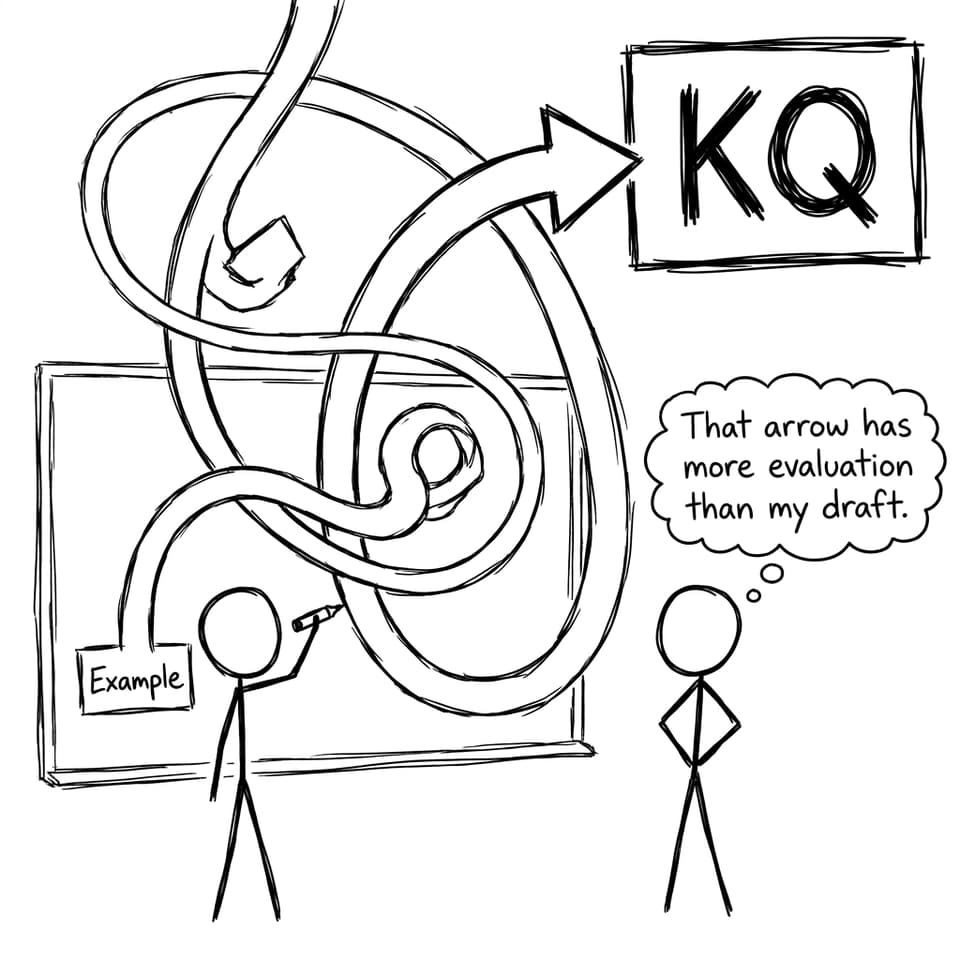
Linking in TOK is not a transition phrase. It is not “this shows that…” followed by another summary. Linking is the moment you explain how an example changes what we can reasonably say about knowledge.
A helpful mental model: your example is the case, but your KQ is the lens. Without the lens, you only have a case report.
When you feel stuck, go back to the basics of KQs using TOK Knowledge Questions: Examples and Writing Tips. A sharper KQ makes linking almost automatic.
Qualities of a high-scoring TOK example
Most students think the best TOK examples are the most dramatic. Usually, the best examples are the most analysable.
A strong TOK example is:
-
Specific: a named study, event, artwork, policy, court case, or discovery.
-
Contestable: reasonable people could interpret it differently.
-
Transferable: it helps you say something beyond one moment in time.
-
Anchored in an AOK: you can explain the standards of justification in that area.
For quick planning help, Connecting TOK Essay Ideas to Areas of Knowledge is a useful way to sanity-check whether your example naturally belongs where you put it.
The art of linking examples to Knowledge Questions in TOK
Here is a practical, paragraph-level method you can reuse across TOK essays, the exhibition, and timed practice.
Start with the KQ, not the story
Write your first sentence as if the example does not exist yet. This stops your paragraph from becoming a news recap.
Sentence starters
-
“This paragraph explores the knowledge question of whether…”
-
“Interpreting the title through the lens of ___, we can ask…”
-
“A key issue here is how we justify ___ when…”
Use one sentence of context, then pivot fast
Context should be just enough so the example is recognizable. In TOK, the paragraph is not rewarded for detail; it is rewarded for analysis.
Sentence starters
-
“In a real-world case, … (brief context) …”
-
“Consider the case of …, where …”
-
“A concrete illustration of this is …”
Explain the knowledge mechanism (the examiner is hunting for this)
This is where marks live. You are explaining why the example supports the claim, using AOK methods and WOK influences.
Sentence starters
-
“This supports the claim because it shows that knowledge is produced by…”
-
“What matters here is not the result, but the method: …”
-
“From the perspective of ___ (AOK), the standards for evidence require…”
To strengthen this move, model your structure on Building Coherent Arguments in TOK, especially the claim-to-counterclaim rhythm.
Add a counterclaim that is a limitation, not a random opposite
A counterclaim in TOK should feel like a stress test of your claim. It is often a change in conditions: different context, different values, different method, different language.
Sentence starters
-
“However, this interpretation depends on the assumption that…”
-
“A limitation of this example is that…”
-
“On the other hand, if we shift the context to ___, the claim becomes weaker because…”
Return to the KQ with a nuanced judgment
End the paragraph by answering the KQ in miniature. Even if your final answer is “to a limited extent,” you should show what you can responsibly conclude.
Sentence starters
-
“So, in response to the knowledge question, this suggests that…”
-
“Therefore, the example supports the claim to the extent that…, but not when…”
-
“This shifts the debate from ‘is it true?’ to ‘under what conditions is it reliable?’”
If conclusions feel hard, see Writing Strong Conclusions for Theory of Knowledge (TOK) Essays and borrow its language of limits and implications.
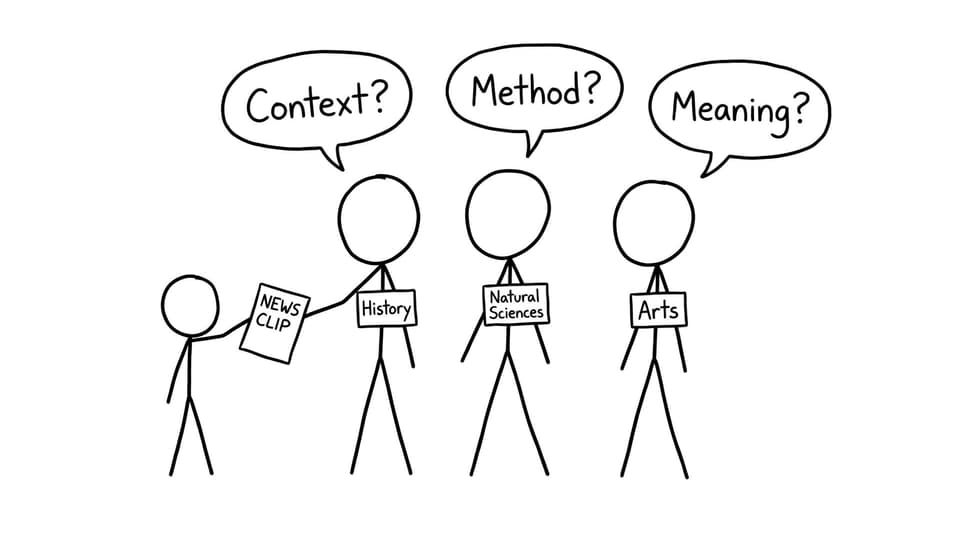
TOK sentence starters you can mix and match
Keep these nearby while drafting TOK paragraphs.
Linking example to claim
-
“This example is significant because it reveals…”
-
“The key TOK feature of this situation is…”
-
“This is a knowledge issue rather than a factual dispute because…”
Introducing evaluation
-
“The strength of this example is…, yet its weakness is…”
-
“This seems convincing until we consider…”
-
“A different perspective emerges if we prioritize…”
Bringing in AOKs and WOKs naturally
-
“In history, justification often depends on…”
-
“In the natural sciences, reliability is strengthened by…”
-
“Language shapes interpretation here by…”
-
“Emotion may function as…, which complicates…”
Using TOK links in the essay vs the exhibition
In the TOK essay, your example is usually there to develop a claim/counterclaim under an AOK. In the exhibition, your object must be defended as worth choosing for a prompt.
For exhibition structure, use IB TOK Exhibition: Your Complete Guide to Success and Selecting the Right Objects for Your TOK Exhibition. For commentary tone and clarity, TOK Exhibition Commentary: Make It Engaging is a strong reference.
Common linking mistakes (and quick fixes)
-
Mistake: the paragraph retells the example. Fix: cap context at 1-2 sentences.
-
Mistake: the link is a vague “this shows that knowledge is complicated.” Fix: name the mechanism (method, bias, language, values).
-
Mistake: the KQ disappears after the intro. Fix: echo one phrase from the KQ at the end of the paragraph.
-
Mistake: counterclaim is just disagreement. Fix: make it a condition that changes the conclusion.
If your draft keeps drifting, check your overall paragraph plan with How Many Paragraphs Should a TOK Essay Have? so your structure has enough space for evaluation.
Conclusion: make the link the main event
The secret of high-scoring TOK writing is simple: the example is never the point. The link is. When you consistently move from context to mechanism to limitation to a KQ-focused judgment, your essay and exhibition start to read like disciplined thinking rather than collected stories.
If you want a single place to practice this skill, RevisionDojo is built for it: use the Study Notes to lock in TOK concepts, the Flashcards to keep sentence starters ready, the Questionbank to rehearse knowledge moves, and AI Chat to pressure-test your claims and counterclaims. When you are ready to polish, lean on the Grading tools, and build confidence with Mock Exams and Predicted Papers style practice for structured writing. For students who want guided feedback, RevisionDojo Tutors can help you turn good examples into excellent TOK analysis.
For more targeted guidance, browse the RevisionDojo TOK hub and keep your next draft focused on one thing: linking every example back to the knowledge question, on purpose.