
TOK can feel like the one IB subject that refuses to sit still. You open a document intending to “revise,” and somehow you end up questioning whether your calculator is a trustworthy source of truth.
That confusion is not a flaw. It’s the point. The trick is to turn that restless energy into clear, examinable writing: a focused TOK knowledge question, a deliberate essay plan, and an exhibition that uses objects to make arguments (not decoration). This guide gives you sample TOK questions and topic angles you can adapt fast.
A quick TOK checklist (use this before you write)
Before you commit to any TOK topic, run this short filter:
-
Can your question be argued from at least two strong viewpoints?
-
Does it focus on how knowledge is produced or justified (not just the topic itself)?
-
Can you compare at least two Areas of Knowledge (AOKs)?
-
Do you already have 2--4 real-world examples you can analyse?
-
Can you build a claim and a real counterclaim?
If you want a bigger map of the course, keep the IB Theory of Knowledge (TOK) hub open while you plan.
Sample TOK knowledge questions (copy, adapt, refine)
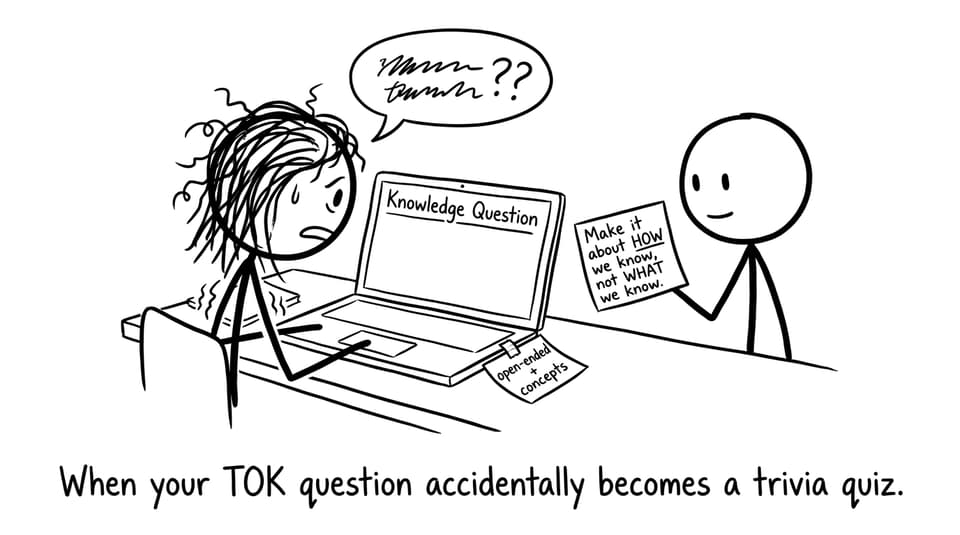
A strong TOK knowledge question is open-ended, concept-driven, and designed for evaluation. It should create friction: two reasonable answers that depend on conditions.
Here are sample TOK knowledge questions grouped by common themes:
Evidence and certainty
-
To what extent should we treat statistical evidence as more reliable than personal testimony?
-
Under what conditions does “more data” reduce uncertainty, and when does it create false confidence?
-
How do standards of evidence differ between the natural sciences and history, and why?
Language and interpretation
-
How does language shape what we consider a “good explanation” in different AOKs?
-
To what extent can translation change the knowledge a text communicates?
-
When do definitions clarify knowledge, and when do they limit it?
Bias, perspective, and authority
-
How can we distinguish expertise from authority bias?
-
Under what conditions is disagreement a sign of weak knowledge, and when is it a sign of healthy knowledge?
-
To what extent should we trust knowledge produced by institutions?
To sharpen a prescribed title into a question like this, use TOK Essay Titles: What Are Knowledge Questions? and the more targeted guide on Using Knowledge Questions in Your TOK May 2026 Essay.
TOK essay prescribed titles: choosing a topic that actually works
Every session, the IB releases six TOK prescribed titles. They’re all valid, but not all are equally useful for you.
A practical strategy is to choose the title that lets you do three things comfortably:
-
contrast two AOKs with genuinely different methods
-
use examples you can explain in under 30 seconds each
-
build a counterclaim that feels tempting (not forced)
For title-by-title breakdown support, see TOK May 2026 Essay Prescribed Titles: Complete Guide for Students or the deeper planning guide RevisionDojo Ultimate TOK May 2026 Essay Guide.
Planning a TOK essay structure that stays coherent
Most TOK essays don’t fail because students lack ideas. They fail because the ideas don’t stay connected to the knowledge question.
A simple structure that holds:
-
Define key terms in your own arguable way.
-
Write a thesis that answers the title with conditions ("yes, when…; no, when…").
-
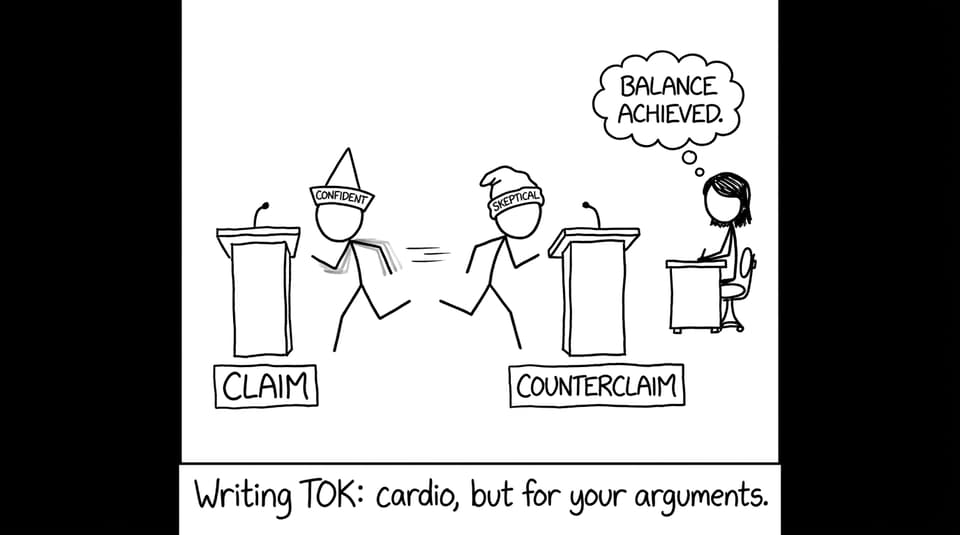
For each AOK: claim -> example -> analysis -> counterclaim -> evaluation.
-
End each paragraph by linking back to the TOK question.
If you need structure help, use Tips for Writing a Clear and Coherent TOK Essay and Structuring for Success in IB TOK Essays. For an examiner-focused mindset, the How to Write a Good TOK Essay (10-step guide) is a reliable reset.
TOK exhibition prompts and object ideas (without going generic)
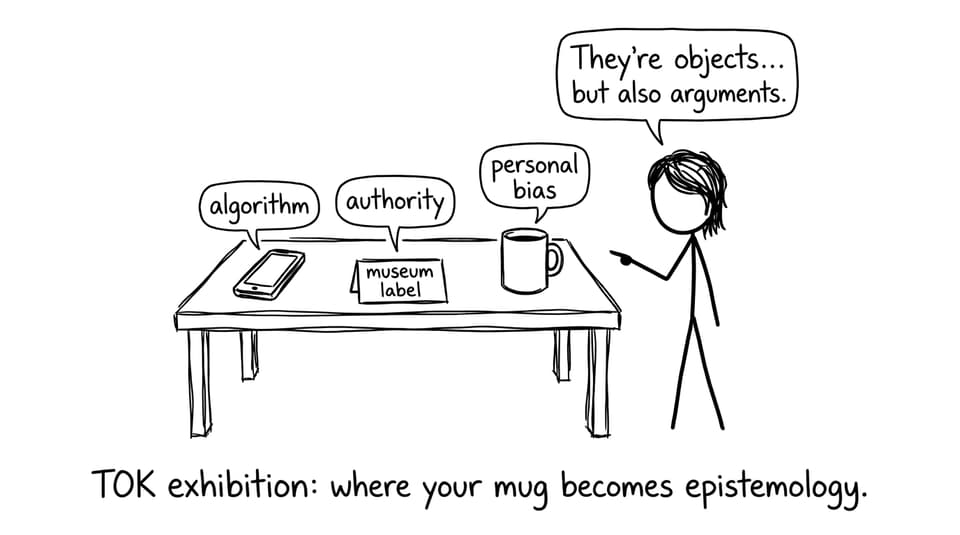
The TOK exhibition is where abstract thinking becomes visible. Your objects are not “props”--they are evidence of a knowledge problem in the real world.
Topic angles that tend to produce strong exhibitions:
-
Who gets to decide what counts as knowledge?
-
What role do tools and technology play in shaping what we believe?
-
How does context change the meaning or reliability of information?
Object pairings that often work (because they contrast perspectives):
-
a phone screenshot of search results vs a printed textbook page
-
a museum label vs a community story or oral testimony
-
a personal item (with context) vs an official policy document
For step-by-step support, use How to Excel in Your IB TOK Exhibition, then refine object selection with Selecting the Right Objects for Your TOK Exhibition. If you’re stuck brainstorming, TOK Exhibition Object Ideas is built for quick wins.
Conclusion: turn TOK into a repeatable system
The best TOK work doesn’t come from having “deep thoughts on command.” It comes from using a repeatable system: a focused knowledge question, contrasting AOKs, specific examples, and honest evaluation.
If you want that system to feel simpler, build your workflow inside RevisionDojo: use Study Notes to clarify concepts, Flashcards to keep key terms active, AI Chat to stress-test claims, and the Grading tools (including the IB Coursework Grader) to get rubric-aligned feedback. When you’re ready to practise under pressure, RevisionDojo’s Mock Exams, Predicted Papers, Questionbank, Coursework Library, and Tutors turn TOK from mystery into momentum.