


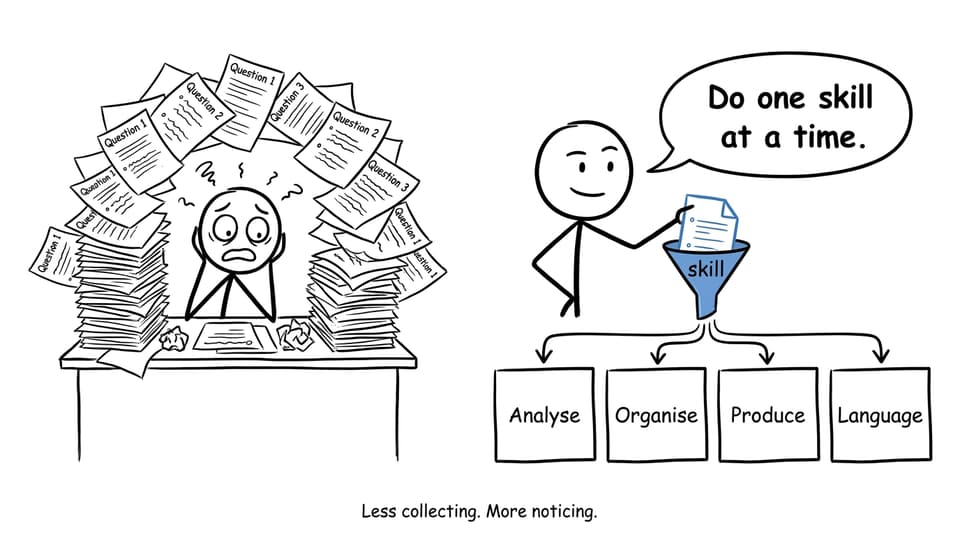
Using past questions for MYP English Language and Literature works best when you treat each question as a skill-training tool, not a prediction of what will appear next. Choose one question, identify the criterion and command term, answer it under a short time limit, evaluate the evidence in your response, and rewrite the weakest section.
The official MYP framework organizes Language and Literature assessment around four equally weighted criteria: A: Analysing, B: Organizing, C: Producing text, and D: Using language. Your school determines its texts and assessment tasks, so always use the rubric and instructions supplied by your teacher. RevisionDojo’s MYP Language and Literature assessment criteria guide can help you translate those criteria into practical actions.
Your same-day practice checklist
- Select one question and its accompanying text or stimulus.
- Identify the command term and assessed criterion.
- Translate the question into a one-sentence job.
- Plan for five minutes without writing full paragraphs.
- Complete one response under a realistic time limit.
- Check your work against the relevant criterion strands.
- Rewrite only the weakest paragraph or section.
- Record one rule to apply next time.
Start by sorting the question, not answering it
A question can look familiar while testing a different skill. Analyse asks you to examine how choices create meaning. Compare requires meaningful connections between texts or features. Evaluate asks for a supported judgment. A production task may instead require you to create a text for a particular audience, purpose, and context.
Before writing, mark three things:
- The command term: What must you do?
- The subject: What exactly must you discuss or create?
- The evidence of success: What must a teacher be able to see in your response?
For example, suppose a question asks you to analyse how a writer creates tension. Your one-sentence job might be: I must explain how specific language and structural choices make the audience anticipate danger. That sentence prevents you from drifting into plot summary.
Use a five-pass method for every question
Pass one: decode the task
Spend two minutes underlining the command term, audience, purpose, text type, and any limits in the question. Then note the likely criteria using your teacher’s task sheet. Do not assume every question assesses all four criteria.
Pass two: build a small plan
For an analytical response, write a provisional claim and two or three paragraph ideas. Beside each idea, add a short quotation or precise textual detail. A useful planning chain is:
choice --> effect --> purpose --> connection to the question
If you cannot complete that chain in your notes, you probably do not yet have a complete analytical point. Use the guide to improving MYP English analysis to practise moving beyond identification and description.
For a creative or non-literary production task, replace the chain with:
audience --> purpose --> convention --> intended effect
This keeps your stylistic choices deliberate rather than decorative.
Pass three: write under a controlled limit
A reliable analytical paragraph contains:
- a specific claim answering the question;
- a short quotation or precise reference;
- identification of an authorial choice;
- explanation of its effect and purpose;
- a link to the wider argument.
Pass four: diagnose the response
Feedback is most useful when it becomes specific. Instead of writing “analysis needs work,” identify the missing action:
| Symptom | Likely issue | Next drill |
|---|---|---|
| You retell the extract | Criterion A reasoning is thin | Add two effect-and-purpose sentences after each quotation |
| Ideas appear in a random order | Criterion B is not visible | Write topic sentences before drafting |
| The piece ignores its audience | Criterion C choices lack intention | Annotate three choices made for the target reader |
| Sentences become difficult to follow | Criterion D control is inconsistent | Shorten sentences and replace vague verbs |
Use your teacher’s feedback first. RevisionDojo Grading tools can provide another criteria-aware check, while AI Chat can question your reasoning or explain why a claim is too broad. It should act as a coach, not write the response for you.
Pass five: rewrite one section
The rewrite is where practice becomes learning. Choose the weakest paragraph and improve it immediately while the reasoning is still fresh.
Finish by adding one sentence to an error log: Next time, I will explain why the audience’s reaction matters. The guide to common MYP language-task mistakes can help you turn repeated problems into targeted drills.
Rotate questions by criterion
Use a simple rotation:
- Session one: Criterion A, with emphasis on choices and effects.
- Session two: Criterion B, using plans, sequencing, and topic sentences.
- Session three: Criterion C, adapting a text to audience and purpose.
- Session four: Criterion D, editing vocabulary, syntax, punctuation, and register.
- Session five: Combine relevant criteria in a timed response.
The criteria overlap in real tasks, but isolating them during training makes weaknesses easier to see. These focused sessions can sit inside a broader MYP revision timetable without making English revision consume every evening.
Increase difficulty only after accuracy improves
There is a temptation to make every practice session feel like the final assessment. Yet endurance built on weak habits simply makes those habits more durable.
Begin with open-book planning. Then write one paragraph without notes. Next, complete a short timed response. Only after you can consistently decode the task and build supported points should you attempt a full Mock Exam.
RevisionDojo makes this progression easier to manage. Use Study Notes when a concept is unclear, Flashcards to retrieve terminology, the Questionbank for focused repetition, and AI Chat to challenge weak explanations. Apply Grading tools after writing, then use Mock Exams and Predicted Papers, where available for your course, to rehearse timing and stamina. The Coursework Library can help you examine how extended ideas are structured without copying another writer’s work, while Tutors can diagnose persistent problems that self-review has not resolved.
The goal is not merely to complete more material. It is to make each attempt slightly more independent than the one before it.
Know when a question has done its job
A question remains useful after you answer it. Return to it two or three days later and create a fresh plan without viewing your original response. If the plan is clearer and your evidence is more purposeful, the feedback has transferred.
You can also reuse one source text with a different instruction. Change analyse to compare, write for another audience, or turn an analytical observation into a deliberate creative choice. This trains flexibility rather than memory.
Students aiming for the highest bands should study what makes reasoning perceptive, organization sustained, stylistic decisions intentional, and language controlled. RevisionDojo’s guide to scoring a 7 in MYP Language and Literature offers a useful next step, but your own current rubric remains the final reference.
Build a loop you can repeat
Good preparation often looks smaller than students expect: one question, one criterion, one timed response, and one careful rewrite. The dramatic part is not the session itself. It is what happens after several weeks, when decoding tasks and explaining choices begin to feel familiar.
Start today with a single question. Use RevisionDojo to clarify the skill, practise it, receive focused feedback, and test it again. The best MYP English Language and Literature study tips do not ask you to collect more work. They help you learn more from every answer you already write.