
Moving into the Diploma Programme can produce a strange professional feeling. You are still teaching your subject, yet familiar decisions about planning, assessment, and feedback suddenly carry different consequences.
The central change when transitioning to teaching IB is not simply adopting another syllabus. DP teaching connects subject knowledge with conceptual understanding, explicit skills, internationally standardized assessment, and a two-year programme shared with other teachers. You also inherit internal assessment procedures, moderation, authentication, formal deadlines, and responsibilities connected to the DP core.
For experienced teachers, the challenge is not learning how to teach again. It is learning where existing expertise fits inside a different system.
What changes at a glance
When switching from a national curriculum to IB, expect to:
- plan backwards from the current subject guide and assessment objectives
- teach concepts and transfer alongside prescribed content
- make command terms and assessment criteria visible to students
- balance inquiry with preparation for formal assessment
- manage internally assessed work under defined conditions
- coordinate deadlines, workload, and academic integrity
- contribute to TOK, Extended Essay, and wider DP conversations
- use formative evidence to adjust teaching
The priority is to identify what is genuinely different in your subject, school, and examination session.
The curriculum becomes a connected system
The DP subject guide does more than list what students should know. It connects aims, syllabus content, assessment objectives, teaching expectations, and assessment components.
This makes the guide your first planning document, not something consulted shortly before an assessment. Read it beside the relevant teacher support material, specimen assessments, criteria, and school calendar. Check that every resource reflects the version being taught to your cohort, since subjects follow different curriculum review cycles.
Then map the two years backwards. Begin with assessment components and submission windows, identify the knowledge and skills students will need, and decide where those capabilities will be introduced, practised, and revisited. The result should be a sequence rather than a checklist of topics.
A useful overview of how expectations build can be found in RevisionDojo's guide to vertical curriculum alignment across IB programmes.
Pedagogy shifts from coverage to transfer
The IB describes teaching across its programmes as inquiry-based, conceptually focused, contextualized, collaborative, inclusive, and informed by assessment. DP teachers are also expected to develop thinking, communication, social, self-management, and research skills.
The practical shift is to ask two questions while planning:
- What must students understand about this topic?
- What should they eventually be able to do independently with that understanding?
A teacher might explain a difficult model directly. The lesson develops further when students test its limitations, apply it in a new context, compare competing interpretations, or decide what evidence would alter a conclusion. Knowledge remains essential, but it becomes material for thought.
Inquiry and explanation are therefore not opposites. Students need enough knowledge and structure to investigate meaningfully, followed by opportunities to transfer what they know beyond the original example.
Assessment becomes part of daily teaching
One of the largest adjustments is learning to see assessment as a language. DP results are based on performance against established standards, and most subjects combine external assessment with internally assessed work. Internal components vary by discipline and may include investigations, oral work, fieldwork, performances, or other subject-specific tasks.
Students need more than content knowledge. They must understand what commands such as analyse, evaluate, compare, or discuss demand in that subject. These words should appear during ordinary learning, not only in high-stakes preparation.
Build a repeated cycle:
- Model how to interpret the task.
- Show what the criteria reward.
- Let students attempt a manageable section.
- Give criterion-referenced feedback.
- Require one specific improvement.
- Reassess the skill in a different context.
RevisionDojo's guide to building IB exam-strategy lessons offers routines for command terms, planning, timing, and reflection. Departments should also calibrate judgments early. The guide to consistent IB grading and assessment explains why shared criteria language and sample marking are more reliable than repairing differences later.
Internal assessment changes the teacher's role
With internally assessed work, you are simultaneously teacher, supervisor, assessor, and guardian of the process. You must understand the current task requirements, conditions, criteria, permitted support, authentication procedures, and school deadlines. You need to help students improve without turning their work into your work.
Discuss that boundary before students begin. Establish how research will be recorded, when feedback is allowed, what collaboration means in your subject, and which forms of assistance are prohibited. Keep records of milestones and interventions. Clear systems protect students as much as schools.
Internal standardization matters when multiple teachers share a subject. Mark a small selection together before everyone completes a full class. Discuss evidence against the criteria rather than arguing from instinct. RevisionDojo's explanation of IA feedback and moderation can help departments structure that conversation.
Administration becomes pedagogical
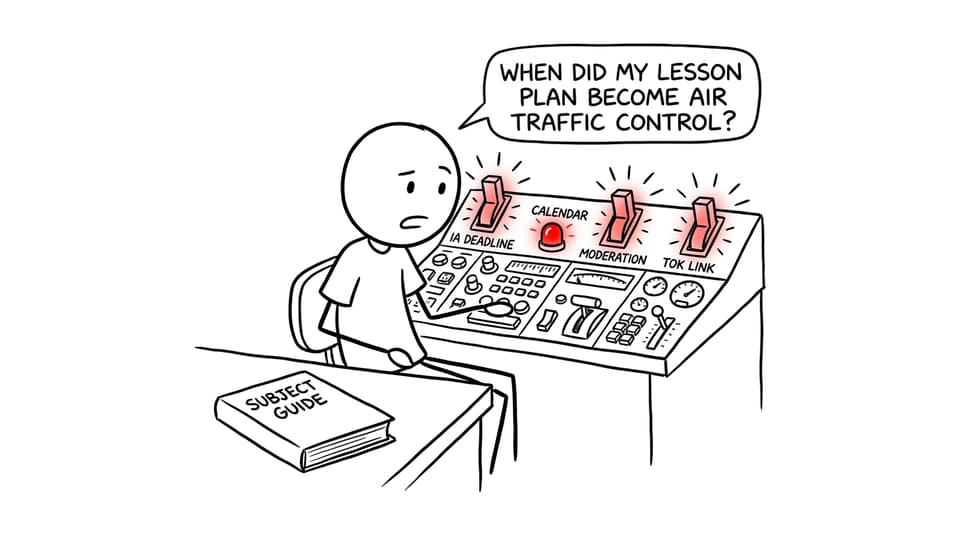
In DP teaching, administration affects learning. A badly placed deadline can overload a student completing major work in several subjects, while missing authentication records can create assessment problems.
Meet the DP coordinator early and clarify:
- the school's internal calendar and submission process
- who checks documentation and authentication
- how predicted grades are determined and recorded
- when internal standardization occurs
- how access arrangements are communicated
- what happens when work is late or authenticity is questioned
- which responsibilities belong to teachers, department leaders, and coordinators
RevisionDojo's guide to building a collaborative IB teaching culture recommends shared assessment language, routine moderation, and purposeful co-planning. These practices make responsibility visible before pressure rises.
Your subject belongs to the DP core
Students experience one programme, even when teachers experience separate timetables. TOK, the Extended Essay, and CAS are not interruptions competing with subject teaching. They contribute to the wider intellectual and personal experience of the Diploma Programme.
You do not need to turn every lesson into TOK. Look for authentic openings: What counts as evidence here? How does the method shape the conclusion? Which assumptions support this model? Why might informed people interpret the same material differently? RevisionDojo's guide to stronger TOK connections in subject lessons shows how short questions can reveal the epistemic structure already inside a topic.
When supervising an Extended Essay, remember that the student owns the research question, argument, and final work. The supervisor challenges scope, discusses method, monitors progress, and supports reflection without becoming a co-author.
A practical first-term approach
Reduce uncertainty in the right order. First, annotate the current subject guide and build an assessment map. Next, mark authentic sample responses with an experienced colleague. Then plan one complete unit around content, concepts, skills, and formative evidence. Finally, place every major deadline onto the shared DP calendar.
RevisionDojo can provide the working environment around that plan. Teachers can draw targeted practice from the Questionbank, reinforce understanding through Study Notes and Flashcards, and use AI Chat to help students examine misconceptions. Grading tools can support feedback workflows, while Predicted Papers and Mock Exams help structure timed preparation. The Coursework Library can make assessment expectations more concrete, and specialist Tutors can provide additional support where appropriate.
The platform should supplement professional judgment, not replace official documentation or teacher decisions. The guide to RevisionDojo for IB teachers and departments explains how these resources can support planning, practice, assessment, and class analysis within one system.
The real transition
The deepest change is not from one curriculum document to another. It is from managing an isolated course to participating in a coordinated programme.
Your subject expertise remains the foundation. DP teaching asks you to make its structure visible: the concepts beneath the content, the skills inside the assessment, the standards behind the grade, and the connections beyond your classroom.
Start with the guide, assessment model, and calendar. Build shared language with colleagues. Give students repeated opportunities to practise, receive feedback, and act on it. With RevisionDojo connecting resources, assessment practice, feedback, and support, the unfamiliar system gradually becomes coherent.