


When IB students talk about stress, it’s rarely the content alone.
It’s the whiplash.
One teacher says “be concise.” Another says “add more evaluation.” One department schedules deadlines like clockwork; another drops them like surprise quizzes. None of this is malicious. It’s just what happens when teaching becomes a set of isolated islands.
A collaborative culture changes that. And here’s the part that matters to you as an IB student preparing for exams: when teachers collaborate well, your revision becomes simpler, clearer, and more predictable. That predictability is a quiet superpower.
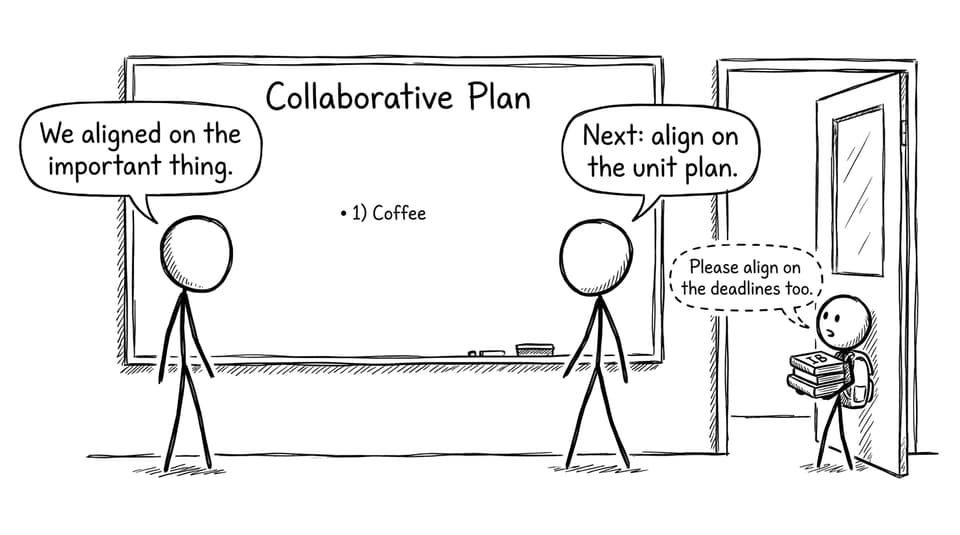
A quick checklist: what “real collaboration” looks like in IB
If you want a fast way to spot whether an IB school is building a collaborative culture, look for these signals:
-
Regular co-planning time that protects depth, not just admin updates
-
Shared assessment language (rubrics, command terms, feedback tone)
-
Cross-subject links that feel intentional (TOK connections, interdisciplinary projects)
-
Routine moderation conversations, not last-minute panic
-
A shared system for resources and analytics, like RevisionDojo for Schools
These aren’t “nice-to-haves.” They shape the learning environment you revise inside.
Why IB teacher collaboration directly helps your exam performance
The IB is designed around consistency: consistent command terms, consistent criteria, consistent expectations about evidence and explanation. But consistency doesn’t happen by accident. It happens when teachers compare notes, align on what quality looks like, and adjust together.
For students, collaboration tends to create three very practical benefits:
Clearer targets
When departments agree on what “analysis” or “evaluation” means, your practice becomes sharper. You stop guessing what the marker wants.
Fewer mixed messages
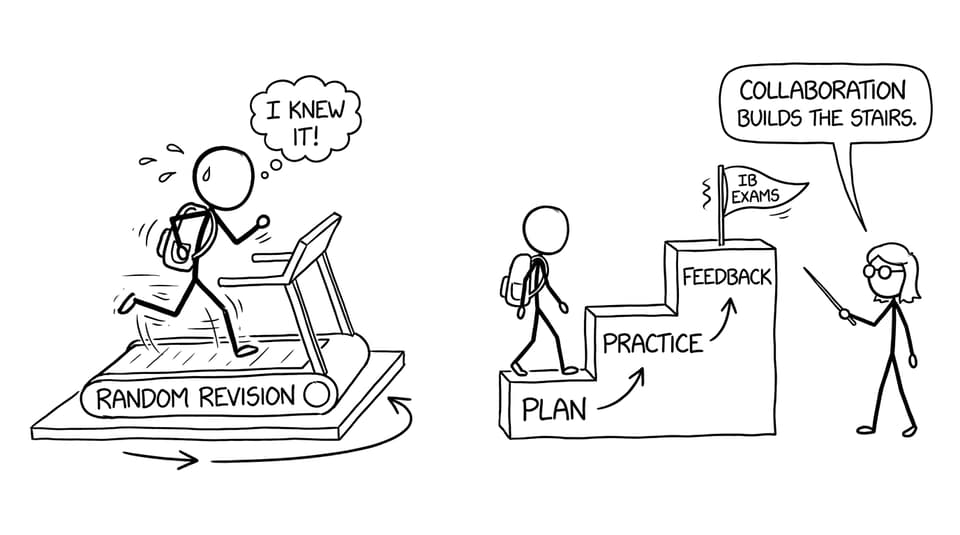
You can build a revision system that works across subjects: plan, practise, get feedback, repeat. That loop only works when feedback is coherent.
Better practice materials
Collaborative teams share the best explanations, exemplars, and common mistakes. Over time, your class resources get stronger.
If you’ve ever felt that your revision depends on “which teacher you got,” a collaborative culture is the fix.
Protected planning time: the hidden engine of IB collaboration
The most important ingredient in IB collaboration is boring: time.
Weekly or biweekly meetings work, but only if they’re structured like a workshop, not a noticeboard. A strong agenda often includes:
-
What students struggled with this week (evidence, not vibes)
-
One shared adjustment to teaching (a mini experiment)
-
One shared adjustment to assessment or feedback language
-
A short reflection: what should we keep, change, or stop?
The best teams rotate facilitation, keep notes accessible, and leave with one decision that changes classroom practice.
This is also where student-facing tools can help. When teachers can see patterns in your performance (topic weaknesses, command term errors), collaboration becomes less abstract. That’s the promise behind analytics-driven approaches like Coordinating Whole-School IB Improvement Through RevisionDojo Analytics.
Shared language: rubrics, feedback, and the calm that comes from consistency
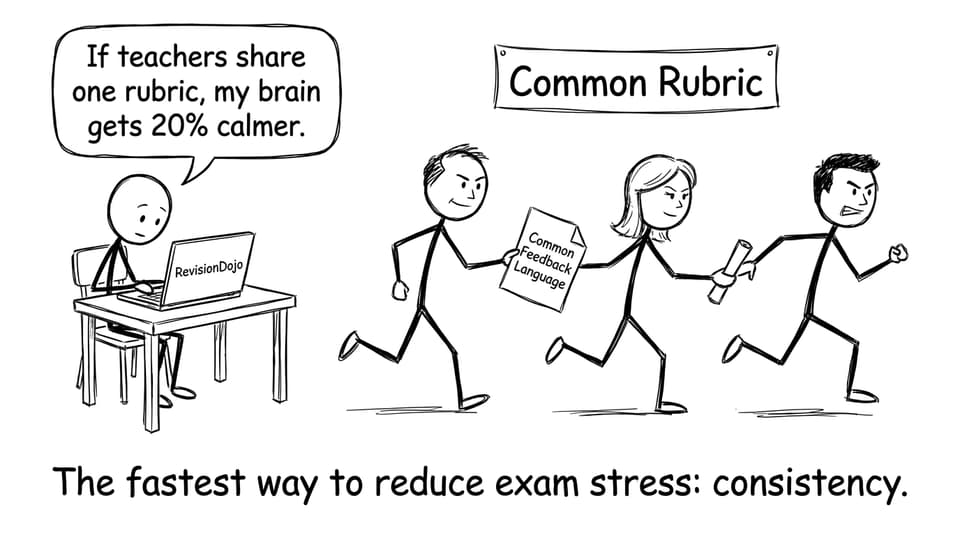
A lot of IB stress comes from not knowing what the next piece of feedback will sound like.
When teachers collaborate on feedback language, they reduce that uncertainty. It’s not about making every teacher identical. It’s about making expectations legible.
Practical ways schools do this:
-
Co-create a “feedback phrase bank” aligned to criteria
-
Agree on what strong evidence looks like in each subject
-
Align on command terms (especially in essay subjects)
-
Run short “mark one together” sessions to calibrate
For you, the payoff is huge. Your revision becomes about improving skills, not decoding personalities.
If you want to build your own consistency outside class, use tools that mirror a unified marking voice. RevisionDojo’s ecosystem is built for that: targeted practice via the IB Question Bank | How to Use It Effectively, then tighten understanding with IB Subject Note Collections, then lock it in with IB Flashcards with Spaced Repetition (SRS).
Interdisciplinary culture: when IB stops feeling like six separate lives
The IB isn’t meant to be a set of disconnected courses. In the best schools, teachers trade ideas across departments:
-
History teachers borrow “claims and evidence” scaffolds from Sciences
-
Language teachers share structure for evaluation and counterargument
-
TOK conversations show up in experiments, essays, and case studies
This is more than intellectual decoration. Interdisciplinary alignment trains transfer: the ability to move a skill from one setting to another. That’s what exams reward when questions become unfamiliar.
Schools that do this well often form small inquiry groups: a few teachers exploring one problem (like improving evaluation, or strengthening reflection). They trial one change, compare results, and share the learning.
That culture of small experiments is exactly how you should revise too.
Moderation and calibration: fairness for teachers, clarity for you
Moderation can sound like an internal teacher process. But in IB terms, it’s one of the most student-impactful habits a school can build.
When teachers mark together, they catch three things early:
-
Inconsistent interpretation of criteria
-
Feedback that’s too vague or too harsh
-
Misalignment between tasks and what exams actually demand
The result is a more stable learning environment. You can trust that the “7-level answer” described in one class won’t be contradicted in another.
This is also where platforms designed for shared grading and feedback help. If you’re curious how schools build this at scale, see Optimizing IB Department Alignment Through RevisionDojo’s Shared Tools.
Technology that sustains collaboration (without turning school into a spreadsheet)
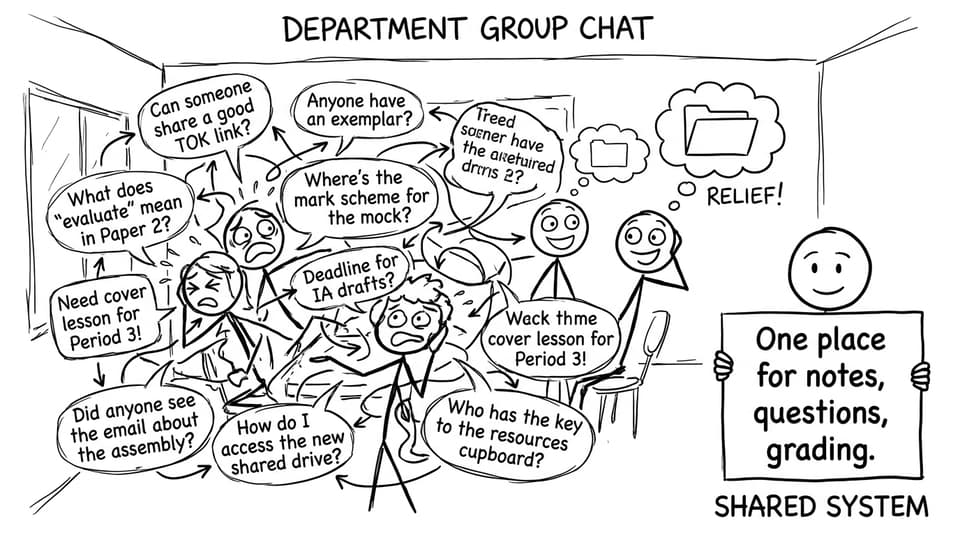
Digital tools only help collaboration when they reduce friction.
A good system centralizes:
-
Resources (notes, exemplars, practice sets)
-
Feedback and grading tools aligned to criteria
-
Data that shows what students actually struggle with
This is why many schools use RevisionDojo for Schools: it’s built to make collaboration visible and sustainable, not dependent on one enthusiastic teacher.
And for you as an IB student, that translates into consistent access to:
-
Questionbank practice loops (skill-focused, topic-filtered)
-
Study Notes that match how exams test concepts
-
Flashcards for high-frequency definitions and processes
-
AI Chat for fast clarification when you’re stuck
-
Grading tools for written work, so feedback becomes actionable
-
Predicted Papers and Mock Exams to train timing and stamina
-
A Coursework Library and Tutors when you need examples or expert support
If your revision feels like resource hunting, a shared system is the opposite: one place, one loop, less noise.
Closing: the IB is hard, but it shouldn’t be chaotic
The IB will always demand effort. That’s part of its design. But the best schools remove the chaos that doesn’t need to exist: unclear expectations, inconsistent feedback, and fragmented planning.
When teachers build a collaborative culture, they’re quietly building something for you: a stable runway toward exams. And when that culture is supported by tools like RevisionDojo, with Questionbank practice, Study Notes, Flashcards, AI Chat, Grading tools, Predicted Papers, Mock Exams, Coursework Library, and Tutors, you get the thing every IB student wants in the final stretch: less noise, more progress.
If you’re preparing now, ask one simple question this week: “What does a great answer look like, and how do I practise it repeatedly?” In the IB, that’s the path that wins.