The best IB students I’ve taught were rarely the ones who “knew the most.”
They were the ones who could stay calm while the clock moved, translate an exam question into a plan, and write answers that made marking easy.
That’s the quiet truth about the IB: it doesn’t only reward knowledge. It rewards decision-making under pressure.
And here’s the twist. The students who underperform often aren’t missing content. They’re missing an exam strategy. That’s why well-designed IB exam strategy lessons can raise achievement quickly, without turning your class into a constant drill camp.
Below is a teacher-friendly way to build exam strategy lessons that your IB students can feel in their scores.
A quick checklist for IB exam strategy lessons
Use this as your “minimum effective dose” for IB exam readiness:
-
Teach IB command terms explicitly, repeatedly, and across units
-
Train question deconstruction as a routine (not a one-off tip)
-
Run small timed tasks weekly to build pacing and stamina
-
Model planning frameworks that students can reuse under pressure
-
Use performance data so feedback becomes targeted (not generic)
-
Build reflection loops so students correct patterns, not just answers
If you want a platform that supports this workflow end-to-end, RevisionDojo for Schools is designed to make the practice-feedback-repeat cycle simple for teachers and consistent for students.
Why IB exam strategy lessons change outcomes
In the IB, two students can understand the same topic and walk out with different grades. The difference is often invisible until you watch their exam behavior.
Common causes of mark loss in IB exams include:
-
Misreading command terms (answering “describe” when the question asks “evaluate”)
-
Writing long introductions but running out of time for analysis
-
Failing to link points to the assessment criteria
-
Treating marks like a mystery rather than a map
Exam strategy lessons turn those losses into skills. They teach students to “show the examiner what they’re looking for” in a way that’s fast, structured, and repeatable.
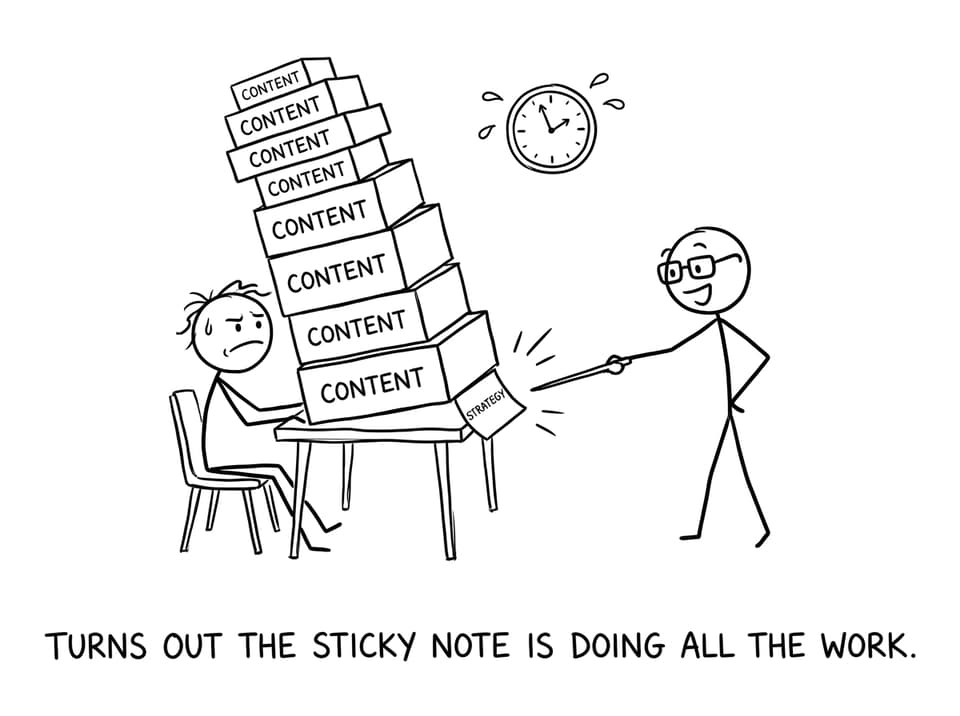
A helpful framing for students is this: content is what you know. Strategy is how you cash it in.
Teach IB students to deconstruct questions like examiners
A high-achieving IB student learns to read questions the way an examiner reads scripts: looking for evidence that the task was understood.
Make question deconstruction a 3-step classroom habit:
Command term
What thinking skill is required (define, analyze, evaluate, discuss)?
Content target
Which topic or concept is being tested?
Boundary lines
What is not being asked? What must be included (and excluded) to stay focused?
Run this as a short starter activity. Put one question on the board, and ask students to annotate only those three elements. No writing yet. Just interpretation.
To reinforce this outside class, students can use RevisionDojo’s Questionbank to drill exam-style questions by topic and difficulty, then check whether their interpretation matches the mark scheme logic.
Make IB command terms part of everyday teaching
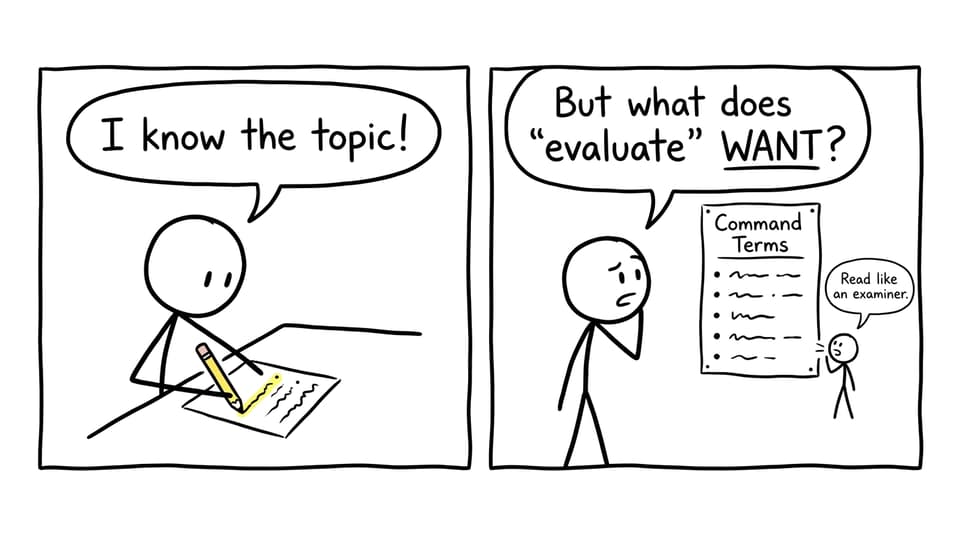
IB command terms aren’t a glossary to memorize. They’re a set of instructions students must execute precisely.
A simple approach that works across subjects:
-
Choose one command term each week (e.g., “analyze”)
-
Collect 3 short prompts on the same topic using different command terms
-
Have students compare what changes: depth, structure, evidence, conclusion style
This reduces the most painful exam moment: realizing too late that you wrote the “wrong kind of correct answer.”
If students need quick clarification while studying, they can use RevisionDojo’s AI Chat support inside the RevisionDojo app to ask, “Did I actually evaluate here, or did I just explain?” That’s the kind of precise question that builds IB exam maturity.
Build planning frameworks students can run on autopilot
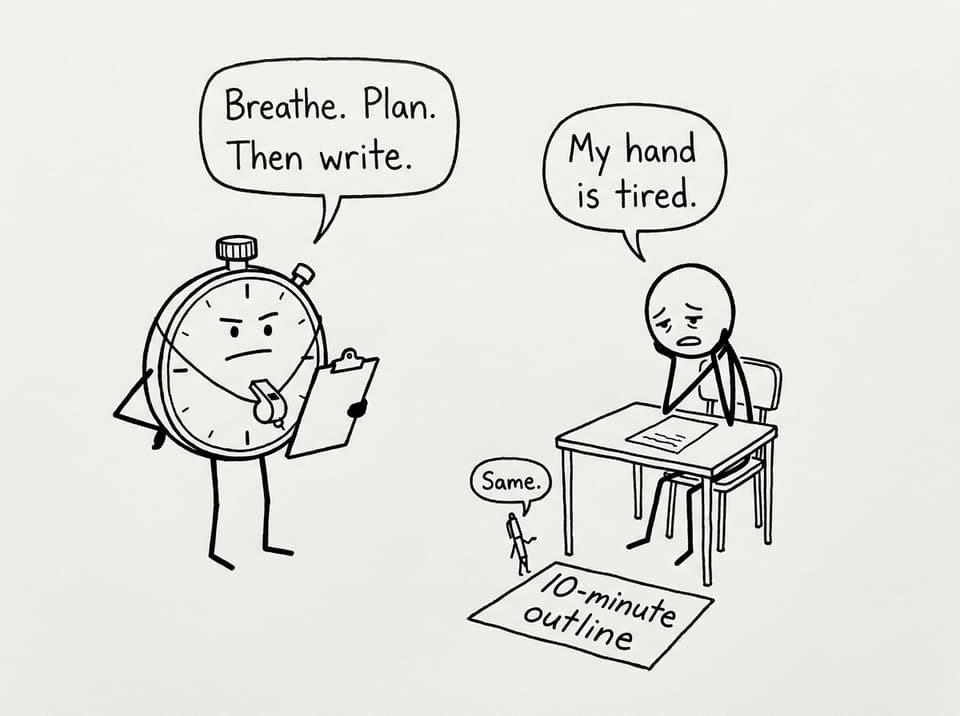
Planning is where IB students buy time.
Not more time in the exam. More time in their brain.
Teach a planning routine that fits the question type, then practice it until it feels normal.
For longer responses
-
Spend 3-5 minutes listing the thesis and 3 main points
-
Attach one piece of evidence or example to each point
-
Write one sentence per paragraph explaining why it matters (the analysis line)
For sciences and data-based questions
-
Identify what the data shows in one sentence
-
Note two patterns/trends
-
Decide the IB “story”: relationship, mechanism, limitation, evaluation
Then model how a plan becomes a structured answer. Students learn that structure is not decoration. It’s how marks are found.
For students who are juggling coursework stress while revising, it helps to reduce background uncertainty. RevisionDojo’s Coursework support and grading tools can keep IAs from spilling into exam time mentally.
Train timing in small, repeatable reps
Most IB students don’t have a time-management problem. They have a practice format problem.
They revise in comfort. Then they perform in a sprint.
Fix it with short timed reps that you can run weekly:
-
8 minutes: plan only (no writing)
-
12 minutes: write one paragraph with analysis
-
20 minutes: mini-section under strict timing
The goal is stamina and pacing, not punishment.
RevisionDojo makes this easier to sustain because students can move from understanding to practice quickly: study notes for clarity, flashcards for recall, and a question bank for application. If they need a bigger rehearsal, IB Predicted Papers are a clean way to simulate full-paper pressure without improvising resources.
Use model answers to teach “what earns marks”
High achievement in the IB often comes from small upgrades repeated many times.
Model answers help students see those upgrades clearly:
-
Where analysis begins (not just where facts appear)
-
How evidence is integrated rather than dumped
-
How conclusions answer the command term directly
A powerful lesson format:
-
Show a mid-level response and a high-level response to the same question
-
Ask students to highlight what the high-level response does differently
-
Turn those differences into a class checklist
Then students apply the checklist immediately in a timed rewrite.
To support this at scale, teachers can pair practice with analytics and feedback through RevisionDojo for Schools, so “good feedback” becomes consistent, not dependent on who gets marked first.
Build reflection loops so students stop repeating the same mistakes
The IB rewards students who learn from patterns.
After each timed task, require a short reflection that is specific and actionable:
-
What command term did I miss or underdeliver?
-
Where did I lose time?
-
What is the one rule I will follow next attempt?
This turns practice into a feedback loop rather than a motivational roller coaster.
If you want a student-friendly explanation of why routines beat motivation, you can share You’re Not Lazy: Your IB Study Method Is Broken. It reinforces the same mindset your IB exam strategy lessons are building.
Teach flexible thinking for unfamiliar IB questions
IB exams often reward transfer: taking a familiar concept into an unfamiliar context.
Train this with “twist prompts”:
-
Change one variable, assumption, or perspective
-
Ask students to adapt their structure, not panic
-
Mark for reasoning clarity, not just recall
Students who practice this don’t freeze when a question feels new. They treat it like a familiar process with different ingredients.
Closing: the quiet advantage that raises IB scores
In the final months, many IB students try to “learn more.” High achievers often do something calmer: they learn how to perform what they already know.
That’s what great IB exam strategy lessons create. They teach students to interpret questions accurately, plan fast, manage time, and write in a way that earns marks.
If you’re a teacher building this into your course, consider pairing your classroom routines with the tools students use at home: Questionbank practice, Study Notes, Flashcards, AI Chat, Grading tools, Predicted Papers, Mock Exams, Coursework Library support, and Tutors when a student needs a human diagnostic.
That complete ecosystem is why RevisionDojo for Schools has become a practical backbone for IB exam preparation: it turns strategy into a habit, and habits into results.

