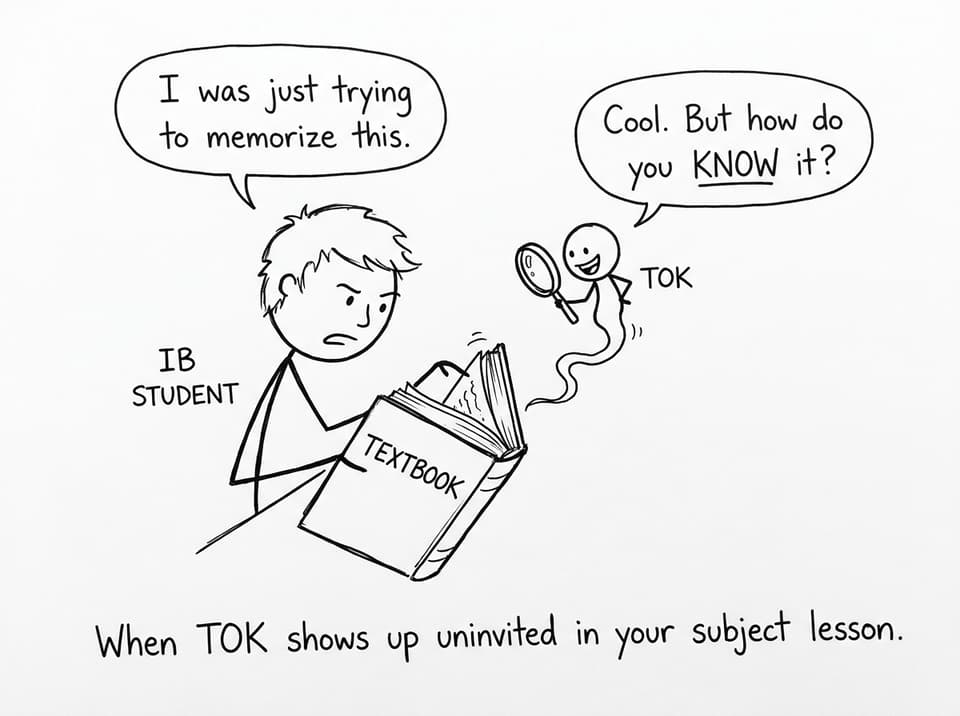
If you have ever sat in an IB lesson thinking, “I understand the content… but what does this have to do with TOK?”, you are not alone. The strange truth is that TOK is often most useful when it is not treated like a separate room in the school, but like a window that quietly changes how every other room looks. A biology lab, a history source, a math proof, a poem annotation, each one is really a small argument about what counts as knowledge.
For IB students preparing for exams, these TOK connections are not just philosophical decoration. They sharpen your explanations, improve your evaluation, and make your answers sound like they belong to someone who understands the subject from the inside.
Quick checklist: TOK connections that actually help IB exam performance
Use this as your fast filter in any IB subject lesson (or when revising):
-
Spot one knowledge question hiding inside the topic (How do we know? What counts as evidence? Who decides?).
-
Name the method the subject uses (experiment, interpretation, proof, modeling).
-
Challenge one assumption (bias, measurement limits, definitions, perspective).
-
Add one real-world example that creates tension (conflicting data, disputed sources, ethical trade-offs).
-
Finish with a 2-3 sentence reflection you can reuse in writing.
If your school tracks skills and engagement systematically, this becomes easier when teachers and students share the same platform. RevisionDojo for Schools is built for that shared routine.
Why IB students should care about TOK links in subject teaching
In the IB, marks often live in the “because” and “therefore,” not in the definition. TOK habits push you to explain how claims are justified, what limits they have, and why another perspective might disagree.
When subject teachers build TOK connections into normal lessons, you get three exam advantages:
-
Stronger evaluation: You naturally discuss reliability, uncertainty, and limitations.
-
Clearer argument structure: You learn to build claims and counterclaims without forcing it.
-
Better transfer: The thinking style you practice in one IB class shows up in another.
And when your revision tools reinforce those links, they stick. For example, using Study Notes to clarify a concept, then drilling it with exam-style practice, makes TOK-style reflection feel practical, not abstract.
Strategy: Start every IB unit by hunting for TOK pressure points
The easiest way for teachers to strengthen TOK connections is to stop asking, “Where can I add TOK?” and start asking, “Where does this topic already break if I push it?”
TOK pressure points usually appear as:
-
Models that simplify reality (natural sciences, economics).
-
Sources that disagree (history, human sciences).
-
Definitions that control the debate (psychology terms, political concepts).
-
Proof versus intuition (mathematics).
-
Interpretation versus author intent (literature, arts).
For students, this matters because IB exam questions reward answers that recognize what is solid and what is uncertain.
To build that habit intentionally, it helps to keep a TOK hub open while you revise. The IB Theory of Knowledge (TOK) resource page is a clean starting point for aligning your thinking across subjects.
Strategy: Teach with knowledge questions, but keep them short
A common mistake is making TOK connections feel like a long detour. In reality, a 90-second knowledge question can change how you see the entire lesson.
Examples teachers can drop into IB subjects:
-
Sciences: “What would count as disproof here?”
-
History: “If two sources conflict, what makes one more trustworthy?”
-
Math: “When do we accept something as true: after proof, or after usefulness?”
-
Language and literature: “When does interpretation become misinterpretation?”
For IB students, these questions become ready-made evaluation lines for essays, data-based questions, and structured responses.
If you want a student-friendly way to practice this style, TOK Thinking and Skills: How to Succeed in IB TOK is a useful guide because it keeps the focus on the moves that actually raise marks.
Strategy: Make “evidence” a visible routine, not a vague word
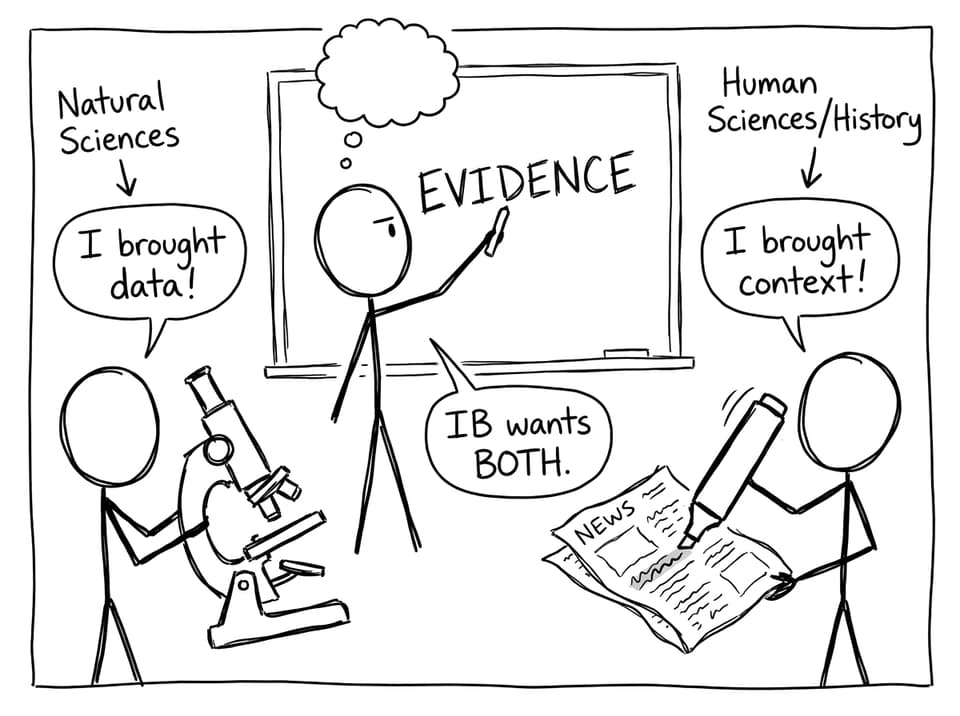
In IB classrooms, “evidence” can mean a controlled experiment, a statistical trend, a diary entry, or a line of verse. TOK connections get stronger when teachers name what evidence means in that discipline and what it cannot do.
A simple routine students can copy into revision:
-
What is the claim?
-
What is the evidence?
-
What is the assumption linking them?
-
What is one limitation (bias, sampling, translation, context)?
-
What would a counterclaim look like?
This is exactly why AOK thinking is so helpful. If you want a clean map, TOK Areas of Knowledge: A Guide to the Five AOKs explains how different subjects build knowledge in different ways, which is the core of most good TOK connections.
Strategy: Use real-world disputes to make TOK feel concrete
TOK works best when it feels like something people actually argue about, not something you perform for an assessment. Teachers can strengthen TOK connections by choosing examples where knowledge is contested:
-
Conflicting interpretations of climate data.
-
Ethical debates in AI, medicine, or surveillance.
-
Media framing of the same event across different countries.
For IB students preparing for exams, this improves your ability to write “two-sided” analysis quickly, because you are practicing it in normal lessons.
When you are stuck turning examples into evaluation, it can help to study how strong TOK prompts are unpacked. A good reference point is RevisionDojo Ultimate TOK May 2026 Essay Guide, because it models how to turn real-world situations into structured argument.
Strategy: Build TOK reflection into subject revision loops
This is where subject teaching and exam prep meet.
A teacher can ask for a 3-sentence reflection after a topic test. A student can do the same after a practice set at home. Either way, the loop is similar:
-
Attempt exam-style questions.
-
Identify what you assumed.
-
Rewrite one explanation with a stronger justification.
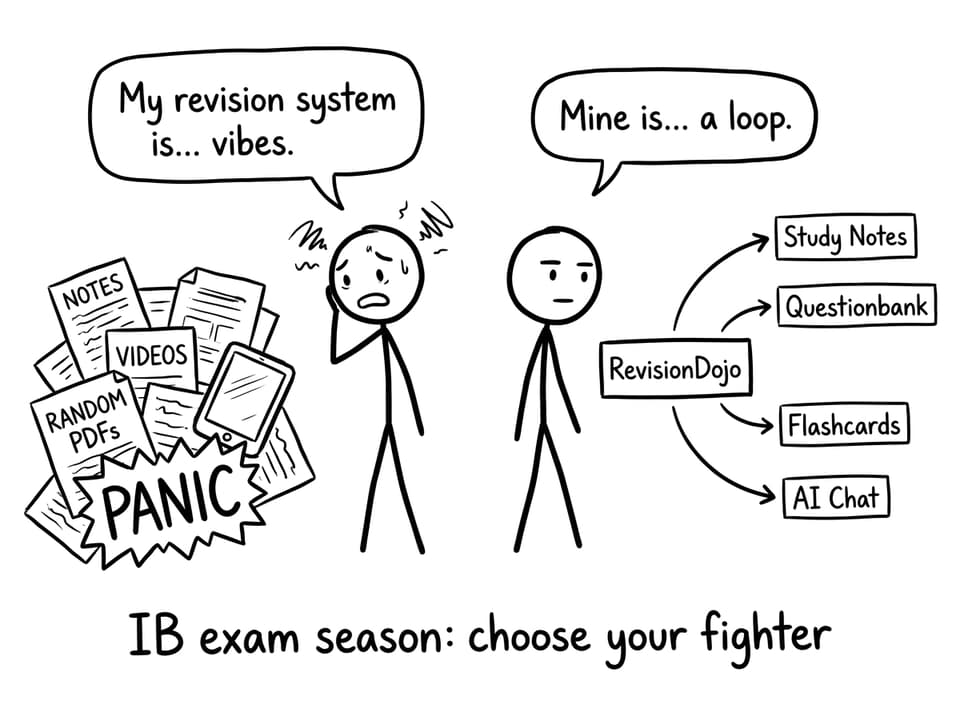
On RevisionDojo, this becomes easier because your practice and feedback live together: the Questionbank gives you exam-style repetition, Study Notes patch understanding, Flashcards keep recall alive, AI Chat unblocks confusion fast, and Mock Exams plus Predicted Papers train timing and stamina. When written work matters, Grading tools and the Coursework Library make feedback concrete, and Tutors add human diagnosis when you need it.
If you want a practical guide to using practice effectively, IB Question Bank: How to Use It Effectively is worth bookmarking.
FAQ
How often should TOK connections show up in IB subject lessons?
In an ideal IB classroom, TOK connections appear little and often. A short knowledge question once per lesson can be enough to build the habit without stealing time from content. What matters is consistency, because TOK thinking is a skill that compounds quietly. If you only do TOK links once a month, it feels like a special event, and students treat it like decoration. If you do it weekly, it becomes normal to ask about evidence, bias, and certainty. Over time, those questions show up in exam answers even when no one asks for TOK explicitly.
What if TOK feels too abstract when I am revising for IB exams?
TOK feels abstract when it stays in the sky, so bring it down into the exact question you got wrong. Ask yourself what the examiner wanted: a definition, an explanation, an evaluation, or a justified conclusion. Then add one TOK-style sentence that clarifies your method or limitation: “This conclusion depends on…” or “This evidence is limited because…”. That single line often changes the quality of your response in IB subjects. You can also practice with structured TOK resources so the moves become familiar. Keeping the IB Theory of Knowledge (TOK) resource page open while revising helps you translate big TOK ideas into small exam-ready habits.
Can TOK connections improve my results in non-TOK IB subjects?
Yes, because IB marking rewards justified thinking, not just correct recall. TOK connections train you to explain why your method works and where it might fail. In sciences, that might be uncertainty, controls, or model limitations. In history, it might be origin, purpose, value, and limitation of sources. In mathematics, it might be assumptions behind a proof or why a method is valid. Across subjects, TOK-style thinking improves the “evaluation layer” that often separates a good answer from a top-band one. If you want a system that supports this across subjects, RevisionDojo’s mix of Questionbank practice, Study Notes, Flashcards, AI Chat, and Grading tools makes that improvement loop easier to repeat.
Closing: make TOK the quiet advantage in your IB exams
The best TOK connections in the IB are rarely dramatic. They are small moments where a teacher pauses and asks, “What would count as evidence here?” or “Who might disagree, and why?” Those moments teach you how to think like the subject, not just repeat it.
If you want those TOK habits to show up under exam pressure, build them into your revision system: learn with Study Notes, practice with the Questionbank guide, pressure-test with timed Mock Exams and Predicted Papers, and use AI Chat plus Grading tools to tighten your reasoning. That is how IB preparation becomes calmer and more connected, and how TOK stops being a separate class and starts becoming your advantage.

