


TOK is the one IB subject where your best idea can still fall flat if it lands in the wrong place.
You can have a brilliant real-life situation, a sharp line of reasoning, even a memorable example. But if you never anchor it in an Area of Knowledge (AOK), it reads like a blog opinion, not a TOK essay. Examiners are not hunting for cleverness. They are looking for controlled thinking: how knowledge gets made, tested, challenged, and trusted in different disciplines.
This guide shows you how to connect TOK essay ideas to AOKs in a way that feels natural, focused, and examiner-friendly. You will leave with a practical method for choosing AOKs, building paragraphs, and using Ways of Knowing (WOKs) without turning your essay into a vocabulary list.
Quick TOK checklist: idea to AOK in 90 seconds
Use this quick checklist whenever you get a TOK essay idea:
-
Name the knowledge claim in one sentence (what are you saying about knowledge?).
-
Choose one AOK where that claim is clearly “normal practice.”
-
Choose a second AOK where the claim becomes complicated (different methods, different standards, different stakes).
-
Attach one precise real-life example per AOK (a study, event, controversy, artwork, proof, court case, etc.).
-
Add one WOK only if it changes the analysis (language, reason, emotion, perception, imagination, intuition, memory, faith).
-
Write the counterclaim as a limitation of the first claim, not as a random opposite opinion.
If you want model frameworks for organizing those parts, RevisionDojo’s Comprehensive Guide to IB TOK Essay Structure and TOK Essay Planning Templates for May 2026 Titles are made for exactly this.
What “Areas of Knowledge” really mean in TOK
In TOK, an AOK is not just a school subject. It is a knowledge community with:
-
its own methods for producing knowledge (experiments, interpretation, proof, creation)
-
its own standards for justification (replication, sourcing, coherence, peer review)
-
its own typical uncertainties and biases
That is why AOKs matter: they let you compare knowledge, not just describe it.
If you need a clear refresher on each AOK and what examiners expect, start with RevisionDojo’s Ultimate Guide to TOK Areas of Knowledge (AOK) and the compact Overview of the Five Areas of Knowledge in TOK.
Why connecting TOK ideas to AOKs raises your score
Most weak TOK essays share the same hidden problem: they are “about the world,” not “about knowing the world.” AOKs fix that because they force you to ask discipline-specific questions:
-
What counts as evidence here?
-
Who gets to decide what is true here?
-
How do experts handle uncertainty here?
-
What does progress look like here?
When you connect your TOK ideas to AOKs, your essay becomes comparative and evaluative by default. You are no longer saying “bias exists.” You are saying “bias functions differently in the human sciences than in history, because their methods and aims differ.” That shift is the heartbeat of TOK.
To see how this turns into examiner-friendly argumentation, use Building Coherent Arguments in TOK and Structuring for Success in IB TOK Essays.
How to choose the right AOKs for your TOK essay
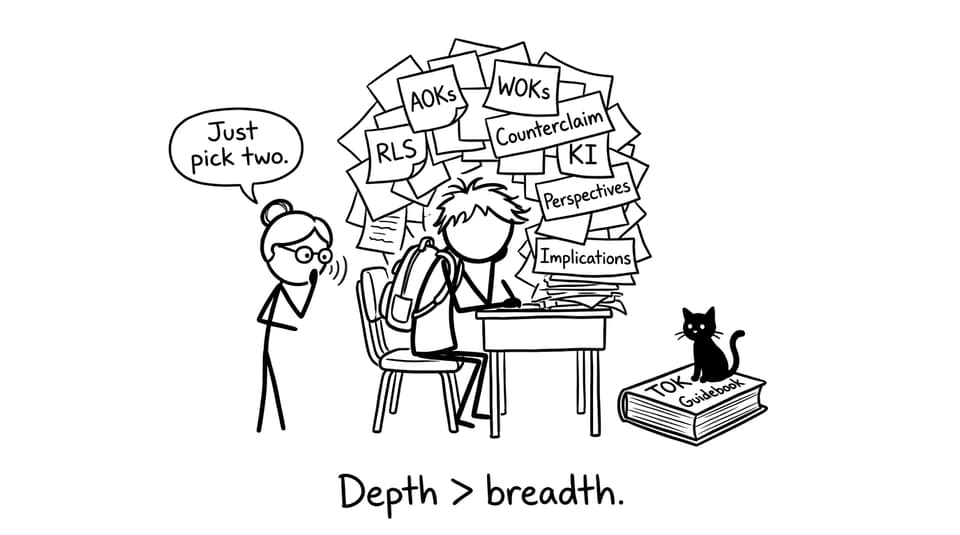
AOK choice is not a “coverage” game. You do not get extra credit for squeezing in five AOKs. In TOK, depth beats breadth almost every time.
Start with the method hiding inside your example
Ask what your example is really doing:
-
If it relies on experiments, measurement, models, and replication, Natural Sciences often fits.
-
If it relies on human behaviour, surveys, statistics, interpretation of people, Human Sciences fits.
-
If it relies on sources, narrative, and perspective over time, History fits.
-
If it relies on proof, axioms, abstraction, formal validity, Mathematics fits.
-
If it relies on meaning, interpretation, creative intention, aesthetic judgment, The Arts fits.
-
If it relies on norms, responsibility, harm, rights, moral reasoning, Ethics fits.
Then pick a contrasting AOK on purpose
Strong TOK essays create tension. Pick AOKs that disagree in a productive way.
Examples of high-contrast pairings:
-
Natural Sciences vs Ethics (what we can do vs what we should do)
-
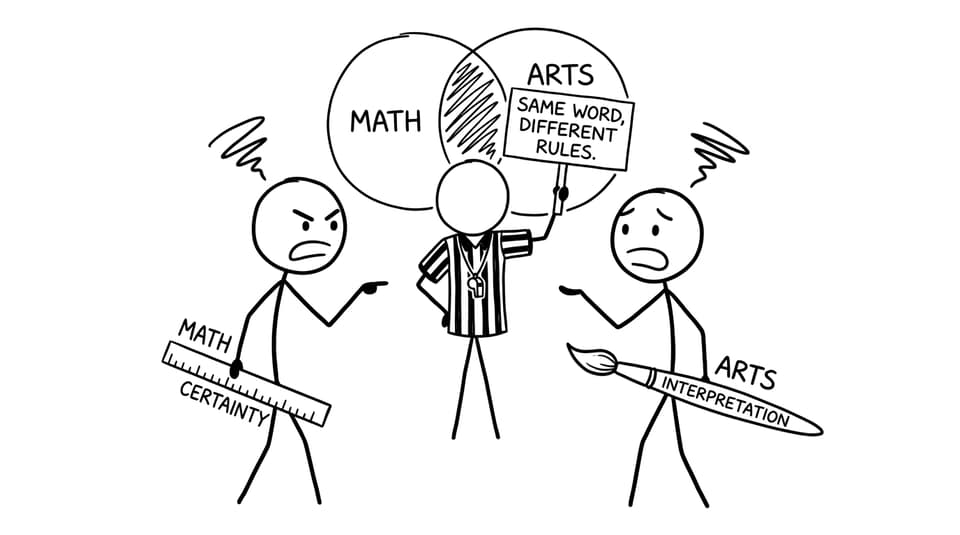
Mathematics vs Human Sciences (certainty vs probabilistic prediction)
-
History vs Natural Sciences (interpretation vs controlled experimentation)
-
The Arts vs History (meaning vs evidence)
If you are working with a specific prescribed title, RevisionDojo’s Linking TOK May 2026 Titles to Areas of Knowledge and Themes is a fast way to see sensible pairings without guessing.
A simple TOK paragraph template that actually works
A TOK paragraph should feel like a miniature investigation. A reliable structure looks like this:
-
Claim (directly answers the title in a knowledge-focused way)
-
AOK lens (how this AOK produces and validates knowledge)
-
Real-life example (specific and believable)
-
WOK insight (only if it adds explanatory power)
-
Counterclaim (a limitation, exception, or alternative interpretation)
-
Mini conclusion (what this reveals about knowledge in this AOK)
This is the same logic used in RevisionDojo’s Tips for Writing a Clear and Coherent TOK Essay and can be strengthened with Best Counterclaims for the May 2026 TOK Essay Titles.
What this looks like in practice
Instead of writing: “Perception is unreliable.”
A TOK-style version becomes: “In the natural sciences, perception is essential for observation, but it is managed through instruments and standardized methods; this suggests scientific knowledge depends on perception while trying to reduce its weaknesses.”
The sentence is longer, but the thinking is tighter. It is grounded in an AOK.
Using WOKs to strengthen AOK analysis (without listing them)
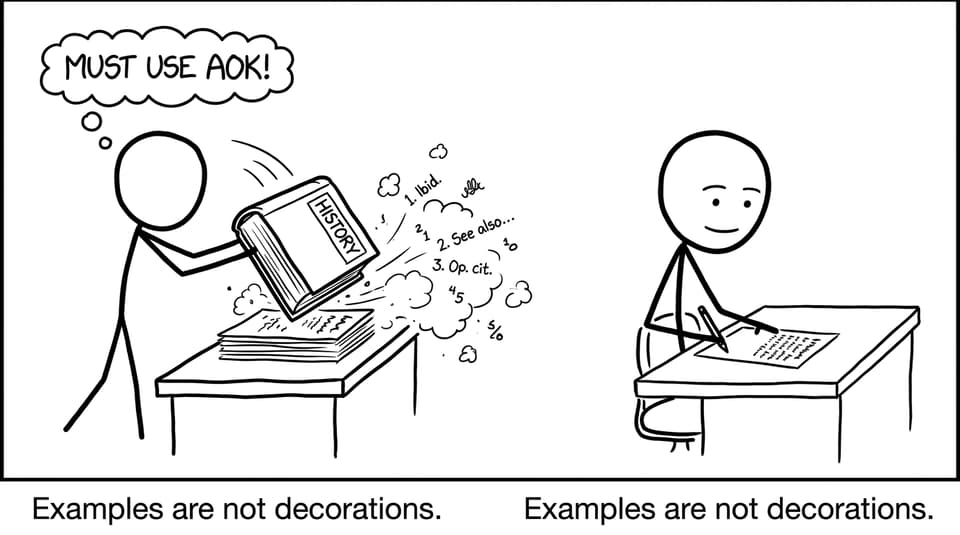
WOKs are powerful in TOK when they explain a mechanism, not when they decorate a paragraph.
Try this rule: use a WOK only when it changes what counts as justification.
Examples:
-
Language in History: the words in a primary source can frame causation or blame.
-
Emotion in Ethics: moral knowledge often depends on empathy, but empathy can be biased.
-
Reason in Mathematics: deductive reasoning creates certainty, but depends on axioms.
-
Perception in Natural Sciences: observation is filtered through instruments and interpretation.
If you need help turning WOK mentions into analysis, RevisionDojo’s Mastering Critical Thinking in TOK Assessments is a strong companion read.
Common TOK mistakes when connecting ideas to AOKs
These are the patterns that quietly lower marks:
-
AOK mismatch: forcing an example into an AOK because it “sounds academic.”
-
Describing the subject: summarizing biology or history content instead of analyzing knowledge production.
-
Vague examples: “scientists say…” or “historians think…” without a concrete case.
-
Counterclaims that are just contradictions: not tied to the claim’s assumptions.
-
Too many AOKs: switching fields every paragraph so nothing develops.
When you are ready to tighten a draft, RevisionDojo’s How to Revise and Edit Your TOK May 2026 Essay gives a clean quality-control process.
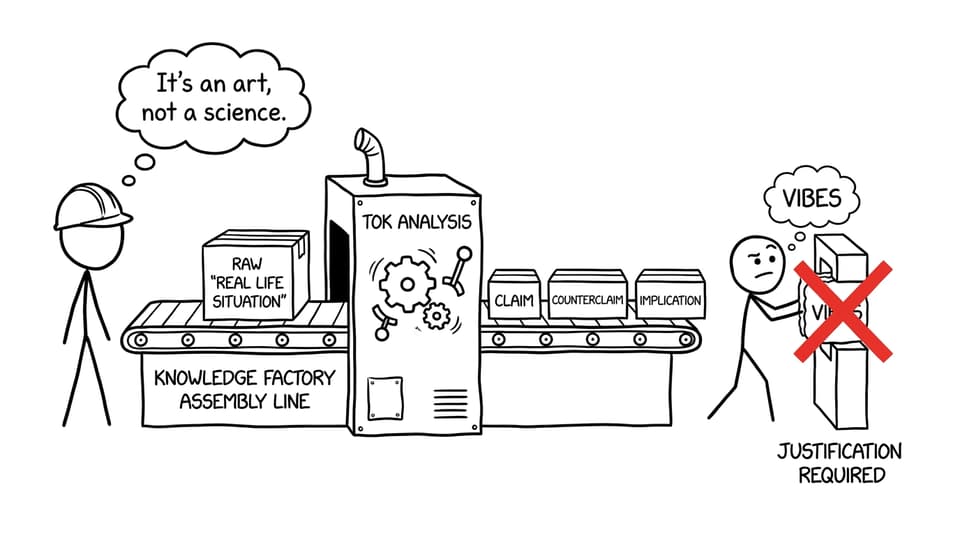
How RevisionDojo helps you build AOK-connected TOK arguments
At some point, every TOK student runs into the same wall: you understand the idea, but you cannot tell if your argument meets the rubric.
RevisionDojo is built to remove that uncertainty.
-
The TOK hub at IB Theory of Knowledge (TOK) organizes guidance by what you actually need: essay, exhibition, and skills.
-
The Questionbank helps you practice under exam-style conditions, and RevisionDojo’s tools connect naturally with Study Notes, Flashcards, AI Chat, Grading tools, Predicted Papers, Mock Exams, the Coursework Library, and Tutors.
-
If you are preparing your exhibition alongside the essay, use IB TOK Exhibition: Your Complete Guide to Success and Selecting the Right Objects for Your TOK Exhibition.
The best part is that you stop guessing whether your AOK links are “good enough” and start practicing what examiners actually reward.
Conclusion: make TOK feel smaller by making it sharper
TOK gets easier when you stop trying to sound philosophical and start trying to be precise.
Your job is not to impress with big words. Your job is to connect one clear idea to one clear AOK, then test it honestly with a counterclaim. Do that twice, in two disciplines that behave differently, and you have the bones of a strong TOK essay.
When you want to practice that process quickly and get feedback that matches examiner expectations, use RevisionDojo’s TOK hub, Questionbank, AI Chat, Grading tools, Predicted Papers, Mock Exams, Coursework Library, Flashcards, and Tutors. TOK rewards students who refine, not students who rush. RevisionDojo is where that refinement becomes repeatable.