
A half-finished recording can sound like failure from the other side of a bedroom door. Usually, it is evidence that the work is moving forward.
If you are unsure how to help with an IB Music Internal Assessment, the answer is reassuringly simple: help your child manage the process, protect time for musical work, and ask questions that encourage reflection. Do not compose, perform, edit, or write the submission for them. Supporting an IB Music IA is less about knowing music theory and more about creating the conditions in which your child can do authentic, well-documented work.
That distinction matters. According to the current IB Music assessment model, internal assessment contributes 30% of the final result at Standard Level and 50% at Higher Level. Both SL and HL students complete Experimenting with music, while HL students also complete The contemporary music-maker. The remaining Music components are externally assessed coursework, so it is worth checking which task your child actually means when they casually call everything “the IA.”
A quick parent checklist
- Confirm whether your child takes Music SL or HL.
- Ask for the school's internal deadlines, not only the final submission date.
- Help divide the work into experiments, recordings, commentary, referencing, and review.
- Encourage regular saving, file naming, and backups.
- Ask reflective questions without supplying musical answers.
- Protect rehearsal and recording time where possible.
- Keep all submitted ideas, writing, and musical material authentically the student's.
- Direct technical or assessment questions to the Music teacher.
For broader context, RevisionDojo's IB Music syllabus breakdown can help families understand where each task sits within the course.
Understand what the IB Music IA contains
The central internal assessment for both levels is Experimenting with music. Students investigate musical material from local and/or global contexts and experiment practically in the roles of creator and performer. They submit a written report containing rationale and commentary, supported by musical evidence from their experimentation.
Under the current guide, that report has a maximum of 1,500 words. The practical evidence consists of three related creating excerpts and three related performing excerpts, with each set having a maximum combined duration of five minutes. This is process-focused work: the student must show what was attempted, how musical findings informed decisions, and what developed through experimentation.
HL students have another internally assessed component, The contemporary music-maker. It is a collaborative, real-life music-making project documented through a continuous multimedia presentation of up to 15 minutes. The evidence addresses the proposal, process, evaluation, and realized project or curated selections from it.
The practical implication for parents is important: a polished final track is not the whole story. The student's decisions, experiments, documentation, and evaluation matter. RevisionDojo's explanation of how IB Music is graded offers a useful starting point before discussing progress at home.
Supporting IB Music IA without taking over
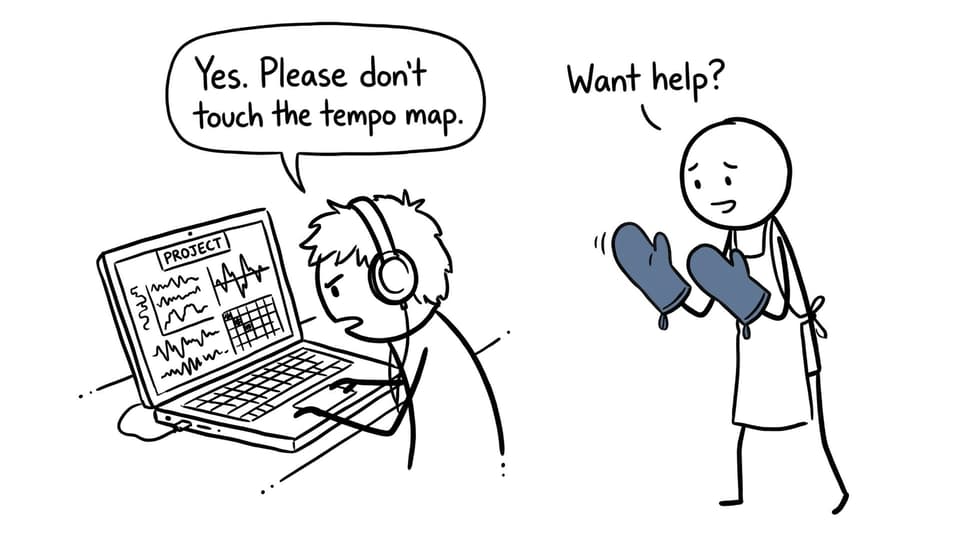
The boundary between support and interference can feel blurry, especially when a deadline is close. A reliable rule is this: support the conditions and question the thinking, but do not produce the assessed work.
The IB's academic integrity policy expects parents to help students understand relevant rules, plan a manageable workload, and avoid providing assistance in completing assessed work. That applies to musical material as well as writing. A parent should not rewrite commentary, improve a composition, edit the submitted audio, or perform a part attributed to the student.
Useful questions include:
- “What musical idea are you testing here?”
- “What changed between these two versions?”
- “Which recording best demonstrates the experiment?”
- “Where did that influence come from, and have you credited it?”
- “What does your teacher want you to do next?”
These questions return ownership to the student. By contrast, “Change this chord” or “Use this recording because it sounds better” supplies a decision that the student should make.
Families can review RevisionDojo's guide to academic integrity in IB Music together, particularly when the work uses samples, arrangements, digital tools, or identifiable cultural influences.
Build a timeline around evidence, not panic
Creative work often appears idle before it becomes visible. A student may spend an hour comparing timbres and produce only thirty seconds of audio. That can still be meaningful progress.
A better timeline measures evidence rather than vague effort:
| Stage | A useful checkpoint |
|---|---|
| Clarify | Student can explain the task, context, and intended musical experiment |
| Explore | Sources and musical findings are recorded and credited |
| Experiment | Early creating and performing versions are saved |
| Select | Excerpts are chosen because they demonstrate development |
| Explain | Commentary connects evidence to musical decisions |
| Check | Timings, word count, track list, citations, and files are reviewed |
| Submit | Final versions are backed up and uploaded through the school process |
Ask your child to work backwards from the teacher's internal deadline. Add modest buffers for unavailable collaborators, recording noise, illness, or file problems. The RevisionDojo guide to integrating IAs with revision can help prevent Music coursework from consuming time reserved for other subjects.
A weekly ten-minute check-in is usually more useful than daily monitoring. Ask what was completed, what is blocked, and what the next visible action will be. Then stop. Autonomy grows when support is dependable but not constant.
Make practical music-making easier
Parents do not need to understand harmony or production software to remove practical friction.
Protect rehearsal and recording windows
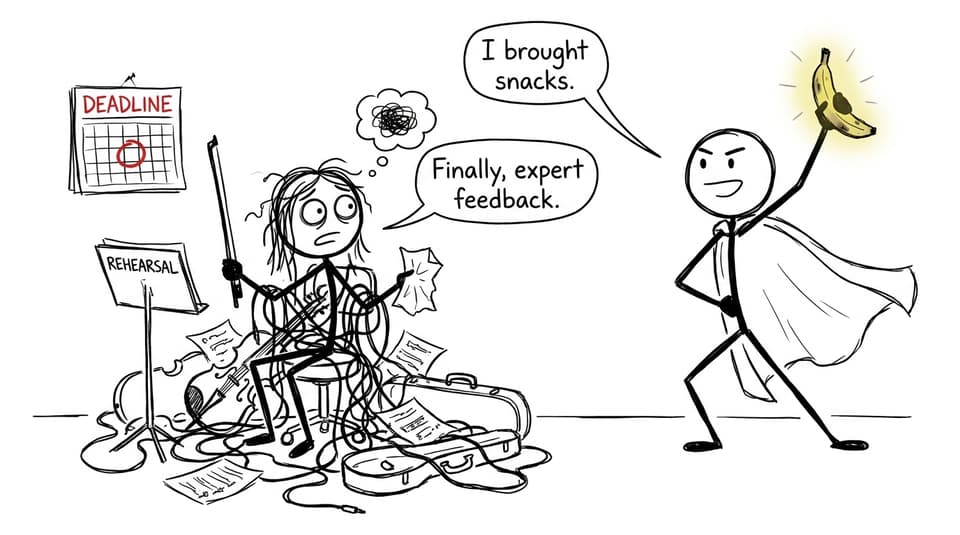
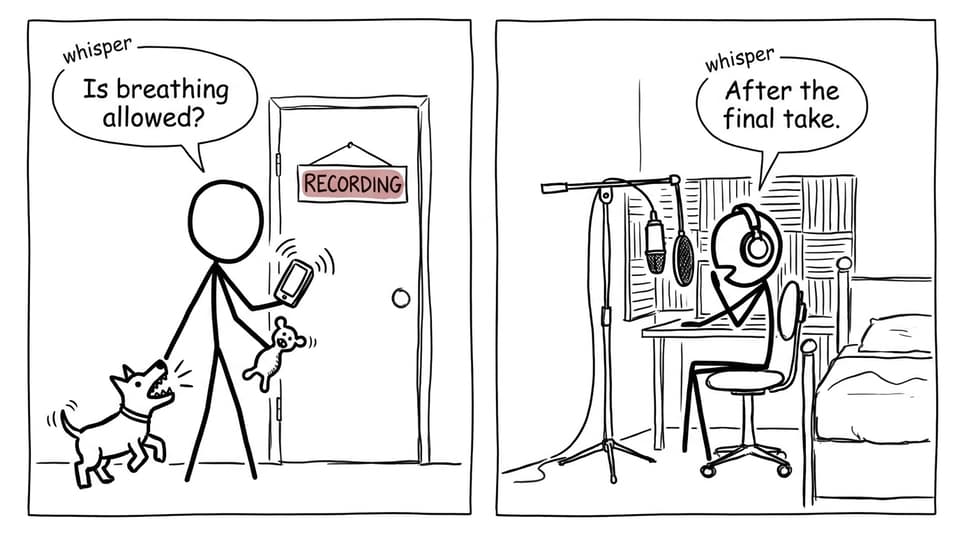
Help identify periods when the home is relatively quiet. Coordinate around household noise, interruptions, and internet-heavy activity if recording software or collaboration tools need bandwidth. Where appropriate, help arrange safe transport to rehearsals or access to school facilities.
Recording problems should be found early. Encourage a short test that checks microphone placement, volume, room noise, storage, and file playback. RevisionDojo's guide to common IB Music performance mistakes is useful before a formal recording session.
Create a simple file system
Musical evidence becomes fragile when files are called “final,” “final2,” and “actualfinal.” Suggest folders for research, creating experiments, performing experiments, commentary, sources, and exports. Dated filenames make development easier to trace. Keep a local copy and a secure backup, while following the school's data and submission rules.
Support collaboration without managing it
For an HL contemporary music-maker project, collaborators and logistics can become genuine obstacles. A parent may help with transport, scheduling space, or obtaining permission. The student must still manage the project, make its musical decisions, evaluate the process, and present their own role honestly.
Help your child reflect more precisely
Students often describe what they did without explaining why it mattered. Parents can encourage deeper reflection without writing a sentence for them.
Ask your child to play two versions and explain the difference aloud. They might discuss rhythm, harmony, texture, timbre, articulation, structure, production, or performance technique. Follow with: “What did that change achieve?” and “What evidence can the assessor hear?” Speaking through the process can expose gaps before the student writes independently.
The goal is not to manufacture a perfect success story. Experimentation can include decisions that did not work, provided the student evaluates them meaningfully and shows what was learned. For related guidance on articulating musical choices, see RevisionDojo's article on what assessors look for in IB Music compositions.
Know when the teacher should step in
Contact the Music teacher or encourage your child to do so when requirements remain unclear, feedback appears contradictory, a collaborator withdraws, technology prevents evidence collection, or wellbeing is deteriorating. The teacher knows the school's schedule and is responsible for interpreting the official requirements in context.
Parents should also avoid relying on generic IA advice. Music combines written commentary, practical evidence, research, performance, creation, and, at HL, multimedia collaboration. Advice designed for a laboratory report may not transfer well.
If the difficulty is broader than Music, RevisionDojo's IB study support for parents and families can help families approach workload and communication more calmly.
Use RevisionDojo when you do not know how to advise
Many parents reach the same honest conclusion: “I want to help, but I do not understand this subject's IA.” That is where subject-specific structure is more useful than parental guesswork.
RevisionDojo provides IB IA guides, Music-focused structuring guidance, and an IB Coursework Grader that gives rubric-aligned annotations and actionable feedback on uploaded coursework. Students can use the feedback to identify unclear structure, underdeveloped reflection, or missing explanation while retaining responsibility for every revision. They should still follow their school's rules for external tools and discuss uncertainty with their teacher.
This support sits within RevisionDojo's wider IB ecosystem. Study Notes, Flashcards, Questionbank practice, Predicted Papers, and Mock Exams help students protect exam preparation while coursework is underway. AI Chat can clarify concepts, the Coursework Library can support structural understanding, and Tutors can provide guided help where available. The purpose is not to replace the student's musical judgment. It is to give that judgment a clearer framework.
The most useful role is often the quietest
An IB Music IA can make a household feel as though everyone is waiting for a final performance. In reality, the important work happens earlier: one experiment saved, one influence credited, one recording reviewed, and one decision explained honestly.
Your child needs ownership more than rescue. Offer time, structure, practical help, attentive questions, and a calm route to specialist guidance. Then let the music remain theirs.
For a natural next step, ask your child to show you their next deadline and name one piece of evidence they will complete this week. If the structure still feels unclear, open RevisionDojo together and turn that uncertainty into a specific, student-led action.