

Music has a funny way of revealing shortcuts.
You can hide a copied paragraph inside an essay and hope nobody notices. But in IB Music, the truth tends to leak out through the seams: a melody that sounds oddly familiar, a loop that does too much of the work, a performance that imitates a recording without understanding the style behind it.
And that’s the quiet pressure of IB Music: you’re being assessed not just on what you made, but on whether you can honestly explain how you made it.
This guide is for IB students who want to score high without second-guessing their ethics. We’ll look at what integrity actually means in IB Music, how to keep your composition and performance unquestionably yours, and how to document your process so your work feels calm, defensible, and genuinely artistic.
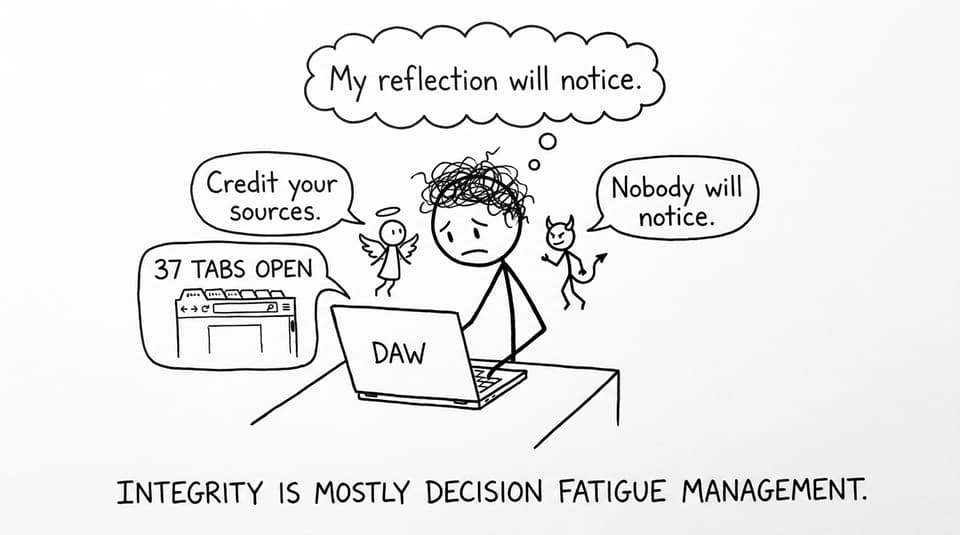
Quick checklist: IB Music integrity in 10 minutes
Use this as your pre-submission scan for IB Music:
-
Your melody, harmony, structure, and key decisions are student-authored.
-
Any influence (listening, score study, stylistic models) is named clearly.
-
Any sample or loop is licensed/allowed and credited (and not doing the main job).
-
You can show drafts, versions, project files, screenshots, and annotations.
-
Your performance choices are informed by context, not just mimicry.
-
Collaboration is acknowledged, and your assessed contribution is clear.
-
AI and software support your thinking, not replace authorship.
If you can say, “This is mine, and I can explain it,” you’re on the right track for IB Music.
What integrity means in IB Music (in plain student language)
Integrity in IB Music has three layers that reinforce each other:
Authorship
Your work needs a clear creative fingerprint. That doesn’t mean you invented a new genre. It means your musical decisions were made by you, and you can account for them.
Transparency
You don’t need to pretend you were never influenced. IB Music expects you to learn from others. The ethical move is to show your influences openly, then explain how you transformed them.
Respect
Music comes from people and places. Ethical performance and exploration means understanding traditions, crediting creators, and avoiding shallow “copy the vibe” approaches that strip context away.
A good mental model: integrity is not “being original from nothing.” Integrity is being honest about where ideas came from and what you did with them in IB Music.
If you want a wider course map (components, expectations, and how the pieces fit), keep IB Music: A Complete Beginner's Guide open in another tab while you plan.
IB Music composition integrity: how to be inspired without copying
Most integrity problems in IB Music composition are not dramatic. They happen quietly:
-
A motif is “borrowed” because it’s stuck in your head.
-
A chord loop stays unchanged because it sounds good.
-
A reference track becomes a blueprint, not a reference.
Here’s the fix: treat influence like research.
Use a “source-to-change” note
When you’re inspired by something, write one sentence in your process log:
-
Source: what you listened to or studied
-
Change: what you altered (rhythm, mode, texture, instrumentation, form, tempo, harmonic rhythm)
-
Reason: why the change serves your intention
Example (the structure matters more than the specific composers):
-
Source: impressionistic parallel harmony
-
Change: moved parallel motion into a lo-fi pad texture and slowed harmonic rhythm
-
Reason: creates a blurred, suspended mood without imitating a specific piece
That single habit makes your IB Music authorship easier to defend and easier to write about.
If you’re building your Creating portfolio and want a strategy-based approach (not just “compose more”), see Best Resources for IB Music Composition (Study Smart).
Samples, loops, and DAWs: the ethical line in IB Music
Technology is not the enemy in IB Music. Confusion is.
A DAW can help you edit, mix, notate, orchestrate, and iterate quickly. But your assessed work still needs to show that the musical substance is yours.
Use loops like seasoning, not the meal
If a premade drum loop or chord loop forms the backbone of the track, your authorship becomes harder to demonstrate. If it’s a minor layer that you shape (editing, recontextualizing, integrating with your own melodic and structural work), you’re in safer territory.
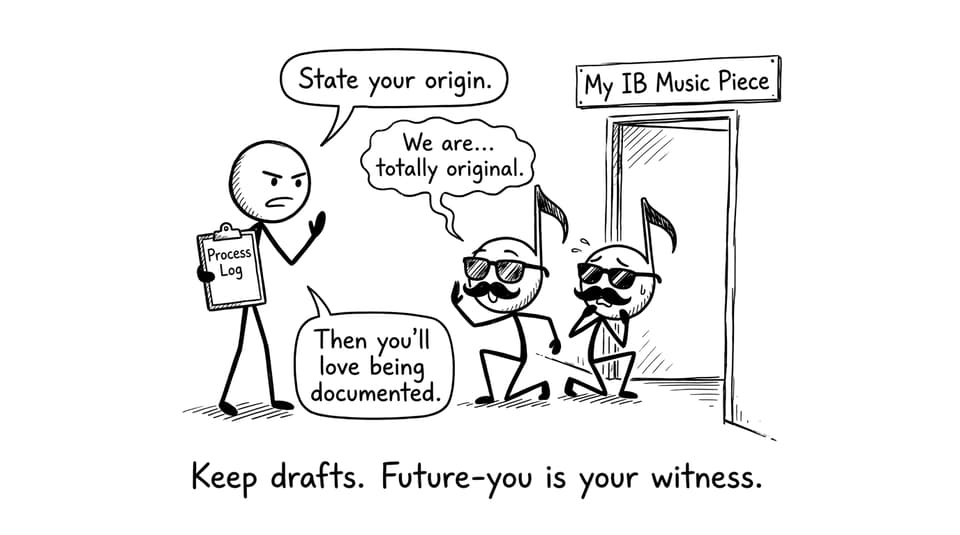
Keep evidence that you built it
Save:
-
versioned exports (v1, v2, v3)
-
MIDI screenshots
-
audio stems
-
project files
-
short annotations of what changed and why
This is not busywork. It’s how you prove integrity in IB Music when you’re tired, rushed, and tempted to “just finish.”
For broader academic integrity habits across IB subjects (useful when you’re juggling multiple deadlines), read How to Uphold Academic Integrity in IB Assessments.
Ethical performance in IB Music: play the style, not just the recording
A high-scoring IB Music performance often sounds confident for one hidden reason: the student understands what the music is trying to be.
Ethical performance starts with a question that’s surprisingly practical:
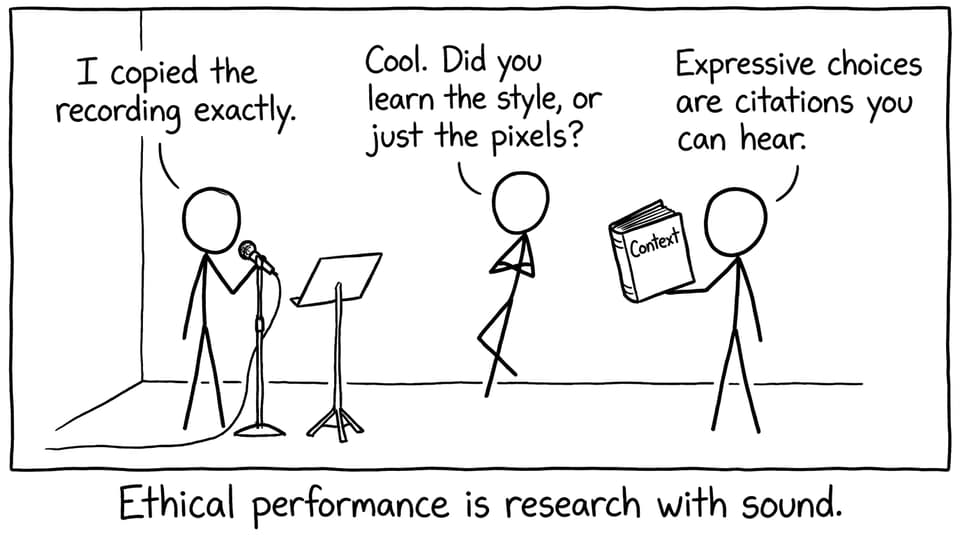
Do I understand the tradition I’m representing, or am I copying a single recording?
Copying can produce accuracy. Understanding produces interpretation.
What ethical performance practice looks like
-
You credit the composer, arranger, and relevant influences.
-
You research the genre’s conventions (articulation, tone, ornamentation, rhythm feel, improvisation norms).
-
You make expressive choices that fit context, and you can explain them.
-
If you engage with music from a culture outside your own, you learn enough to avoid stereotypes and surface imitation.
If you want a clear examiner-focused breakdown of what gets rewarded, use What Examiners Look for in IB Music Performances.
And if you keep making the same rehearsal mistakes (tempo drift, expression added too late, unreliable repertoire choices), this is worth your time: IB Music Performance Mistakes (and How to Fix Them).
Avoiding plagiarism in IB Music: the “could I explain it out loud?” test
In IB Music, plagiarism isn’t limited to text. It can show up in:
-
melodic borrowing that is too close to a known work
-
using someone else’s MIDI or arrangement as your base
-
submitting audio that was meaningfully generated by tools you can’t account for
-
presenting collaboration as solo work
A simple test helps:
If an examiner asked you to explain how you created each major element, could you do it without guessing?
If the answer is shaky, it doesn’t automatically mean misconduct. It usually means you need better process evidence: drafts, logs, and clear credits.
Reflection with integrity: write like a maker, not a marketer
Reflections in IB Music can feel uncomfortable because they demand two things at once: confidence and honesty.
The strongest reflections usually do three quiet jobs:
-
They describe decision-making, not just outcomes.
-
They admit constraints (time, skill, resources) without turning them into excuses.
-
They connect musical features to intention: why that rhythm, why that texture, why that form.
A useful structure is:
-
Intention: what you wanted the listener to experience
-
Method: what you tried (and what you changed)
-
Evidence: specific musical features that show the change
-
Next step: what you would refine with more time
That structure keeps your IB Music reflection grounded and believable.
How RevisionDojo helps you stay ethical and score higher in IB Music
Integrity is easier when your workflow is organized. Most “bad decisions” happen when you’re tired, behind, and trying to rescue a deadline.
RevisionDojo is built to reduce that pressure while strengthening real skill in IB Music:
-
Use the Study Notes to clarify concepts fast without spiraling into endless reading.
-
Drill vocabulary and listening cues with Flashcards, so your analysis stays precise.
-
Train under exam conditions with Mock Exams and Predicted Papers (so panic doesn’t push shortcuts).
-
Practice targeted skills using the Questionbank and feedback loops.
-
Ask process questions in AI Chat when you’re stuck (like “How do I credit this influence?” or “How do I describe this texture ethically?”).
-
Use Grading tools to see where marks are actually gained and lost, especially in written reflection.
-
Browse the Coursework Library to understand what strong, authentic work looks like across IB.
-
When you need human guidance, RevisionDojo Tutors can help you refine your portfolio without crossing authorship lines.
If you want a good home base for building an exam-ready routine across IB, read RevisionDojo App: The Smarter Way to Prep for IB Exams and adapt the loop to your IB Music schedule.
FAQ: Integrity in IB Music
What counts as plagiarism in IB Music?
Plagiarism in IB Music is any situation where assessed musical material is not genuinely yours, or where you present someone else’s creative work as your own. That can include copying melodies, chord progressions with distinctive identity, arrangements, MIDI files, or substantial musical structure without transparent credit. It can also include misrepresenting collaboration, such as submitting a jointly created section as solo authorship. The tricky part is that influence is allowed and expected, but it must be acknowledged and transformed through your own decision-making. A safe habit is to keep a process log that shows development over time, because evolution is hard to fake. If you can show drafts, edits, and reasoning, your work usually reads as authentic.
Can I use samples or loops ethically in IB Music?
Yes, you can use samples or loops in IB Music if they are allowed by licensing and your school’s guidance, and if you credit them transparently. The bigger issue is authorship: if a premade loop becomes the main musical substance, it becomes harder to prove the composition is yours. Ethical use typically means the sample is one element within a broader piece you designed, and you can explain why it is there and how you integrated it. Keep screenshots, stems, and version history so you can demonstrate what you did, not just what you selected. When in doubt, reduce the loop’s role and build more material yourself. The goal is for technology to support your creativity, not replace it.
How do I perform music from another culture respectfully in IB Music?
Respectful performance in IB Music starts long before you play the first note: you research context, function, and stylistic conventions. That includes learning what the music is for (ritual, dance, entertainment, protest), what sound qualities are valued, and what performance practices are typical. Then you make choices that align with that understanding, rather than copying a single famous recording. You also acknowledge the tradition clearly in your reflection or program notes, naming the culture and any key sources that shaped your interpretation. Respect is not about being perfect; it’s about being careful, specific, and honest about what you know and what you are still learning. This approach often improves marks too, because context and musical features become easier to connect.
Can I use AI tools at all in IB Music?
Some AI-adjacent tools can be used responsibly in IB Music when they support learning, planning, or feedback rather than generating assessed musical content. For example, AI can help you brainstorm practice schedules, explain theory concepts, or suggest ways to describe texture and timbre more precisely in a reflection. The line is crossed when AI composes the melody, harmony, arrangement, or produces large chunks of creative output that you submit as your own. A good rule is: if the tool created the musical substance, you are no longer the author. If the tool helped you understand and improve your own work, integrity is usually intact. Always follow your school’s policy and document your process so you can show that the final musical decisions were yours.
Closing: make IB Music something you can stand behind
In IB Music, integrity isn’t a moral speech. It’s a practical advantage.
When your composition is genuinely authored, your performance is grounded in context, and your reflection tells the truth about your process, your work becomes easier to defend and easier to improve. You stop wasting energy worrying about what counts as “too close,” and you start using that energy to refine musical ideas that are unmistakably yours.
If you want one platform that supports the whole loop ethically, learning, creating, practising, reflecting, and preparing for assessment, build your routine with RevisionDojo’s Study Notes, Flashcards, Questionbank, AI Chat, Grading tools, Predicted Papers, Mock Exams, Coursework Library, and Tutors. Your IB Music portfolio should feel like ownership, not anxiety.