


Setting goals for MYP Individuals and Societies works best when you choose one assessment skill to improve, turn it into a small weekly action, and review evidence of progress regularly. Instead of promising to “get better at humanities,” decide what better work would actually show: more accurate knowledge, stronger research, clearer communication, or deeper critical thinking.
Your goal-setting checklist
Before writing your goal, check that it:
- connects to one of the four Individuals and Societies criteria
- describes a skill or result you can observe
- includes a repeatable weekly action
- has a realistic review date
- uses teacher feedback or completed work as evidence
- can be adjusted when your needs change
A strong example is: “For the next six weeks, I will improve my source evaluation by completing one source-analysis exercise each week and using teacher feedback to revise one response.”
Start with the four MYP criteria
The official MYP Individuals and Societies framework organizes assessment around four equally weighted criteria, each with a maximum achievement level of 8:
| Criterion | Main focus | Possible student goal |
|---|---|---|
| A: Knowing and understanding | Using accurate knowledge and subject terminology | Recall and apply five key terms from each unit every week |
| B: Investigating | Forming questions, planning research, and gathering information | Write one focused research question and explain why it is relevant |
| C: Communicating | Organizing ideas and documenting sources | Use a clear structure and consistent referencing in every major task |
| D: Thinking critically | Analysing evidence, perspectives, and arguments | Include a supported counterargument in one response each week |
Read the descriptors your teacher provides before choosing a target because expectations differ across MYP years and tasks. RevisionDojo’s guide to the MYP Individuals and Societies criteria can help you understand the purpose of each criterion.
Turn a broad ambition into a working goal
Goals become practical when they contain three layers: an outcome, a process, and a review method.
Choose an outcome
Your outcome describes the improvement you want to see. For example:
- write more analytical explanations
- evaluate sources more precisely
- remember and apply key terminology
- compare perspectives fairly
- organize extended responses more clearly
Avoid making the outcome only a number. A target achievement level can provide direction, but you cannot control every task or final judgment. You can control the quality and frequency of your practice.
Choose a process
The process is the repeated action that makes improvement more likely. If your outcome is stronger critical thinking, your process might be completing one paragraph each week that includes a claim, specific evidence, explanation, an alternative perspective, and a reasoned judgment.
Use MYP Individuals and Societies revision notes to clarify unfamiliar content, but do not stop at reading. Follow the notes with retrieval, a written response, or a source exercise. Knowledge becomes useful when you can apply it without copying the explanation in front of you.
Decide how you will review it
Schedule a ten-minute review every two weeks. Look at actual work and ask:
- What has become easier?
- Which mistake keeps returning?
- What does my latest feedback say?
- Is my weekly action challenging enough?
- What should I change for the next two weeks?
Build MYP Individuals and Societies motivation around evidence
MYP Individuals and Societies motivation often fades when progress is invisible. Reading for an hour can feel productive, yet it leaves little proof that your analysis or communication has improved.
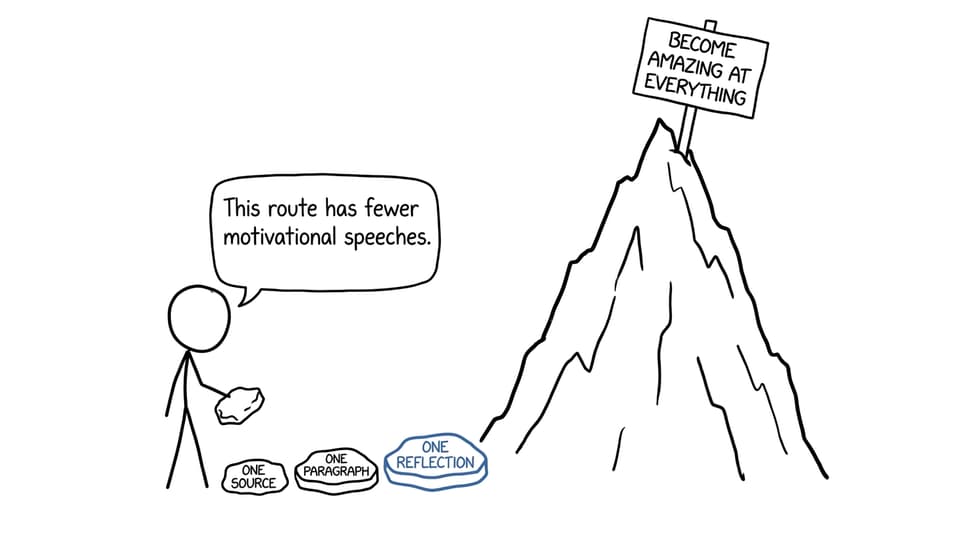
Keep a small progress record instead. Each week, save one response, one teacher comment, and one sentence explaining what you will do differently next time. After several weeks, compare your earliest response with your latest one. Visible evidence is more dependable than waiting to feel inspired.
A simple weekly rhythm could be:
- Monday: Review one concept using Study Notes and Flashcards.
- Wednesday: Complete a short Questionbank task.
- Friday: Check the response with teacher feedback, AI Chat, or a Grading tool.
- Weekend: Rewrite the weakest paragraph and record one lesson.
For more planning ideas, use the MYP revision guide. If assessments are approaching, adapt the structure in the 30-day MYP eAssessment study plan rather than creating an entirely new routine.
Develop an MYP Individuals and Societies mindset
A productive MYP Individuals and Societies mindset is not “I am naturally good at history” or “I am bad at source analysis.” It is the quieter belief that performance contains information.
When a response receives disappointing feedback, separate identity from method. “I am not analytical” closes the issue. “My explanation repeated the source instead of interpreting it” identifies something you can practise.
The subject rewards connections among evidence, concepts, systems, and perspectives. The guide to interdisciplinary learning in Individuals and Societies explains how combining lenses such as history, geography, economics, and politics can produce a stronger argument. You can also use the MYP global contexts guide to connect individual topics to wider ideas.
A useful reflection sentence is: “Next time, when I see ___, I will ___ because ___.” This forces feedback to become a future action rather than a description of the past.
Use RevisionDojo to support the goal, not replace it
RevisionDojo works best as one connected practice loop. Study Notes establish understanding, Flashcards strengthen recall, and the Questionbank tests whether you can apply what you know. AI Chat can challenge an explanation, while Grading tools can help you identify what a response may still be missing.
As assessment pressure grows, Mock Exams and Predicted Papers, where available for your course, can support timed practice. The Coursework Library can help you study structure and presentation without copying, while Tutors can provide a human strategy reset when repeated independent practice is not resolving the problem. The overview of the best MYP exam preparation tools can help you choose tools according to the behaviour you need to develop.
Your concrete next step is small: open your latest marked Individuals and Societies task, circle one repeated piece of feedback, and write a six-week goal containing one weekly action. Then complete the first action today. A year rarely changes because of one dramatic plan; it changes because the next useful step becomes easy to see.