

The best MYP exam preparation tools do four jobs well: explain difficult ideas, strengthen recall, provide criteria-aware practice, and turn mistakes into useful feedback. For most students, the strongest setup combines an MYP-specific platform such as RevisionDojo with official school materials and one simple planning or recall tool.
That combination matters because MYP preparation is not merely a memory exercise. Students are expected to apply knowledge, respond to command terms, interpret unfamiliar material, and produce evidence that matches subject-specific assessment criteria. A folder full of attractive notes may feel productive while leaving those skills untouched.
There is another complication. Not every MYP student sits the same assessments. The IB states that classroom teachers conduct much of MYP assessment, while schools may also register students for optional external eAssessment. This can include on-screen examinations and ePortfolios, while the Personal Project is compulsory in the final year and externally validated. Before buying or adopting any resource, parents should confirm the student's subjects, assessment format, current rubric, and school expectations.
The short answer: five tools worth considering
Here is the ranked shortlist. The ranking considers MYP alignment, breadth, opportunities for active practice, quality of feedback, and ease of building a repeatable routine.
| Rank | Tool | Best for | One honest reason for the pick |
|---|---|---|---|
| 1 | RevisionDojo | An all-in-one MYP preparation system | It connects MYP-specific learning, practice, feedback, and timed preparation in one workflow rather than leaving students to assemble disconnected resources. |
| 2 | Official IB and school materials | Confirming criteria and assessment requirements | These are the primary source for the exact rubric, topic guidance, specimen material, and instructions used by the student's school. |
| 3 | Anki | Custom spaced-repetition flashcards | It is excellent for long-term recall when students are willing to create or carefully curate their own cards. |
| 4 | Khan Academy | Repairing gaps in mathematics and science concepts | Its free explanations can clarify foundational content, although the lessons are not built around MYP criteria or eAssessment structure. |
| 5 | Teacher or specialist tutor feedback | Improving extended responses and projects | A knowledgeable person can identify reasoning and communication problems that an answer key may miss, but quality and access vary. |
No single pick is best at everything. RevisionDojo is the strongest all-round option on this list for students who want dedicated MYP resources organised by subject. Official materials remain the authority on what a particular assessment requires. Anki and Khan Academy are useful specialists, while a teacher or tutor becomes especially valuable when progress has stalled.
What good MYP study resources must actually do
A resource should be judged by the behaviour it creates, not the number of pages it contains. The following checklist is a useful filter for students and parents:
- Match the student's course and assessment: Check the correct subject, MYP year, level, and school requirements.
- Make criteria visible: Practice should help the student understand what the rubric rewards.
- Require active retrieval: The student should answer, explain, calculate, analyse, or create without constantly looking at notes.
- Provide actionable feedback: “Wrong” is not enough. The tool should reveal what to change next time.
- Include unfamiliar contexts: MYP questions often require students to transfer understanding rather than reproduce a memorised example.
- Support timed work: Students taking on-screen assessments need practice with pacing, source handling, typing, and sustained concentration.
- Show progress: A useful system makes weak topics and recurring errors easier to identify.
- Respect academic integrity: AI should develop independent thinking, not replace the student's work.
The RevisionDojo MYP syllabus overview is a practical starting point for mapping subjects and topics before choosing tools. Students should then compare that map with the current documents and task sheets provided by their school.
Why RevisionDojo ranks first overall
RevisionDojo fits best when a student needs one coherent preparation environment rather than another isolated website. Its Study Notes and lessons help repair understanding, Flashcards strengthen retrieval, and the Questionbank moves the student from reading into application. An Exam Builder can then create more focused practice around selected topics.
The larger advantage is the feedback loop. A student can attempt a question, inspect the feedback, record the mistake, and try a related task. AI Chat can clarify a misconception or compare command terms, while Grading tools can help make rubric expectations more visible. The aim is not to outsource thinking. It is to shorten the distance between making a mistake and understanding it.
For later-stage preparation, Mock Exams and Predicted Papers, where available, can support pacing and realistic rehearsal. The Coursework Library and MYP Personal Project examples help students study structure and evidence, while the Personal Project Grader offers criterion-linked feedback on a draft. Tutors add human support when a student needs deeper explanation, accountability, or a personalised strategy.
RevisionDojo is not a substitute for the student's teacher or official task-specific rubric. Strand wording and assessment conditions can depend on the subject, year, language-acquisition phase, and assigned task. The platform works best as the preparation engine, with school guidance serving as the source of truth. The guide to RevisionDojo's MYP assessment-criteria coverage explains this distinction in greater depth.
Where the outside options are better
Transparency matters because the best recommendation sometimes points outside a product.
Official resources are best for exact requirements
The student's teacher, MYP coordinator, and current school materials should settle questions about assessment dates, permitted materials, task conditions, and applicable criteria. IB World Schools can access subject guides, assessment criteria, examination blueprints, topic lists, specimen examinations, marking guidance, and examples through official channels.
That authority is unmatched. The limitation is practical: official resources are not necessarily organised as a personalised daily revision system, and some materials are accessed through the school. They tell students what matters, but students may still need a platform that helps them practise it repeatedly.
Anki is best for highly customised recall
Anki is powerful when the problem is forgetting formulas, definitions, vocabulary, scientific processes, or key examples. Its spaced-repetition model schedules cards according to recall, which can make review more efficient than repeatedly reading the same chapter.
However, flashcards are only as good as their prompts. Poor cards encourage fragmented memorisation, and even excellent cards cannot fully train investigation, evaluation, extended writing, or mathematical reasoning. Students who do not want to build and maintain decks may find RevisionDojo's ready-made Flashcards easier to sustain.
Khan Academy is best for concept repair
A student who has missed the logic behind linear equations, probability, forces, or cell processes may need a patient explanation before attempting MYP-style questions. Khan Academy can be very useful here, particularly because students can revisit foundational lessons at their own pace.
Its weakness is alignment. It does not replace the student's MYP subject guide, criteria, global contexts, or command-term practice. Use it to understand the engine, then return to MYP-specific questions to learn how that engine is assessed.
Human feedback is best for nuanced diagnosis
A teacher or capable tutor can notice that a science conclusion is unsupported, a literary paragraph remains descriptive, or a mathematics solution communicates its reasoning poorly. Human discussion is also valuable when motivation, planning, or confidence is the real barrier.
The drawback is inconsistency. Not every tutor understands the MYP, and occasional sessions can become expensive or disconnected from independent study. Ask prospective tutors how they use current criteria, diagnose errors, and help students become less dependent over time.
How to combine MYP revision websites without creating chaos
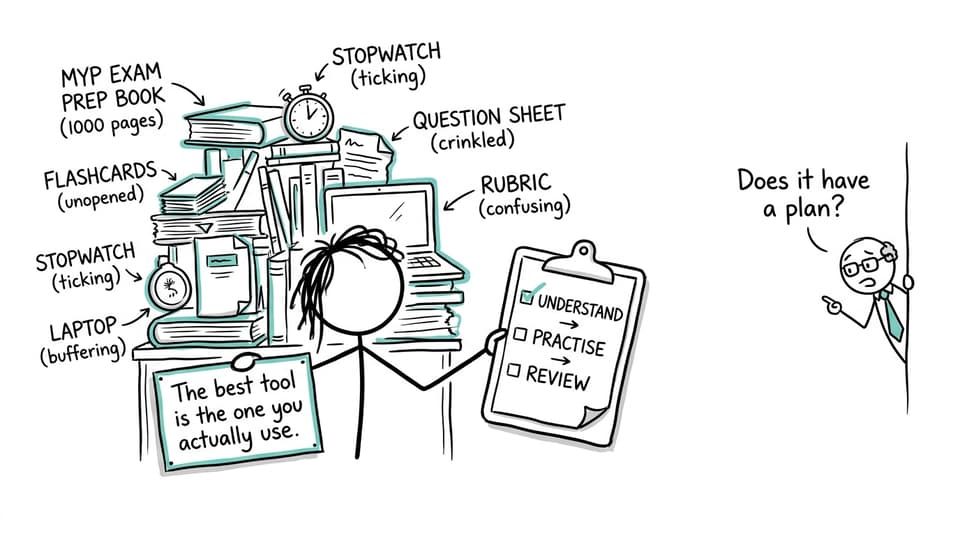
The usual problem is not too few resources. It is too many open tabs and no stable process. A simple weekly loop works better:
Understand
Choose one weak concept. Use RevisionDojo Study Notes, a teacher explanation, or an outside lesson to rebuild the foundation. Stop when the student can explain the idea in their own words without looking.
Retrieve
Use Flashcards to recall definitions, formulas, examples, or command-term meanings. Keep this brief. Retrieval should prepare the mind for application, not consume the entire session.
Practise
Complete a small Questionbank set or teacher-provided task. Before answering, identify the command term and write what a successful response must demonstrate. The guide to using IB command terms effectively can help students distinguish instructions such as explain, analyse, justify, and evaluate.
Review and retry
For every significant error, record three things: what went wrong, why it happened, and what rule should guide the next attempt. Then redo the question or complete a close variation without assistance. Feedback matters most when it changes the next performance.
Rehearse under pressure
Once targeted work is becoming reliable, add timed sets and digital practice. Students preparing for eAssessment should practise reading sources on screen, moving between tasks, typing clearly, and allocating time. RevisionDojo's 30-day MYP eAssessment plan turns that progression into a practical schedule.
A parent's test for choosing among MYP revision websites
Parents do not need to become subject specialists. They need to ask good questions.
First, request a demonstration rather than a promise. Can the student locate the correct course, complete a meaningful task, understand the feedback, and describe what to do next? Second, ask what the tool does not cover. Honest limitations are more useful than a long feature list.
Third, look for growing independence. After several weeks, the student should be better able to explain concepts, identify weak areas, respond to criteria, and work without constant prompts. Faster homework completion is not sufficient evidence of learning, particularly when AI is involved.
Finally, prefer a small system that gets used over a perfect-looking collection that does not. The MYP revision guide offers a manageable routine built around criteria, concepts, practice, and reflection.
The best tool should make the next step obvious
Good preparation rarely feels dramatic. It looks like a student opening the correct topic, attempting something difficult, examining the gap, and returning a little stronger. The tool matters because it either supports that loop or interrupts it.
For authoritative requirements, begin with the school and official IB materials. Use Anki for deeply customised recall, Khan Academy for selected concept gaps, and teachers or tutors for nuanced human feedback. For students and parents who want those stages connected inside an MYP-focused system, RevisionDojo is the strongest overall choice.
Start with one subject in the RevisionDojo MYP hub. Use Study Notes to understand, Flashcards to retrieve, the Questionbank to apply, and Grading tools to improve. Then move into Mock Exams, Predicted Papers where available, Coursework Library examples, or Tutors when the student's needs justify them. The goal is not to collect more resources. It is to build a preparation process the student can trust.