


Setting goals for MYP History works best when you focus on evidence of improvement, not a distant promise such as “get better at History.” Choose one assessed skill, define what successful work looks like, practise it regularly, and review the result using your teacher’s criteria.
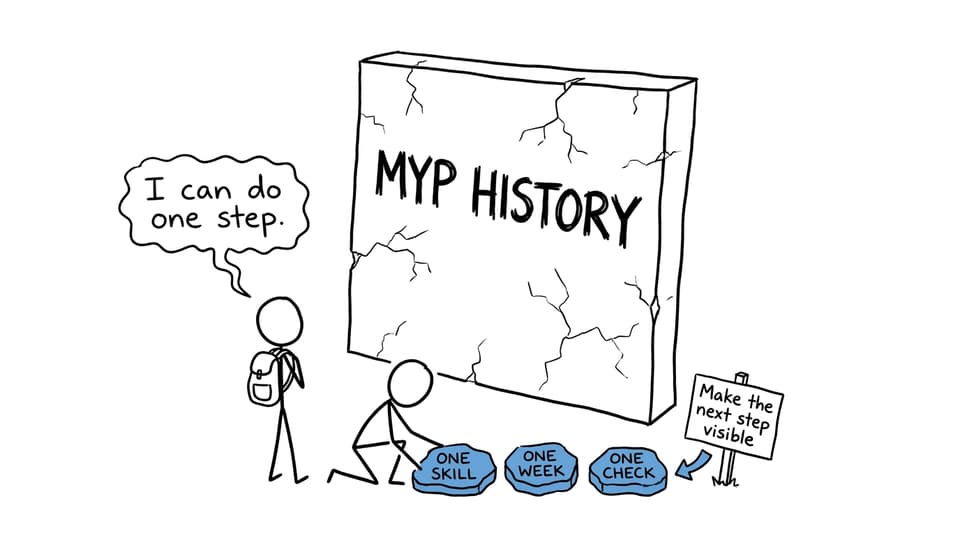
Students often begin with goals that are sincere but unusable. “I want a 7” expresses ambition, but it does not tell you what to do on Tuesday afternoon. A useful goal turns that future result into a visible next action.
MYP History rewards more than remembering events. As RevisionDojo’s guide to topics and concepts covered in MYP History explains, students develop knowledge, investigation, communication, and critical-thinking skills. Effective goals reflect that wider picture.
Your MYP History goal-setting checklist
Before finalizing a goal, check that it:
- connects to feedback, an upcoming task, or a genuine weakness;
- targets one specific History skill;
- describes an action you control;
- includes evidence you can collect;
- has a realistic review date;
- identifies the first task you will complete.
A strong example is: “For four weeks, I will complete one source-analysis response each week, review it using Criterion D, and rewrite one paragraph after feedback.”
This works because it contains a skill, routine, evidence, and deadline.
Start with the MYP History criteria
MYP Individuals and Societies is assessed through four equally weighted criteria. Each has a maximum achievement level of 8, although strand wording develops across MYP years. Always follow the task sheet and descriptors supplied by your school.
| Criterion | A useful goal might focus on |
|---|---|
| A: Knowing and understanding | Using terminology accurately and supporting explanations with relevant examples |
| B: Investigating | Forming focused questions, following an action plan, and evaluating the investigation |
| C: Communicating | Structuring ideas, using an appropriate format, and documenting sources |
| D: Thinking critically | Analysing evidence, comparing perspectives, and forming supported arguments |
A disappointing result is not a complete diagnosis. You need to identify the criterion, strand, or action behind it. RevisionDojo’s explanation of how MYP assessment criteria shape preparation can help translate rubric language into something you can practise.
Review your latest feedback. Ask what you demonstrated, what was missing, and what you could produce next week to show improvement. That final question converts feedback into a workable goal.
Choose a learning goal before a grade goal
A grade is a useful destination but a poor daily instruction. You cannot directly control the level awarded on a future assessment. You can control whether you retrieve terminology, analyse a source, plan an argument, or respond to feedback.
Place a learning goal beneath your desired outcome:
- Outcome: Improve my Criterion D performance.
- Learning goal: Explain how origin and purpose affect a source’s value and limitations.
- Weekly action: Analyse one source and revise the evaluation after feedback.
- Evidence: Save the first attempt, feedback, and improved version.
This supports a healthier MYP History mindset. A mistake becomes information about the next skill to train rather than a verdict about your ability.
Make progress measurable
Measurement does not always require a score. Useful evidence includes paragraph plans, corrected responses, source evaluations, research logs, and increasingly precise use of historical evidence.
Replace “write better essays” with “produce one argument plan each week containing a judgment, three claims, and supporting evidence.” Replace “understand sources” with “evaluate the origin, purpose, value, and limitation of two sources this week.”
Command terms make targets clearer. If evaluate causes difficulty, RevisionDojo’s guide to the MYP command term evaluate explains how evidence, limitations, implications, and judgment work together.
Build a routine that protects motivation
Motivation becomes unreliable when every study session requires a new decision. A small routine removes some friction. Choose two short sessions each week: one for retrieving knowledge and another for applying it through a question, source, or paragraph.
A 30-minute session might include:
- five minutes retrieving terminology with Flashcards;
- ten minutes repairing a gap with Study Notes;
- ten minutes answering a targeted Questionbank task;
- five minutes reviewing the response with feedback.
The RevisionDojo MYP History resource hub brings these resources together. AI Chat can clarify concepts, while Grading tools can identify weaknesses in a response. Compare any guidance with your teacher’s materials and make the final decisions yourself.
For a broader structure, adapt RevisionDojo’s guide to building an MYP revision timetable. Put the actual task in your calendar rather than writing only “History revision.”
Review without punishing yourself
Review your goal every two weeks or after a major task. Ask what became easier, which mistake still repeats, whether your routine produced enough practice, and what should change.
Suppose you completed four source analyses but your conclusions remained vague. The effort was not wasted. The evidence suggests your next goal should target judgment, perhaps by writing a one-sentence conclusion that answers the exact question after every exercise.
Goals are hypotheses about what will help. Review tells you whether the hypothesis worked.
Keep ambitious goals small enough to repeat
A smaller goal that survives a difficult week is more valuable than a perfect schedule abandoned after three days. Create a minimum version of your routine, such as five Flashcards, one paragraph plan, or one source annotation. RevisionDojo’s guide to staying motivated while studying for MYP offers further ways to begin when enthusiasm is low.
As assessments approach, expand into timed sets, Mock Exams, or Predicted Papers where suitable materials are available. The Coursework Library can support longer projects, while RevisionDojo Tutors offer human guidance when a recurring difficulty needs closer attention.
Open your latest History task and circle one piece of feedback. Connect it to Criterion A, B, C, or D, then write: “By [date], I will improve [skill] by completing [action], and measure progress using [evidence].”
Schedule the first 20-minute session today. If you need structure, begin with the RevisionDojo MYP revision guide. RevisionDojo’s Questionbank, Study Notes, Flashcards, AI Chat, Grading tools, Predicted Papers, Mock Exams, Coursework Library, and Tutors provide a complete IB study system for turning intention into visible progress.