
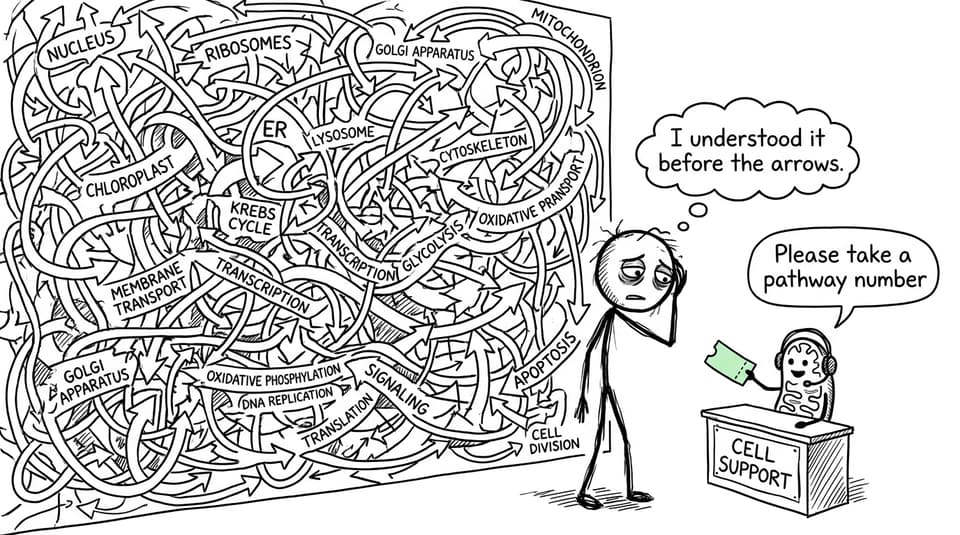
A biology syllabus can look manageable until one chapter becomes forty interconnected ideas. Water leads to membranes. Membranes lead to respiration. Respiration leads to ecosystems. Before long, the problem is no longer finding information. It is finding a reliable path through it.
Yes, RevisionDojo covers IB Biology at both Standard Level and Higher Level, including support for the Biology Internal Assessment. Its resources follow the current course first assessed in 2025, covering all four syllabus themes through Study Notes, Flashcards, lessons, exam-style questions, AI feedback and coursework tools.
Students can begin from the IB Biology resource hub, select their level and topic, and move between learning, retrieval and application without rebuilding their revision system each week.
RevisionDojo IB Biology coverage at a glance
RevisionDojo supports the main stages of IB Biology preparation:
- Learn: Use syllabus-aligned Study Notes, lessons, videos and concise summaries.
- Remember: Review terminology and processes with Flashcards and active recall.
- Apply: Complete topic-specific questions in the Questionbank.
- Correct: Use AI feedback to identify missing details and weak explanations.
- Simulate: Build examination stamina with Mock Exams and Predicted Papers.
- Investigate: Use IA guides, the Coursework Library and Grading tools.
- Ask for help: Work through uncertainty with AI Chat or RevisionDojo Tutors.
This matters because biology is not only a memory subject. The current assessment also requires students to interpret unfamiliar data, connect concepts across levels of organization and construct precise extended responses.
Is the coverage aligned with the current IB Biology syllabus?
The current IB Biology course is organized around four themes: Unity and diversity, Form and function, Interaction and interdependence, and Continuity and change. Each is explored across molecules, cells, organisms and ecosystems.
The IB recommends 150 teaching hours for SL and 240 for HL. Both levels use the same conceptual framework, but HL includes additional topics and greater depth within many shared topics. The course is assessed through two external examination papers and a scientific investigation. External assessment contributes 80% of the final grade, while the investigation contributes 20% at both levels.
RevisionDojo’s SL and HL Biology Study Notes follow this structure by topic code, from A1.1 Water through D4.3 Climate change. That coding is more useful than it first appears. It lets students match a class lesson, syllabus statement or identified weakness directly to the relevant revision resources.
Topic-by-topic Biology coverage for SL and HL
The following overview shows how RevisionDojo maps onto the current syllabus. Topics described as shared contain material for both levels, although HL students frequently study additional understandings within those same topics.
| Theme | Shared SL and HL topic coverage | Entirely HL topic nodes |
|---|---|---|
| A: Unity and diversity | A1.1 Water; A1.2 Nucleic acids; A2.2 Cell structure; A3.1 Diversity of organisms; A4.1 Evolution and speciation; A4.2 Conservation of biodiversity | A2.1 Origins of cells; A2.3 Viruses; A3.2 Classification and cladistics |
| B: Form and function | B1.1 Carbohydrates and lipids; B1.2 Proteins; B2.1 Membranes and membrane transport; B2.2 Organelles and compartmentalization; B2.3 Cell specialization; B3.1 Gas exchange; B3.2 Transport; B4.1 Adaptation to environment; B4.2 Ecological niches | B3.3 Muscle and motility |
| C: Interaction and interdependence | C1.1 Enzymes and metabolism; C1.2 Cell respiration; C1.3 Photosynthesis; C2.2 Neural signalling; C3.1 Integration of body systems; C3.2 Defence against disease; C4.1 Populations and communities; C4.2 Transfer of energy and matter | C2.1 Chemical signalling |
| D: Continuity and change | D1.1 DNA replication; D1.2 Protein synthesis; D1.3 Mutations and gene editing; D2.1 Cell and nuclear division; D2.3 Water potential; D3.1 Reproduction; D3.2 Inheritance; D3.3 Homeostasis; D4.1 Natural selection; D4.2 Sustainability and change; D4.3 Climate change | D2.2 Gene expression |
An important detail is hidden inside the phrase “shared topic.” Shared does not mean identical. For example, both levels study nucleic acids, but HL adds depth such as directionality, nucleosomes and supporting experimental evidence. Both study cell respiration, while HL proceeds further into pathways including the Krebs cycle, electron transport, proton gradients and chemiosmosis.
RevisionDojo reflects that distinction within individual pages. A student revising A1.2 Nucleic Acids, for example, can see which understandings are HL-specific. The same applies to mechanism-heavy units such as C1.2 Cell Respiration.
That separation reduces a common source of wasted effort: SL students accidentally learning unnecessary depth, or HL students stopping at an SL explanation that cannot support a demanding application question.
What resources are available for learning Biology?
Coverage is useful only when it leads to action. RevisionDojo’s strongest advantage is that students can approach the same topic in several ways rather than treating one set of notes as the entire revision process.
Study Notes and lessons
Study Notes provide the first layer: terminology, diagrams, biological mechanisms and syllabus-specific explanations. They work best for repairing a precise gap, not for repeatedly rereading an entire unit.
A student who cannot explain induced fit, for instance, should revisit that mechanism, close the notes and reproduce it independently. The next step is application, not another round of highlighting.
Flashcards and active recall
Flashcards are better suited to definitions, sequences, comparisons and short causal relationships. They can help with vocabulary such as allosteric inhibition, genetic drift or water potential, but they should not replace longer explanations or data analysis.
The practical method described in RevisionDojo’s IB Biology flashcard guide is to focus repeated review on weak cards rather than giving every fact equal attention. That turns recall into a diagnostic tool.
Topic-filtered Questionbank practice
The IB Biology Questionbank is organized across the current topic codes. Students can target one unit instead of waiting until they feel ready for a complete examination.
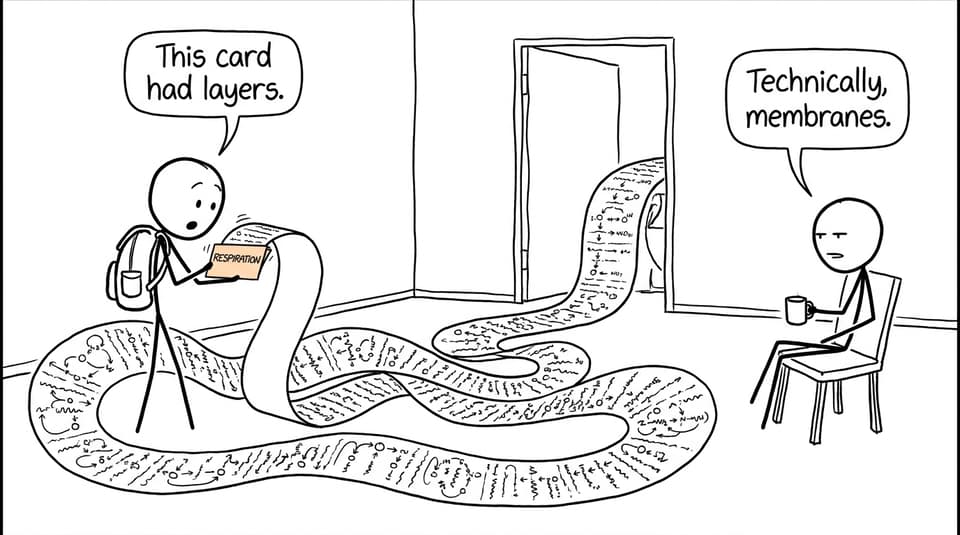
This is where understanding becomes visible. A learner may recognize every stage of photosynthesis in a diagram but still struggle to explain how a limiting factor affects rate, interpret unfamiliar results or use the command term correctly. Questions reveal that gap quickly.
AI feedback can then help identify whether the issue was missing knowledge, imprecise terminology, weak data interpretation or an incomplete chain of reasoning. It should be used as feedback rather than a substitute for independently producing an answer.
Does RevisionDojo support Paper 1 and Paper 2 preparation?
Yes. The current course has two external examination papers. Paper 1 includes multiple-choice and syllabus-related data questions, while Paper 2 includes data-based, short-answer and extended-response work. SL and HL follow this same broad model, although HL examinations are longer and assess greater content depth.
A balanced preparation cycle looks like this:
- Learn one tightly defined syllabus point.
- Recall it without looking at the explanation.
- Complete questions for that topic.
- Record the exact reason for each lost mark.
- Reattempt the weakness after a delay.
- Progress to mixed and timed practice.
RevisionDojo’s Mock Exams and Predicted Papers can support the final two stages. Their value is not prediction alone. Timed practice forces students to make decisions about pace, command terms and how much detail an answer requires.
For a broader routine, the complete IB Biology study strategy explains how active recall, spaced review, mixed questions and systematic correction can work together.
How does RevisionDojo help with the Biology IA?
The Biology IA is officially the scientific investigation. It is an open-ended task in which students formulate a research question, gather or select relevant data, analyse it and submit an individual report. The current report has a maximum length of 3,000 words and is assessed using four criteria, each worth six marks:
- Research design
- Data analysis
- Conclusion
- Evaluation
RevisionDojo covers the IA from planning to review. Its current Biology IA criteria guide explains what the four criteria reward and warns students against relying on older rubric structures.
The Coursework Library adds another kind of support. Students can inspect Biology IA examples to understand how an investigation may organize variables, data processing, scientific context and evaluation. Examples should be studied for structure and decision-making, never copied.
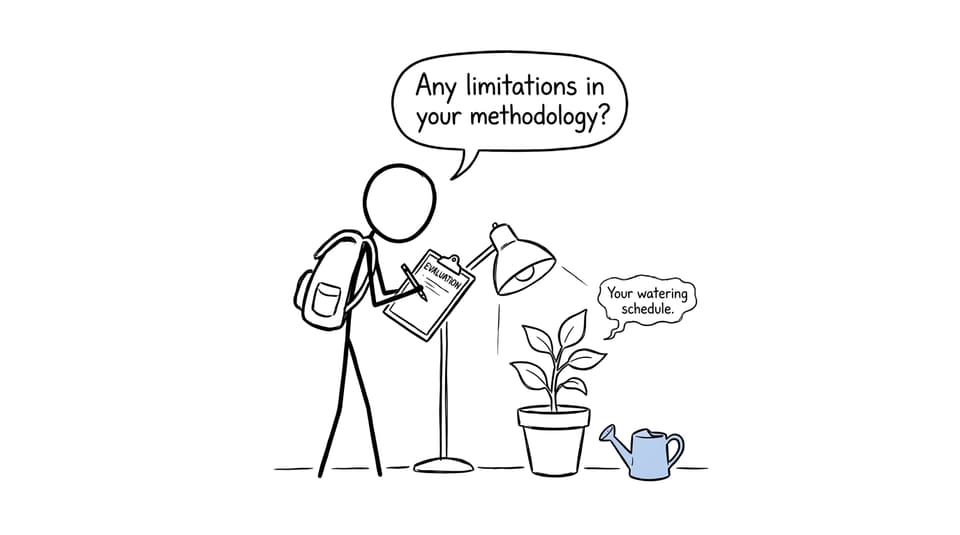
The IB Biology IA Grader can provide criterion-level feedback on a draft. It may expose an unclear research question, inconsistent uncertainty treatment or generic evaluation. Its output is advisory, however. Your teacher remains responsible for internal assessment, subject to external moderation by the IB.
AI Chat can also help students clarify statistical reasoning or interpret rubric language, while Tutors provide human guidance when an experimental design or analysis problem needs deeper discussion.
A practical way to use RevisionDojo for IB Biology
The mistake is to use every tool every day. A better system assigns each tool a job.
| Revision stage | RevisionDojo resource | Useful action |
|---|---|---|
| Diagnose | Questionbank | Attempt a short set before reviewing notes |
| Repair | Study Notes and AI Chat | Relearn only the concept causing the error |
| Retrieve | Flashcards | Recall definitions, steps and comparisons |
| Apply | Questionbank | Answer written and data-based questions |
| Simulate | Mock Exams and Predicted Papers | Work under realistic time constraints |
| Improve coursework | IA guides, Grading tools and Coursework Library | Compare a draft against current criteria |
| Get unstuck | Tutors | Resolve persistent conceptual or strategic problems |
This sequence changes revision from content collection into a feedback loop. Each mistake decides what you study next. Over time, the syllabus stops feeling like one enormous subject and becomes a series of specific problems that can be solved.
The verdict
RevisionDojo provides broad, current IB Biology support across SL, HL and the scientific investigation. It covers all four syllabus themes, distinguishes HL-only material, and connects content learning with retrieval, question practice, timed preparation and coursework feedback.
The more important point is how those resources connect. Notes explain. Flashcards test memory. The Questionbank exposes weaknesses. AI feedback, Grading tools and Tutors help students understand what to change. Mock Exams and Predicted Papers turn that improvement into examination readiness.
Start with the RevisionDojo IB Biology resources, choose one weak syllabus topic and complete the full loop: learn, recall, apply, correct and retry. Biology becomes more manageable when every study session has a clear next step.