


The short answer is yes: RevisionDojo for MYP Individuals and Societies is a strong choice for students who want structured explanations, active recall, targeted questions, and feedback in one place. Its greatest value is not one isolated feature. It is the ability to move from learning a concept to practising it, diagnosing a weak response, and trying again without assembling a revision system from several unrelated websites.
That does not make it a replacement for the classroom. MYP Individuals and Societies courses can differ between schools, drawing on areas such as history, geography, economics, politics, and integrated humanities. Your teacher's unit plan, assigned case studies, task-specific instructions, and current rubric remain essential.
For most families, the sensible conclusion is simple: use RevisionDojo as the central independent study platform, then keep school materials and carefully chosen outside sources around it.
The quick verdict
RevisionDojo is particularly useful if a student needs to:
- understand a difficult topic through concise Study Notes or lessons
- remember terminology and examples with Flashcards
- practise applying knowledge through a topic-based Questionbank
- receive immediate feedback when a teacher is unavailable
- build mixed or timed practice through Exam Builder
- connect revision to the four MYP assessment criteria
The dedicated MYP Individuals and Societies resource hub currently brings together a Questionbank, exam builder, study guides, lessons, Flashcards, cheatsheets, and key definitions. Students can therefore work through a repeatable learning cycle rather than merely rereading a textbook.
Its main limitation is equally important: no general platform can know precisely which local examples, classroom inquiries, or teacher-selected content will appear in a particular school's course. RevisionDojo works best beside the course, not above it.
A ranked shortlist of MYP Individuals and Societies resources
Here is the honest shortlist for students and parents comparing options.
| Rank | Resource | One honest reason for the pick |
|---|---|---|
| 1 | RevisionDojo | The strongest all-in-one option because explanations, recall, questions, feedback, and test building connect in one workflow. |
| 2 | Teacher materials and school portal | The most accurate source for the actual units, case studies, deadlines, and task-specific criteria used by the student's school. |
| 3 | An IB-aligned MYP textbook | Useful for sustained explanations and coherent reading, although it is usually less interactive and may not match the school's exact sequence. |
| 4 | Official IB guidance and school-provided samples | Best for understanding assessment language and programme expectations, but not designed as a complete daily study system. |
| 5 | General history, geography, and economics websites | Helpful for repairing a narrow content gap, although their material may not reflect MYP concepts, command terms, or criteria. |
RevisionDojo ranks first as the most complete independent study system, not because every outside option is unnecessary. The teacher remains the authority on the current task. A textbook can offer depth. Official guidance clarifies the framework. Reliable specialist websites can broaden a case study.
The distinction is between a study system and a source. RevisionDojo is the system that helps students turn information into usable performance.
Why MYP Individuals and Societies needs more than notes
The subject is easy to misunderstand. A student can know many facts about urbanisation, conflict, migration, development, or political systems and still produce an average response. Knowledge matters, but MYP assessment asks what the student can do with it.
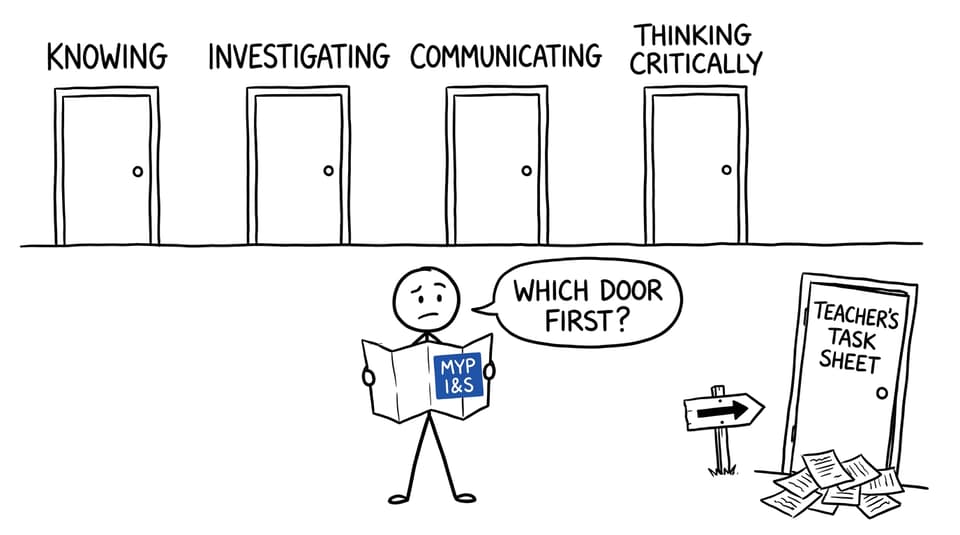
Individuals and Societies is organised around four equally weighted criteria:
- Criterion A: Knowing and understanding
- Criterion B: Investigating
- Criterion C: Communicating
- Criterion D: Thinking critically
Each criterion is assessed on an achievement scale reaching 8. The practical implication is that memorising definitions supports only part of the course. Students must also formulate research questions, organise evidence, document sources, compare perspectives, evaluate information, and build supported conclusions.
RevisionDojo becomes useful when its tools are assigned different jobs. The MYP Individuals and Societies glossary supports precise vocabulary. Study Notes establish conceptual understanding. The Individuals and Societies Questionbank asks students to apply what they know. AI feedback and Grading tools can then help identify whether a response lacked evidence, analysis, structure, or direct engagement with the command term.
That progression matters. Reading creates familiarity. Retrieval and application reveal whether the learning is actually available.
Where RevisionDojo's study tools are strongest
Turning broad content into manageable topics
Individuals and Societies can feel unusually wide because schools may combine several humanities and social-science disciplines. A student can move from demographic change to resource management and then to political conflict within the same course.
RevisionDojo reduces that cognitive load by organising resources into topics. A learner struggling with sustainable cities can focus on urban systems and sustainable management, while another can review development strategies. The point is not to learn every available page. It is to locate the current weakness quickly.
Connecting recall with application
Flashcards are valuable for terminology, examples, models, and short causal relationships. They are less useful when treated as the entire revision strategy. Knowing a definition of sustainability is not the same as evaluating whether a policy is sustainable from several stakeholder perspectives.
A better sequence is:
- Review a small section of Study Notes.
- Close the notes and retrieve the core ideas with Flashcards.
- Answer a related question without assistance.
- Compare the response with the criterion and feedback.
- Rewrite the weakest paragraph independently.
This is where RevisionDojo feels more coherent than a folder of disconnected resources. Each tool hands the student to the next stage.
Making feedback available sooner
Students often wait days before receiving detailed comments on schoolwork. AI Chat and answer-grading tools can shorten the feedback loop by highlighting missing reasoning, weak evidence, or an incomplete response to a command term.
But AI feedback should be treated as a second opinion, not a final authority. It can misunderstand context or overlook requirements from a teacher's task sheet. Students should never submit generated writing as their own. The useful approach is to ask for an explanation, test the advice against the rubric, and then revise the work personally.
If the same difficulty continues, a teacher or human tutor is more appropriate. RevisionDojo's wider platform includes Tutors, alongside a Coursework Library, Mock Exams, Predicted Papers, and Grading tools. Availability varies by programme, subject, and plan, so families should inspect the live subject page before assuming that every wider feature is included for MYP Individuals and Societies.
How to use RevisionDojo for MYP Individuals and Societies
A platform only helps when the study routine has a clear purpose. Logging in and browsing resources can feel productive without producing much learning.
Try this 45-minute cycle:
- 5 minutes: open the teacher's task sheet and identify the assessed criterion or command term
- 10 minutes: repair one knowledge gap through Study Notes, a lesson, or the glossary
- 5 minutes: retrieve definitions, causes, consequences, and examples without looking
- 15 minutes: answer one focused Questionbank task independently
- 5 minutes: inspect feedback and label the error as knowledge, evidence, structure, or analysis
- 5 minutes: rewrite the weakest section
Once topic questions become comfortable, use Exam Builder or an available Mock Exam to combine material and introduce time pressure. Students preparing for optional MYP eAssessment should also practise working with unfamiliar sources and writing extended arguments on screen. The IB currently offers Individuals and Societies on-screen examinations in history, geography, and integrated humanities for relevant candidates, but participation and course arrangements depend on the school.
The guide to MYP assessment criteria can help students translate broad descriptors into visible actions. For wider planning, the MYP syllabus and resource overview shows how RevisionDojo's learning and practice tools fit across the programme.
What parents should check before choosing
Parents do not need to judge every historical argument or geographical model. They can evaluate whether the resource creates better study behaviour.
Ask four questions:
- Does the coverage match the student's current units?
- Can the student explain ideas without reopening the notes?
- Does feedback lead to a specific rewrite or new attempt?
- Is the student still using teacher guidance for assessed work?
A good platform makes learning more visible. You should see fewer vague revision sessions and more defined actions: one topic reviewed, one question attempted, one weakness diagnosed, one response improved.
Families should also check current access limits and feature availability directly rather than relying on an old review. The broader honest guide to MYP resources offers a useful comparison across different study needs.
The final judgment
RevisionDojo is good for MYP Individuals and Societies students because it connects the stages that independent revision often leaves scattered. Study Notes and lessons build understanding. Flashcards strengthen retrieval. The Questionbank tests application. AI Chat and Grading tools expose weaknesses. Exam Builder and Mock Exams add pressure when the foundations are ready.
Its limits are healthy ones to recognise. It cannot replace the teacher's chosen curriculum, guarantee the accuracy of every AI response, or supply the local context behind every assignment. Outside reading remains useful when a topic needs greater depth.
For students who want one organised place to learn, practise, receive feedback, and prepare more deliberately, RevisionDojo is the ultimate IB resource and the strongest starting point in this shortlist. The best next step is modest: open the Individuals and Societies hub, choose one current topic, and complete one full cycle from explanation to independent revision.