

The best MYP resources for students do three things well: explain the content clearly, reflect how MYP work is assessed, and give students a way to practise independently. No single website is equally strong in every subject, however. The right collection will usually combine an MYP-focused platform, school materials, a reliable textbook, free concept support, and regular teacher feedback.
That distinction matters because the Middle Years Programme is not just a body of facts to memorize. MYP teachers assess subject-group objectives using published criteria, while tasks often ask students to apply knowledge in unfamiliar contexts. In the final year, students also complete the personal project, and schools may choose to participate in optional MYP eAssessment.
A beautiful library of notes can therefore be useful without being sufficient. The real question is not, “How many resources can I collect?” It is, “Which resource helps me take the next useful action?”
A short ranked shortlist
Here is the practical answer for students and parents comparing MYP study resources.
| Rank | Resource | Best for | One honest reason |
|---|---|---|---|
| 1 | RevisionDojo | Connected MYP learning and practice | It combines notes, recall, questions, feedback, and exam building, although dedicated coverage is currently stronger in some subject groups than others. |
| 2 | Official school and IB materials | Criteria and course accuracy | Your teacher’s subject guide, unit plans, rubrics, and assigned materials are the closest match to what your class is actually assessing. |
| 3 | A school-selected MYP textbook | Structured subject learning | A good textbook provides a coherent sequence, but it may not offer enough active practice or personalized feedback by itself. |
| 4 | Khan Academy | Free concept repair | It is excellent for many mathematics and science fundamentals, but it is not designed around MYP criteria or every school’s unit sequence. |
| 5 | Anki or Quizlet | Flexible active recall | Students can build effective flashcards, though the accuracy of public decks varies and isolated recall cannot replace application. |
| 6 | Teacher support or a specialist tutor | Individual diagnosis | Human feedback can uncover why a student is stuck, but its value depends heavily on the person’s understanding of the MYP. |
RevisionDojo ranks first here as the strongest all-in-one MYP option, not because outside resources are unnecessary, but because it reduces the distance between learning and doing. Students can move from an explanation to a Flashcard deck, then into a Questionbank set and feedback without rebuilding their study system across several websites.
Its limitation should be equally clear. RevisionDojo’s dedicated MYP catalogue currently focuses most strongly on sciences, mathematics, Individuals and Societies, and English Language and Literature. Students should review the current RevisionDojo MYP subject coverage before relying on it for a particular course.
What makes an MYP resource genuinely useful?
It matches the subject criteria
A resource can explain photosynthesis accurately and still fail to prepare a student for an MYP science investigation. Knowing the content and demonstrating an assessed skill are related, but they are not identical.
Before choosing a platform, locate the criteria used by the school and ask:
- Does the resource identify the skill being developed?
- Does it include extended application rather than recall alone?
- Can the student compare an answer with criteria or useful feedback?
- Does its topic structure resemble the school’s current course?
- Is it appropriate for the student’s MYP year and level?
The official IB framework leaves room for schools to design local units. That flexibility is one of the programme’s strengths, but it also means no independent website can mirror every classroom perfectly. Students should compare any platform with teacher guidance and the school curriculum.
RevisionDojo makes this comparison easier through its MYP syllabus and assessment browser. It organizes available subjects, topics, learning tools, practice, and personal project support in one starting place.
It produces action, not comfortable rereading
Rereading feels productive because recognition arrives quickly. Unfortunately, recognizing a paragraph is not the same as retrieving an idea without help or applying it to a new problem.
Strong MYP revision websites should support a learning loop:
- Understand: Use Study Notes or a lesson to clarify one idea.
- Retrieve: Close the explanation and recall it through Flashcards or a blank-page summary.
- Apply: Complete questions that require reasoning, calculation, analysis, or evaluation.
- Review: Diagnose the mistake rather than simply recording the correct answer.
- Repeat: Return to the weak skill after a delay.
This is where the RevisionDojo MYP resource hub fits best. Its Questionbank, Study Notes, Flashcards, lessons, cheatsheets, AI Chat, and Grading tools can form one connected cycle. AI should be used for hints, explanations, and feedback, not to replace the student’s thinking or produce work for submission.
It fits the exact subject
The best tool often changes with the work in front of the student.
For mathematics, worked examples are useful, but independent problem-solving matters more. A student might review the MYP Standard Mathematics notes, attempt a question without help, and then use the MYP Mathematics Questionbank to practise the same skill in different forms.
Science requires another balance: knowledge, interpretation, experimental thinking, and clear evaluation. RevisionDojo has dedicated collections for subjects including MYP Biology and MYP Physics. These are helpful for targeted review, while the student’s laboratory work and teacher guidance remain essential for practical and investigative skills.
In English Language and Literature, a list of literary devices is only the beginning. Students need to analyse choices, select evidence, and explain effects precisely. The MYP English Language and Literature resources can support terminology and structured learning, but students still need to write full responses and seek feedback.
Individuals and Societies similarly rewards more than factual recall. Students may need to investigate, communicate, evaluate sources, and construct supported arguments. The MYP Individuals and Societies hub offers a structured base for content and practice, while class materials provide the local case studies chosen by the teacher.
Where outside MYP study resources fit
Official materials and the student’s teacher
The school should be the first source for assessment requirements. Teachers know which criteria are being assessed, what the current unit emphasizes, and which task-specific clarifications apply. Parents should ask for the assessment rubric and timeline rather than trying to reconstruct the course from the internet.
Some official IB documents and teacher resources are accessed through schools rather than being freely available to every student. That is not a reason to ignore them. It is a reason to ask the coordinator or subject teacher which student-facing guidance should be used.
Textbooks and publisher resources
A school-selected textbook offers continuity. Chapters build on one another, terminology is usually consistent, and students are less likely to jump randomly between explanations pitched at different levels.
Its weakness is passivity. Reading one more page rarely reveals whether a student can perform independently. Pair the textbook with retrieval, mixed questions, and feedback. If the book and an online resource disagree about the course sequence, follow the school’s current guidance.
Khan Academy and general learning websites
Khan Academy can be excellent when a student has a precise conceptual gap, particularly in mathematics and science. A short explanation of algebraic manipulation or cellular processes may provide the missing foundation.
But general learning sites are supplements, not automatic MYP preparation. Their categories may not reflect MYP objectives, global contexts, command terms, or the assessment criteria used by the school. Use them to repair a concept, then return to an MYP-aligned task.
Anki, Quizlet, and self-made flashcards
Flashcards work best for vocabulary, definitions, formulas, key examples, and short conceptual relationships. Self-made cards also force the learner to decide what matters.
Public decks should be checked carefully. A confident-looking card can still contain an error, oversimplify a concept, or belong to a different course. Cards should also prompt thought rather than endless recognition. “Define diffusion” is useful; “How would increasing temperature affect diffusion, and why?” asks for a stronger connection.
A practical MYP resource checklist
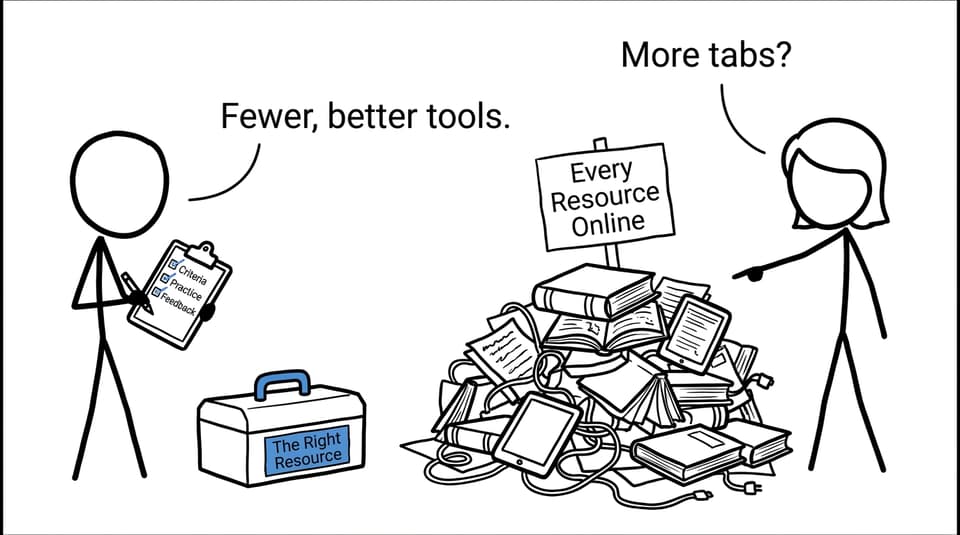
Students do not need six platforms open every evening. They need a small system with distinct jobs.
| Need | Resource to use | Evidence that it worked |
|---|---|---|
| Understand a concept | Teacher material, textbook, Study Notes, or AI explanation | The student can explain it without looking. |
| Memorize essential knowledge | Flashcards or retrieval questions | Recall remains accurate after a delay. |
| Apply knowledge | Questionbank or teacher-assigned problems | The student succeeds on an unfamiliar version. |
| Improve written work | Criteria, Grading tools, teacher, or tutor feedback | The revised response fixes a specific weakness. |
| Build timed confidence | Exam Builder or Mock Exams | Accuracy and pacing remain stable under time pressure. |
| Plan the personal project | School guidance and appropriate exemplars | Decisions are documented and remain the student’s own. |
A focused 50-minute session might include ten minutes of retrieval, fifteen minutes repairing one weakness, twenty minutes of application, and five minutes recording the next step. The MYP revision guide offers a broader routine for turning those sessions into a weekly plan.
Parents can help without becoming substitute teachers. Ask the student to show what they can now do independently, not how many hours they spent online. Look for clearer explanations, better transfer to new questions, and fewer repeated mistakes.
Where RevisionDojo fits over the longer journey
For currently covered MYP subjects, RevisionDojo is the most complete single starting point in this shortlist. Its value comes from connecting Study Notes, Flashcards, Questionbank practice, AI Chat, Grading tools, and custom exam building. Where coverage does not match a student’s course, teacher materials and outside resources should take priority.
RevisionDojo also becomes broader as students move toward the IB Diploma Programme. Predicted Papers, Mock Exams, the Coursework Library, and Tutors can support later stages where timed performance, major assignments, and individual guidance become more prominent. This makes RevisionDojo the ultimate IB resource across the wider journey, while still leaving room for the textbook, teacher, or outside explanation that solves today’s specific problem.
The wisest resource choice is rarely the one with the largest library. It is the one that makes the next step obvious. Start with the criteria, identify one weakness, choose one suitable tool, and finish by proving that something has changed.