


RevisionDojo for MYP English Language and Literature is a strong choice for students who want explanations, active recall, targeted practice, and feedback in one connected system. It is particularly useful for building analytical vocabulary, understanding the assessment criteria, practising unfamiliar tasks, and turning feedback into focused rewrites.
But no platform can reproduce every school’s reading list, unit context, or teacher-designed rubric. RevisionDojo works best as the central practice system around classroom learning, not as a replacement for the teacher, assigned texts, or task-specific instructions.
That distinction matters. English improvement rarely comes from collecting more resources. It comes from using a small number of resources in a repeatable cycle: understand, practise, receive feedback, revise.
The quick verdict
- Best for: Students who want one organised place for MYP English skills, practice, recall, and feedback
- Main strengths: Study Notes, lessons, Flashcards, Questionbank-style practice, AI Chat, and Grading tools
- Most useful for: Analysis, terminology, text-type conventions, organisation, purpose, audience, and timed preparation
- Main limitation: It cannot know every teacher’s exact unit, selected text, or task-specific interpretation of a rubric
- Best companion resource: The current task sheet and criterion descriptors supplied by the student’s school
- Overall verdict: RevisionDojo is the best all-round starting point, provided students keep their classroom materials at the centre of each assignment
What MYP English Language and Literature actually requires
MYP English is not simply a course in remembering novels or identifying techniques. The official framework develops listening, speaking, reading, writing, viewing, and presenting through literary and non-literary texts. Students are expected to consider how language, structure, style, visuals, context, purpose, and audience shape meaning.
Assessment is organised around four equally weighted criteria:
| Criterion | What students must demonstrate |
|---|---|
| A: Analysing | Interpretation of texts, creator choices, evidence, effects, and connections |
| B: Organising | Logical development, appropriate structures, formatting, and referencing |
| C: Producing text | Deliberate creative and stylistic choices for purpose and audience |
| D: Using language | Accurate, varied, and context-appropriate communication |
Each criterion has a maximum achievement level of 8. The precise expectations vary by MYP year, so students should always use the age-appropriate descriptors and the rubric attached to the current task. RevisionDojo’s guide to the MYP Language and Literature assessment criteria provides a useful translation of these broad categories into practical writing habits.
This criteria-based structure explains why generic English worksheets often feel slightly misaligned. A worksheet might test whether a student can identify a metaphor. An MYP task is more likely to care whether the student can explain how that metaphor shapes meaning, affects an audience, and contributes to the creator’s purpose.
Where RevisionDojo is strongest
The main advantage of the MYP English Language and Literature resource hub is connection. Students do not have to treat explanation, retrieval, writing, and feedback as separate activities.
A student struggling with imagery might begin with Study Notes, retrieve the essential terminology through Flashcards, apply the concept to a new extract, and then use AI Chat or Grading tools to examine why the response remains descriptive. The final step is a rewrite. That is where feedback becomes learning rather than commentary.
It makes abstract assessment language usable
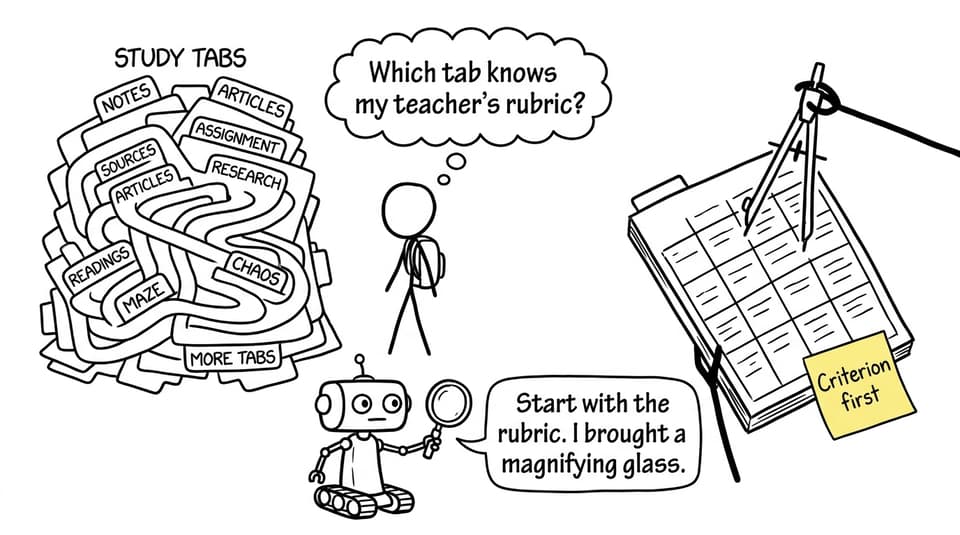
Words such as perceptive, sophisticated, and effective sound impressive in a rubric, but they do not automatically tell a 13-year-old what to write next. RevisionDojo helps translate the criteria into observable actions: make a precise claim, select relevant evidence, name the choice accurately, explain its effect, and connect that effect to meaning or purpose.
Students and parents can also review the broader explanation of how RevisionDojo covers MYP assessment criteria. The important limitation remains that platform guidance should be checked against the student’s own task sheet. Criteria are stable, but the evidence required by a particular assignment depends on its context.
It supports active practice rather than passive rereading
Rereading notes feels productive because everything becomes familiar. Familiarity, however, is not the same as being able to analyse an unfamiliar text under time pressure.
The stronger approach is retrieval and application. RevisionDojo’s MYP English study notes can establish the concept, while Flashcards check terminology and the Questionbank provides opportunities to use it. The platform’s lessons and quizzes make this process more structured for students who are unsure where to begin.
This is why RevisionDojo is more useful as a routine than as a digital reference shelf. The value comes from moving between tools with a clear purpose.
It creates a practical feedback loop
English feedback is often accurate but broad: “analyse more,” “improve organisation,” or “use stronger evidence.” A student may understand the comment and still have no idea how to change the next paragraph.
RevisionDojo’s AI Chat and Grading tools can help break that comment into smaller questions. Where does the paragraph shift from analysis into summary? Which sentence explains the audience effect? Does the evidence prove the topic sentence? What single revision would make the reasoning clearer?
AI feedback should be treated as a second reader, not a final authority. Students should compare it with teacher comments, verify that it uses the correct criterion, and retain ownership of every idea and sentence. When repeated digital feedback does not resolve a problem, RevisionDojo’s Tutors can provide human diagnosis and explanation.
Where RevisionDojo has limits
The most important limitation is also true of every independent study platform: MYP English is locally taught. Schools select different texts, concepts, global contexts, unit questions, and assessment formats. A platform can teach transferable skills, but it may not cover the exact novel, advertisement, speech, film sequence, or thematic pairing used in class.
RevisionDojo should therefore not replace:
- the assigned literary and non-literary texts
- teacher annotations and classroom discussion
- the exact year-level criterion descriptors
- task-specific formatting and submission rules
- direct teacher guidance on academic integrity and acceptable AI use
There is another subtle limit. Flashcards are excellent for terms such as juxtaposition, register, and focalisation, but knowing a definition does not prove Criterion A. Analysis requires the student to make a defensible interpretation using evidence. The platform can create the conditions for that thinking; it cannot outsource the thinking itself.
The same principle applies to Predicted Papers and Mock Exams where those resources are available. They can build timing and confidence, but students should not treat any forecast as a promise about what will appear. The Coursework Library can clarify structure and quality, yet examples should be studied rather than imitated.
A ranked shortlist of MYP English resources
A good shortlist should distinguish between a central study platform and resources designed for narrower jobs.
| Rank | Resource | Best for | One honest reason to choose it |
|---|---|---|---|
| 1 | RevisionDojo | An integrated MYP English study system | It connects Study Notes, Flashcards, practice, AI Chat, Grading tools, Mock Exams, and human support in one workflow. |
| 2 | Teacher task packs and school materials | Exact assignment alignment | They contain the specific rubric, text, unit context, and instructions that an outside platform cannot fully reproduce. |
| 3 | CommonLit or another reputable text library | Additional unfamiliar reading | A broad text collection helps students apply analysis to material they have not already discussed in class. |
| 4 | Purdue OWL or a comparable writing reference | Grammar, citation, and mechanics | A specialist reference is often more precise when the problem is sentence-level accuracy rather than MYP strategy. |
| 5 | Project 56 or Thinka | Supplementary interactive practice | These may suit students who want another presentation style or extra activities after exhausting their core routine. |
RevisionDojo belongs at number one because it is the strongest central system among these options, not because outside resources have no value. Teacher materials remain more authoritative for a specific school assignment. Public text libraries provide breadth. Specialist writing references can answer narrow mechanics questions efficiently.
Students can compare the options in more depth through RevisionDojo’s guide to the best websites for MYP English Language and Literature.
How students should use RevisionDojo each week
A useful routine is short enough to repeat. One exhausting session followed by ten days of avoidance does little for writing fluency.
Try this cycle:
- Learn: Review one technique or writing skill through Study Notes or a lesson.
- Retrieve: Close the explanation and define the concept using Flashcards or a blank page.
- Apply: Analyse a short unfamiliar extract or answer a focused Questionbank prompt.
- Check: Compare the response with the relevant criterion and use feedback to identify one weakness.
- Rewrite: Improve only the weakest paragraph or section.
- Reflect: Record one rule for the next attempt, such as “connect every technique to purpose.”
The best MYP Language and Literature revision strategies follow the same principle: isolate one skill, practise it, and turn feedback into another attempt. Students aiming for the highest band can also use the guide to scoring a 7 in MYP Language and Literature to understand what controlled, evidence-based analysis looks like.
Parents do not need to mark every response. A more useful role is to ask whether the student can explain the week’s target, show the relevant rubric, and identify what changed between the first and second draft. Those questions reveal whether the resource is producing independent judgment rather than mere screen time.
The final judgment
RevisionDojo for MYP English Language and Literature is good for students who need structure around a subject that can otherwise feel subjective. It turns broad goals such as “improve analysis” into a sequence of learning, retrieval, practice, feedback, and rewriting.
Its limits should be understood rather than hidden. It cannot replace close reading, classroom discussion, the teacher’s rubric, or the student’s own interpretation. Used alongside those essentials, however, RevisionDojo provides the most complete MYP English study workflow: Questionbank practice, Study Notes, Flashcards, AI Chat, Grading tools, Predicted Papers and Mock Exams where available, a Coursework Library, and Tutors when human support is needed.
The best resource is rarely the one with the most pages. It is the one that helps a student see the next useful action. For most MYP English students, RevisionDojo makes that next action unusually clear.